

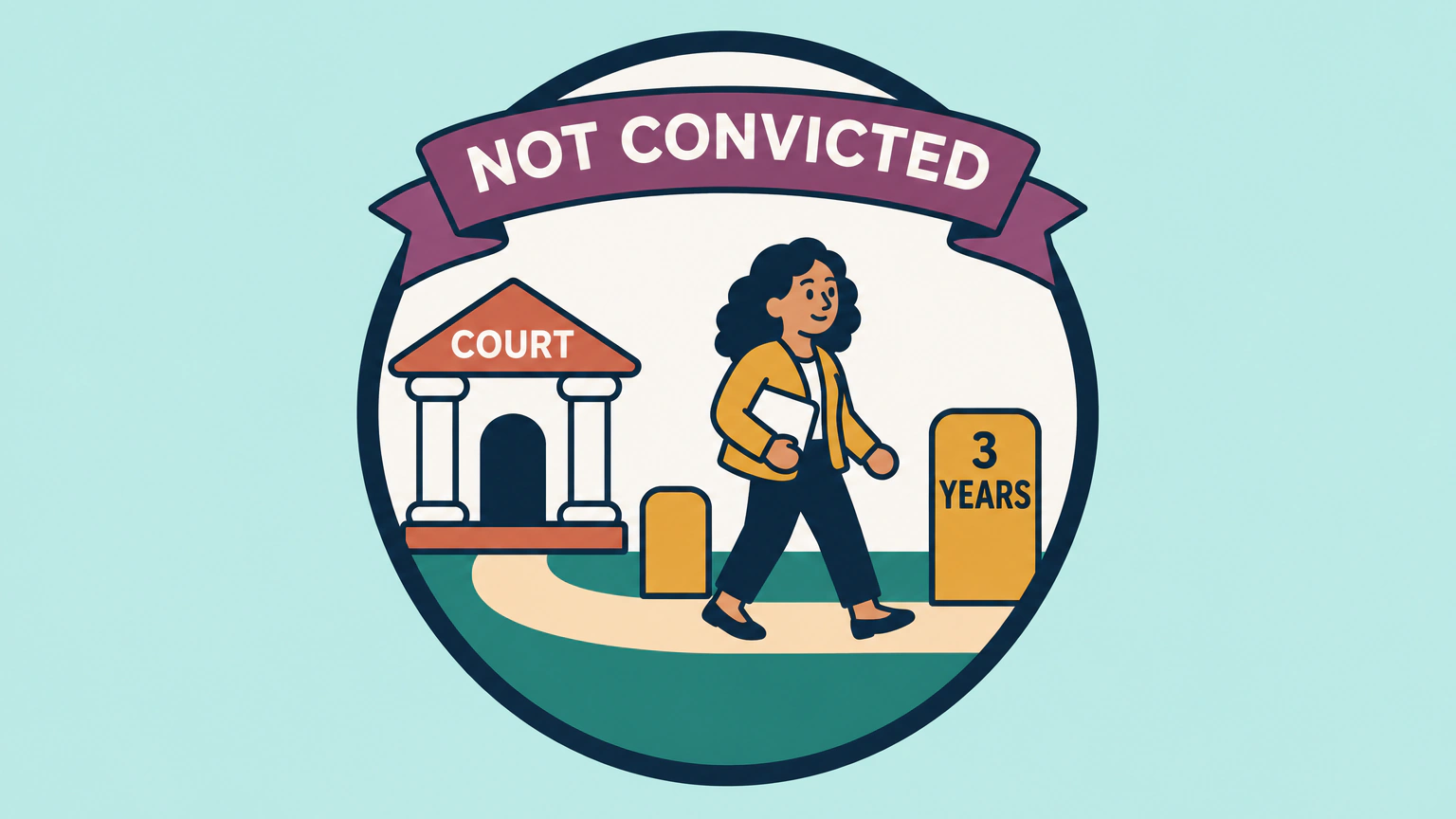
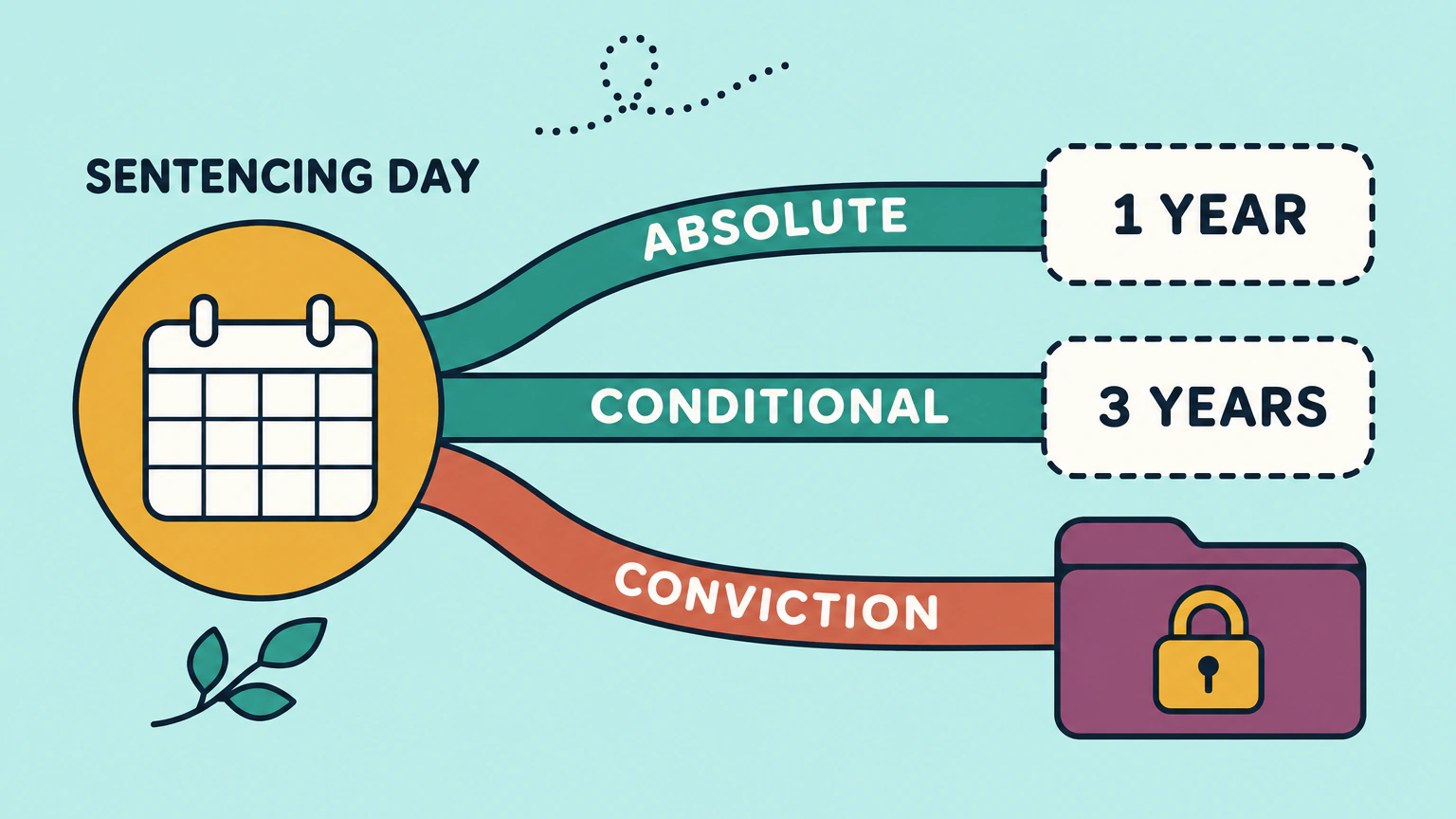
The RCMP seals it three years from the day you're sentenced, not three years after probation ends, so you never need a record suspension for it. An absolute discharge, the kind with no conditions, is sealed after one year.
A suspended sentence or a conditional sentence is different. Both are convictions, and that decides who sees your record, when it goes away and what a border officer makes of it.
On this page
- What a conditional discharge actually means
- Discharge, suspended sentence or conditional sentence: which ones are a conviction
- When a discharge comes off your record, and the day the clock starts
- Who can see a discharge before it's sealed
- Crossing into the U.S., and what it means if you're not a citizen
- Before you say yes to a discharge
- Questions people ask about conditional discharges
What a conditional discharge actually means
Section 730 of the Criminal Code sets this up. After you plead guilty, or a judge finds you guilty, the court can discharge you "instead of convicting" you. It does that only if it considers a discharge "in the best interests of the accused and not contrary to the public interest". Then you're "deemed not to have been convicted".
An absolute discharge ends things on the spot, with no conditions. A conditional discharge comes with the conditions of a probation order, and you live under them for a set time.
Often, nobody argues about it. The Crown and your lawyer agree on a discharge in advance, and after you plead guilty they ask the judge for it together, in what lawyers call a joint submission.
Who can get one, and who can't
Section 730(1) rules out three things: an organization, an offence with a minimum punishment, and an offence punishable by 14 years or life.
Impaired driving shows how the minimum works. Driving while impaired, driving over 80 (a blood alcohol level of 80 mg or more per 100 mL within two hours of driving) and refusing a breath or blood demand all carry at least a $1,000 fine on a first offence. So none of them can end in a discharge. With the Crown's consent, a judge can delay sentencing so you can finish a provincially approved treatment program, and finishing it lets the judge skip the minimum. Even then, the Code says the court "shall not direct a discharge" (s. 320.23(2)).
Being eligible isn't the same as getting one. Above that floor, it's the judge's call.
The probation, and what happens if you break it
Every probation order carries three conditions the judge must set. You keep the peace and are of good behaviour. You come to court when required. And you tell the court or your probation officer before you change your name or address, and promptly when your job changes.
The judge can add more, such as reporting to a probation officer within two working days, staying away from named people or places, not leaving the court's jurisdiction without written permission, and not drinking or using drugs.
A probation order can't run longer than three years, unless a new conviction leads the court to extend it by up to a year. If your life changes, you, your probation officer or the Crown can ask the court to change the optional conditions or shorten the order.
Breaking a condition without a reasonable excuse is a crime of its own. If the Crown prosecutes it by indictment, the more serious of its two routes, it carries up to four years in prison.
A new charge can cost you the discharge: If you're convicted of any offence while you're on the probation that came with your discharge, a breach of probation included, the court that gave you the discharge can revoke it, convict you of the original charge and impose any sentence it could have imposed on the day of the discharge.
Discharge, suspended sentence or conditional sentence: which ones are a conviction
All four outcomes start in the same place, with a guilty plea or a finding of guilt. Only the two discharges leave you unconvicted, and apart from a conviction for simple drug possession, only those two leave your record on their own.
What each outcome leaves you with
| Outcome | A conviction? | What you live with | Not available when | When the RCMP seals it |
|---|---|---|---|---|
| Absolute discharge | No | No probation and no conditions | The offence has a minimum punishment, or a maximum of 14 years or life | 1 year after the discharge, automatically |
| Conditional discharge | No, unless a court revokes it | Probation for up to 3 years | The same limits as an absolute discharge | 3 years after the day it's ordered, automatically |
| Suspended sentence | Yes | Probation for up to 3 years, and a sentence can still be imposed if you're convicted again while it runs | The offence has a minimum punishment | Not automatically, except for simple drug possession. A record suspension is possible 5 or 10 years after the whole sentence ends |
| Conditional sentence | Yes | A jail term under 2 years served in the community, under conditions | The offence has a minimum jail term or is excluded by s. 742.1, or the judge finds the community at risk | Not automatically, except for simple drug possession. The same record suspension wait applies |
Criminal Code ss. 730, 731, 732.2 and 742.1. Criminal Records Act ss. 4 and 6.1. The 5-year wait applies when the Crown proceeded summarily and the 10-year wait when it proceeded by indictment.
A suspended sentence is a conviction with the sentence held back
With a suspended sentence, the court convicts you, then suspends "the passing of sentence" and releases you on probation (s. 731(1)(a)). It isn't available when the offence carries a minimum punishment.
The sentence isn't gone. It's waiting. If you're convicted of any offence while you're bound by the order, a breach of probation included, the court can revoke it and "impose any sentence that could have been imposed if the passing of sentence had not been suspended" (s. 732.2(5)(d)). The conviction stays on your record until you get a record suspension, and that's years away.
So why would a lawyer take one? Because when a discharge is off the table, it keeps you out of jail.
A conditional sentence is jail time served in the community
Under section 742.1 of the Criminal Code, a conditional sentence is a real jail term of less than two years that the judge lets you serve in the community. Three things have to line up. It mustn't endanger the community, and it has to fit the purpose and principles of sentencing. The offence can't carry a minimum jail term. And it can't be on the excluded list, which covers attempted murder, torture, advocating genocide, and indictable terrorism or criminal organization offences with a maximum of 10 years or more.
Every conditional sentence order makes you report to a supervisor and stay within the court's jurisdiction unless you get written permission. People's Law School says it "usually has conditions that restrict your freedom", such as house arrest or a curfew. Breach one and the judge decides on the balance of probabilities, a lower bar than a criminal trial. Proving a reasonable excuse is up to you, and the judge can send you to jail for the rest of the term (s. 742.6(9)).
The law has changed. For offences committed on or after July 15, 2026, the Bail and Sentencing Reform Act rules out a conditional sentence for sexual assault with a weapon or causing bodily harm, and for aggravated sexual assault. When the Crown proceeds by indictment, it also rules one out for sexual assault, sexual exploitation of a person with a disability and sexual offences involving anyone under 18. Older offences keep the old rules.
When a discharge comes off your record, and the day the clock starts
The Criminal Records Act starts the clock in the courtroom. Once "more than one year" has passed since an absolute discharge, or "more than three years" since "the day on which the offender was ordered discharged" on probation conditions, no federal record of it can be disclosed without the minister's approval (s. 6.1(1)). The RCMP must also remove it from CPIC, the national police database. It says it seals both kinds without being asked, and the Parole Board says people who have only discharges don't need to apply for a record suspension.
Some guides count the three years from the end of probation. The law doesn't.
Here's what that mistake costs. Say a court orders your conditional discharge on March 2, 2026, with 18 months' probation. Probation ends September 2, 2027. Your three years run out on March 2, 2029, 18 months after probation ended. Count from the end of probation instead and you'd wrongly expect to wait until September 2, 2030, a year and a half too long.
Very old discharges are the exception. One ordered before July 24, 1992 isn't sealed on its own. You have to send the RCMP a written request, and it costs nothing.
What sealing doesn't erase
Sealed doesn't mean destroyed. If a fingerprint identified as yours turns up at a crime scene, police can still be given your name, date of birth and last known address (s. 6.2).
The fingerprints and photos taken when you were charged stay with the police service that took them unless you ask it to destroy them and it agrees. York, Peel and Durham regional police each make you wait one year after an absolute discharge and three years after a conditional one before you can apply, and York also wants no criminal convictions on file. Our stayed-charges guide explains how to ask police to destroy your fingerprints.
One copy may sit outside Canada's control. The RCMP says it shares record information with foreign authorities "who may save this information".
If your sentence was a conviction
Outside simple drug possession, suspended and conditional sentences stay on your record until the Parole Board of Canada grants a record suspension, what people used to call a pardon. You can apply 5 years after the whole sentence is finished if the Crown proceeded summarily, or 10 years if it proceeded by indictment.
Finished means all of it. The Parole Board counts probation, the conditional sentence itself, and every fine, surcharge and restitution order. The application fee is $50.
Some people can't apply at all. That includes most people convicted of a listed sexual offence involving a child, and anyone convicted of more than three indictable offences that each brought a prison sentence of two years or more (s. 4(2)).
Who can see a discharge before it's sealed
Until the clock runs out, a discharge can show up on a police check, and which check matters. In Ontario, the Police Record Checks Reform Act, 2015 decides what each kind may show. The results come to you first, and they reach the employer or group that asked only if you give written consent after you've seen them. The RCMP's fingerprint checks follow its published list of types of certified criminal record checks, which turns on why the check was requested. Outside Ontario, ask your police service what its check includes before you sign a consent.
Who sees a discharge before it's sealed
| Who runs it | The check | Does an unsealed discharge show? |
|---|---|---|
| Ontario police | Criminal record check | No, never |
| Ontario police | Criminal record and judicial matters check | Yes, within 1 year of an absolute discharge or 3 years of a conditional one |
| Ontario police | Vulnerable sector check | Yes, on the same 1-year and 3-year terms |
| RCMP fingerprint check | Private-sector job, volunteering or other employment | Only if you also have an earlier conviction on file |
| RCMP fingerprint check | Provincial government job | Only if you also have an earlier conviction on file |
| RCMP fingerprint check | Federal government job | Yes |
| RCMP fingerprint check | Police officer job | Yes |
| RCMP fingerprint check | Permanent residence or citizenship application | Yes |
| RCMP fingerprint check | Visa, border crossing, foreign travel or work | No. Only convictions are released |
Ontario rows: Police Record Checks Reform Act, 2015, Schedule items 3 and 4. RCMP rows: the RCMP's published list of what each certified check releases. The years count from the date of the discharge.
When a form asks whether you've been convicted
Read the question before you answer it. Because the Criminal Code deems you not convicted, a question that asks only about convictions isn't asking about your discharge.
A question that asks whether you've ever been found guilty, or pleaded guilty, is different. You were. That's exactly what lets a judge give a discharge in the first place.
Licensing bodies, immigration forms and some employers ask that wider question. So read the exact words on the page, and answer what's being asked, truthfully. The United States asks a wider question still.
Crossing into the U.S., and what it means if you're not a citizen
A discharge isn't a conviction in Canadian law, and that binds Canada. Two other systems can read the same guilty plea differently.
At the U.S. border
The RCMP says U.S. law enforcement and border agencies have "limited access to active records" through CPIC, and that other countries, the U.S. included, may not recognize a Canadian record suspension.
The bigger problem is the definition. American immigration law counts a conviction even where a court holds back a formal judgment of guilt. A guilty plea plus "some form of punishment, penalty, or restraint" on your liberty is enough (8 U.S.C. § 1101(a)(48)(A)), and probation can fit that. A visitor can also be refused for admitting the essential elements of a drug offence or a "crime involving moral turpitude", a U.S. legal category, conviction or not (§ 1182(a)(2)(A)(i)).
Whether your offence lands in one of those boxes is a U.S. question with U.S. answers, and officers decide entry case by case. U.S. law lets officials admit an inadmissible visitor temporarily at their discretion (§ 1182(d)(3)(A)). That's what a waiver is, and getting one takes time. If you cross often, we'd get advice on U.S. admissibility before you enter the plea.
If you're a permanent resident or on a permit
For Canadian immigration, a discharge isn't a conviction. The Immigration and Refugee Board's legal guide says so, relying on the same Criminal Code rule.
Citizenship is different. No one can be granted citizenship or take the oath while they're "under a probation order" (Citizenship Act s. 22(1)(a)(i)). So a conditional discharge or a suspended sentence puts a citizenship grant on hold until probation ends. An unsealed discharge also shows on the RCMP checks for permanent residence and citizenship.
A suspended or conditional sentence is a conviction, and that's where status gets risky. Under the Immigration and Refugee Protection Act, a permanent resident convicted of an offence with a maximum of 10 years or more, or sentenced to more than six months in prison, can be found inadmissible (s. 36(1)(a)). A hybrid offence, one the Crown can prosecute either way, counts as indictable even when it goes ahead summarily (s. 36(3)(a)). So for a permanent resident, the indictable maximum is what matters, whatever sentence you get.
Talk to an immigration lawyer before the plea, not after. If you're still choosing, here's how a lawyer or a licensed consultant compares on status cases.
Before you say yes to a discharge
A discharge starts with a guilty plea or a finding of guilt, and not every country will treat that as sealed. So before you agree, ask whether the Crown would withdraw the charge or accept a peace bond instead. A criminal defence lawyer can tell you what each would leave behind.
Our criminal defence page puts the planning fee to resolve a straightforward charge by guilty plea at C$4,000 to C$9,000. That's an uncontested plea in a summary case, planned for one court day, and we tell you to confirm whether initial appearances and sentencing are included. Weighing a trial instead? Here's what a criminal lawyer costs in Canada.
We're not your lawyer, and a guilty plea can follow you in ways a sealed record doesn't. Talk your plea through with a criminal defence lawyer before your court date.
Before you agree to a plea for a discharge
- Ask whether the Crown would withdraw the charge or accept a peace bond instead, and what each would leave on your record.
- Check that the offence qualifies. It needs no minimum punishment and a maximum under 14 years. Impaired driving, over 80 and breath-demand refusals never do.
- Ask how long the probation will run and what each condition means for your work, your home and your travel.
- Write down the date the judge orders the discharge. Your one-year or three-year clock runs from that day.
- If you cross into the U.S., get advice on U.S. admissibility before you enter the plea.
- If you're not a Canadian citizen, get immigration advice before you plead. Probation also puts a citizenship grant on hold until it ends.
- If you'll need a vulnerable sector check within three years, plan for the discharge showing on it.
- Ask what the lawyer's quote covers, including first appearances and the sentencing hearing.
Questions people ask about conditional discharges
Is a conditional discharge a conviction in Canada?
No. The judge finds you guilty and then discharges you instead of convicting you, and the Criminal Code says you're "deemed not to have been convicted". That holds as long as you keep your probation. If you're convicted of a new offence while you're bound by it, a breach of probation included, the court can revoke the discharge and convict you on the original charge.
How long does a conditional discharge stay on your record?
Three years from the day the judge orders it, not three years after your probation ends. After that the RCMP seals it on its own, with no application to make. An absolute discharge is sealed after one year. A discharge from before July 24, 1992 is the exception. For one of those, you send the RCMP a written request, and it costs nothing.
Does a conditional discharge show up on a criminal record check?
On Ontario's basic criminal record check, never. On the judicial matters check and the vulnerable sector check it can appear for three years from the date of the discharge. An RCMP fingerprint check for a private-sector job shows it only if you also have an earlier conviction. Checks for federal jobs, police officer jobs, permanent residence and citizenship show it until it's sealed.
Can you travel to the U.S. with a conditional discharge?
Maybe, but Canada's rule that a discharge isn't a conviction doesn't bind the U.S. American immigration law counts a guilty plea followed by "some form of punishment, penalty, or restraint" as a conviction, and probation can fit. Whether that keeps you out depends on how U.S. law treats your offence. The RCMP also shares records with foreign authorities, who it says "may save this information".
Do you need a record suspension for a discharge?
No. The Parole Board says that if you've only received absolute or conditional discharges, you don't need to apply. The RCMP seals them on its own after one or three years. Record suspensions are for convictions, including suspended and conditional sentences. For those, apart from simple drug possession, you apply 5 or 10 years after the whole sentence is over, and the fee is $50.
What's the difference between a suspended sentence and a conditional sentence?
A suspended sentence holds your sentence back and puts you on probation. If you're convicted of something new while it runs, the judge can impose the sentence after all. A conditional sentence is a jail term of less than two years served in the community, and breaking a condition can send you to jail for the rest of it. Both are convictions.
Can you get a conditional discharge for impaired driving?
No. Impaired driving, driving over 80 and refusing a breath or blood demand all carry a minimum punishment, starting at a $1,000 fine for a first offence ($2,000 for a refusal). A discharge is never available when there's a minimum, and finishing an approved treatment program doesn't change that. A judge who delays sentencing for one can skip the minimum, but "shall not direct a discharge".