

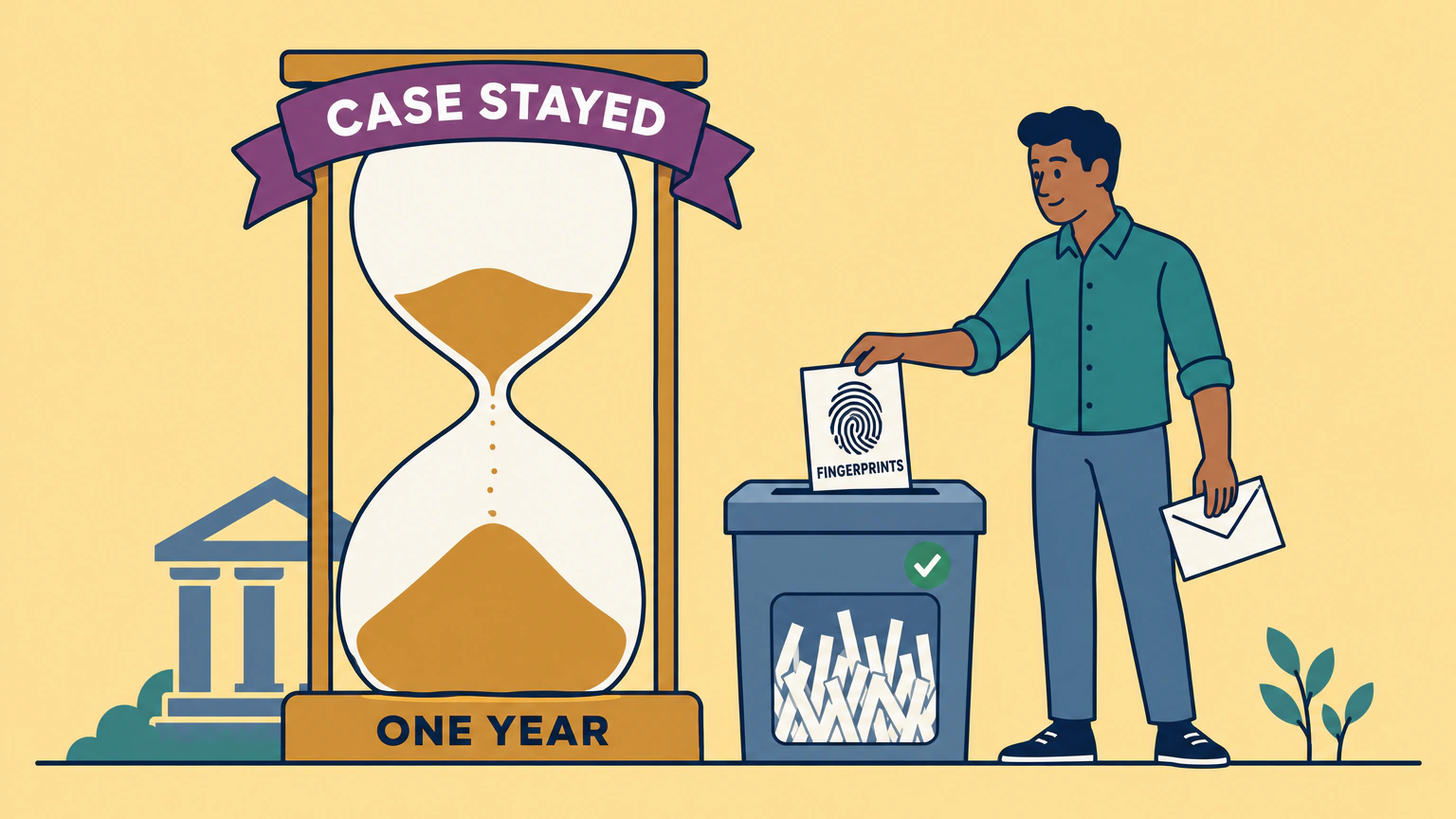
A stayed charge is a prosecution that has stopped without a verdict, so you weren't convicted. But if the Crown entered the stay, it can restart the case for up to a year, and only after that does the law treat it as if it never began. For adult charges, your fingerprints, photos and national police entry can remain after a stay. You can ask the police service that charged you to destroy them. Every service we checked has a one-year wait after a Crown stay, with longer waits or exclusions for some offences.
That leaves three practical questions: whether the case can come back, what a police check will show, and how to get your prints destroyed.
On this page
What a stay does to your case, starting today
A stay stops the prosecution. Nobody decides whether you did it, so it isn't a conviction, and it isn't an acquittal either.
When the Crown enters a stay, the Criminal Code says "any undertaking or release order relating to the proceedings is vacated." In plain terms, your bail conditions end that day, no-contact terms included.
The stay covers only the charge it's entered on. Criminal Law Notebook, a reference lawyers use, notes that breaches of conditions and missed court dates while the charge was live carry on as their own cases.
There are two kinds of stay, and they don't mean the same thing.
When the Crown stays it
The Crown can stay a prosecution at any point after it starts and before judgment. What the stay tells you depends on where you live.
In Ontario, the Crown Prosecution Manual says that when there's no reasonable prospect of conviction or no public interest in going ahead, the prosecutor "must withdraw the charge." A stay "is only appropriate where the proceedings are temporarily discontinued with an expectation of recommencing within one year." The Ontario Court of Justice adds one common route to a stay: once you finish a diversion program, the Crown withdraws or stays the charges.
B.C. runs the other way. When a charge no longer meets the BC Prosecution Service's standard, Crown counsel end the prosecution, "usually by directing a stay of proceedings." About half of all Crown stays there come with something else attached, such as a peace bond, alternative measures or a guilty plea on another file. In 2024/25, 35% of the 40,605 prosecutions the service concluded ended in a stay.
So in Ontario, treat the year as live. In B.C., a stay is usually just how a case that won't go ahead gets closed.
When a judge stays it
A judicial stay of proceedings is a remedy. A judge orders one to answer a Charter breach, such as delay that violates your right to be tried within a reasonable time (s. 11(b)), or an abuse of process. In R. v. Jordan, the Supreme Court set ceilings: 18 months from charge to the end of trial in provincial court, and 30 months in superior court, or in provincial court after a preliminary inquiry. Delay the defence caused doesn't count. Past the ceiling, unless the Crown could show exceptional circumstances, "a stay will follow."
That changed for offences committed on or after July 18, 2026. The Protecting Victims Act added Part XV.1 to the Criminal Code, and it says a court "shall not order a stay of proceedings as a result of a finding of unreasonable delay unless it is satisfied that no other remedy would be appropriate and just in the circumstances." The judge has to weigh five things: the stage of the case, the impact on any victim, the prejudice to you, public confidence in the justice system, and society's interest in a decision on the merits. The prosecutor also has to take reasonable steps to tell victims about the delay application.
Offences before that date keep the Jordan rule. Explainers written before July 2026 often treat the delay stay as the automatic result of a breach. For newer offences, it isn't.
A judge's stay is final unless the Crown appeals and wins. Delay stays are rare, too: B.C. counted seven in 2024/25.
How a stay compares with the other ways a charge ends
| Outcome | Who ends it | Can it come back? | Is it a conviction? | Earliest fingerprint request in Toronto |
|---|---|---|---|---|
| Crown stay | The Crown, at any point before judgment | Yes, by notice within one year, or sooner for a summary-only charge | No | One year after the stay |
| Judge's stay | A judge, as a Charter remedy | Only if the Crown appeals and wins | No | One year after the stay |
| Withdrawn | The Crown | No restart clock. The charge is dropped. | No | Five months after the last court date |
| Acquitted | A judge or jury after a trial | Only if the Crown appeals and wins | No | Five months after the last court date |
Waits are Toronto Police Service policy. Other police services set their own.
Can a stayed charge come back?
Yes, for a while. The Crown restarts a stayed case by giving notice to the court clerk, with no new charge needed. It has one year from the stay, or until the time to start the case runs out, "whichever is the earlier." If no notice comes by then, "the proceedings shall be deemed never to have been commenced."
The earlier date matters for summary-only charges. Those must be started within 12 months of the alleged offence, unless you and the prosecutor agree otherwise (s. 786(2)). Say the offence was on January 10, 2026, and the Crown stayed the charge on October 1, 2026. One year after the stay is October 1, 2027. Twelve months after the offence is January 10, 2027. The earlier date, January 10, 2027, closes the window.
A charge prosecuted by indictment keeps the full year, because that 12-month limit doesn't apply to it. If you don't know which kind yours was, or the Crown could have gone either way, ask your lawyer.
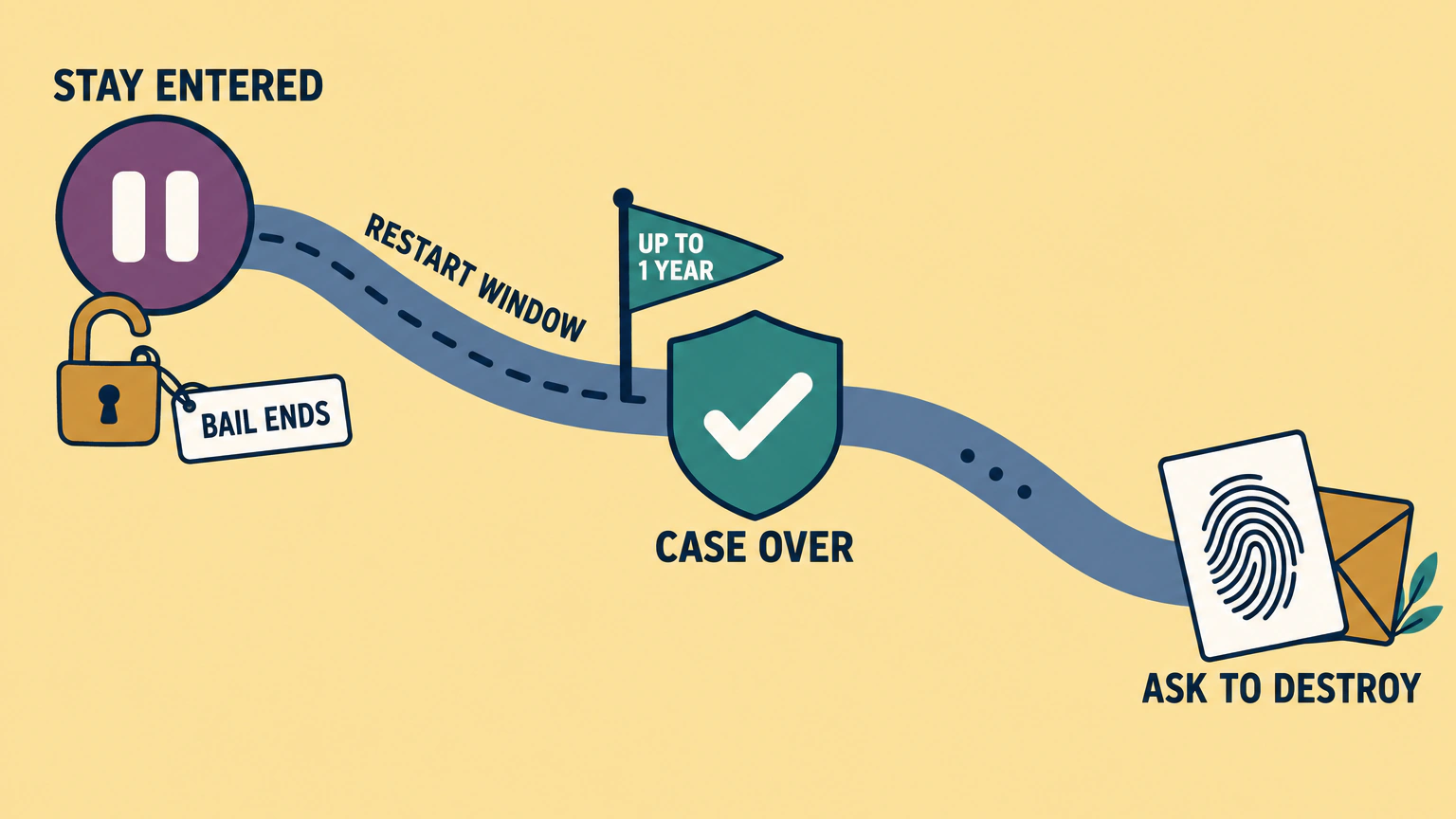
If a new charge arrives over the same events after the restart window closes, call a lawyer that day. Any filing deadline still applies. A court can stop a prosecution that amounts to an abuse of process. A judge's stay comes back only if the Crown wins an appeal.
Until the year is up, keep your release papers and the court record of the stay where you can find them. And make sure your lawyer can still reach you.
What stays on your record after a stay
No conviction means no criminal record in the usual sense. The RCMP says you don't need a record suspension when the charges against you were "dismissed, stayed or withdrawn." The charge still sits in three places.
The first is the RCMP's national repository, which keeps non-conviction records. The RCMP says that "includes withdrawn or dismissed charges, and stays of proceedings." Through the Canadian Police Information Centre (CPIC), authorized users can see the charges and court decisions on file.
The second is the police service that charged you. It keeps its own occurrence file, and Vancouver, Transit Police, York and Peel all say destroying your prints doesn't remove it.
The third is the court. In B.C., Court Services Online has a policy "to remove a matter that has been stayed one year after the stay is ordered." That's the public online search. Vancouver Police notes the result stays in the court's own database.
What an Ontario police check will show
Ontario writes this into law. The Police Record Checks Reform Act, 2015 defines non-conviction information to include a charge that "was dismissed, withdrawn or stayed." Its schedule keeps that off the criminal record check and the criminal record and judicial matters check.
The vulnerable sector check, the one for work with children or vulnerable people, can include it only through "exceptional disclosure." All three tests in s. 10(2) have to be met: a prescribed offence, an alleged victim who was a child or vulnerable person, and reasonable grounds to believe in a "pattern of predation." The result goes to you first. It reaches an employer only if you give written consent. You can also ask for reconsideration, which has to be decided within 30 days.
Some explainers say an employment background check will show the arrest and charge. In Ontario, a police record check won't show a stayed charge, outside that narrow vulnerable sector exception. A peace bond is different. The schedule treats court orders as their own item, so a bond can appear on the judicial matters and vulnerable sector checks unless it was tied to a withdrawn charge.
What each Ontario police record check shows about a stayed charge
| Check | Does a stayed charge appear? |
|---|---|
| Criminal record check | No |
| Criminal record and judicial matters check | No |
| Vulnerable sector check | Only if all three tests in section 10 are met: a listed offence, an alleged victim who was a child or vulnerable person, and a pattern of predation |
Police Record Checks Reform Act, 2015, Schedule item 9 and section 10.
Outside Ontario, ask what the check covers
In B.C., the police services we checked describe their own police information checks rather than pointing to a statute. Vancouver Police says the incident and court information "may be disclosed during a police information check process," and Transit Police says the same about its record checks. That holds even after your prints are destroyed, because the local file and the court record stay.
Before you apply for a job or a volunteer role, ask the police service running the check what it discloses for a stayed charge. Ask for the result to come to you first.
How to get your fingerprints and photos destroyed
Police can fingerprint and photograph people charged with indictable offences, including hybrid ones that could have been prosecuted by indictment. A summary-only charge may have left no prints at all.
You apply to the service that laid the charge. If it agrees, it asks the RCMP to destroy the national record, and Toronto and Vancouver both warn that the RCMP can still say no.
Every service we checked makes you wait a year after a Crown stay, against 30 days to five months after a withdrawal. The exclusions matter more than the wait. Toronto's policy carves out primary and secondary designated offences under s. 487.04 of the Criminal Code, and "secondary" takes in any Code offence that can carry five years or more on indictment. Ordinary assault carries five, so it falls outside Toronto's standard destruction rules. Ottawa sends those offences to extra review. Durham excludes charges involving sex, drugs, violence or weapons. Vancouver and Transit Police set a five-year minimum wait for a list of serious offences, sexual offences among them.
Durham, York and Ottawa each quote six to 12 months to process a request. Among the services that publish a fee, it runs from nothing at York to $69.62 at Durham.
How long police make you wait before destroying fingerprints
| Police service | After a Crown stay | After a withdrawal | Worth knowing |
|---|---|---|---|
| Toronto Police Service (ON) | One year | Five months after the last court date | Designated offences under s. 487.04, assault included, fall outside the standard policy |
| Peel Regional Police (ON) | One year from the disposition | 60 days | Requests can take up to a year |
| Durham Regional Police (ON) | One year, Crown or judicial stay | 30 days, or two years from the date of diversion | $69.62 fee. Charges involving sex, drugs, violence or weapons don't qualify. |
| York Regional Police (ON) | One year, or 30 days after a judge's stay | 30 days | No fee. Six to 12 months to process. |
| Ottawa Police Service (ON) | One full year | Four months | Designated and other serious offences get extra review and may be refused |
| Vancouver Police Department (BC) | One year | Three months | $66.78 fee. The incident and court result can still come up in a police information check. |
| Transit Police (Metro Vancouver, BC) | One year | Three months | $68.25 fee. Five-year minimum for listed serious offences, sexual offences included. |
Each police service sets its own rules. If yours isn't listed, ask the service that charged you for its destruction policy.
A peace bond changes the timing, and Ottawa and Durham both say a bond usually runs about a year.
If your stay came with a peace bond: A stay is often part of a deal. In B.C., about half of Crown stays come with another consequence, such as a peace bond. If yours did, your fingerprint request waits for the bond. Toronto, Peel and York Regional Police won't take a request while a peace bond is still in force.
Each service has its own form or letter, but they ask for much the same things.
What to send with a destruction request
- Your full name now, and the name you were arrested under if it has changed
- Your date of birth and current address
- The charge, the date of the offence and the court outcome, as best you remember them
- A copy of government photo ID, if the service asks for one
- The fee by certified cheque or money order, where the service charges one
- A separate request to each police service that charged you
Travel and immigration while the year runs
Crossing the border is the United States' decision, not Canada's. The RCMP says U.S. law enforcement and border agencies "have limited access to active records" in its repository through CPIC. It also says it shares record information "with foreign authorities who may save this information." Toronto Police warns that destroying your prints "does not guarantee" entry to the United States, which is "solely at the discretion of U.S. authorities."
If you're not a citizen yet, there's a second question. The Citizenship Act bars a grant of citizenship, or taking the oath, "while the person is charged with, on trial for, subject to or a party to an appeal relating to" an indictable offence. Whether a Crown-stayed charge still counts during its restart year is a question for an immigration lawyer before you file. If you're unsure whether the application needs a lawyer or a licensed consultant, settle that first.
When it's worth calling a criminal lawyer
You won't need a lawyer for every stay. These are the situations where a call to one of the criminal defence lawyers we list is worth it, and our guide to what a criminal lawyer costs in Canada can help you budget for one.
The Crown has restarted the case, or you've heard it might. You want someone who knows the file before the first court date.
The stay is being offered as part of a deal, with a peace bond or alternative measures. Find out what you're agreeing to, and what it does to your fingerprint request, before you sign.
Your trial is drifting past the Jordan ceilings. Your offence date decides which delay rules apply. Turning down a trial date can count as defence delay when the court and Crown are ready and the defence isn't. Raise delay concerns early so the court can address them.
You're not a Canadian citizen. A charge that's still live can hold up a citizenship grant.
Your destruction request was refused. Toronto runs a review process, Peel takes appeals, and the RCMP takes appeals by letter to its Canadian Criminal Real Time Identification Services.
We're not your lawyer. If your stay still has months left on its clock, one conversation with a criminal lawyer is worth the time.
Questions people ask about stayed charges
Is a stay of proceedings a conviction?
No. A stay stops the prosecution before anyone decides guilt, so there's no conviction to show on a criminal record check. It isn't an acquittal either. The RCMP lists stays with withdrawn and dismissed charges as non-conviction records, and says you don't need a record suspension for any of them.
Can stayed charges be brought back after a year?
Not the same case. A Crown stay can be restarted only by notice within one year, and the window closes sooner if a summary-only charge's 12-month limit runs out first. After that, the law treats the case as never started. If a new charge is laid over the same events, any filing deadline still applies. A court can stop a prosecution that amounts to an abuse of process. A judge's stay comes back only through a Crown appeal.
How long do stayed charges stay on your record?
There's no conviction record to expire. The charge can remain in police and RCMP files after the case ends. Ask the police service that charged you about destroying your fingerprints, photos and national record. The local occurrence file stays even if they're destroyed. In B.C., the online court record comes down a year after the stay.
Is a stayed charge the same as charges being dropped?
Close, but not the same. "Dropped" usually means withdrawn: the Crown ends the charge and there's no restart clock. A Crown stay allows up to one year to restart, or less if a summary-only charge's filing limit runs out sooner. In Ontario, Crowns are told to withdraw a charge that fails their screening test and to stay one only when they expect they may restart it, so a stay there deserves more caution.
Do I need a pardon if my charges were stayed?
No. A record suspension, the current name for a pardon, is for convictions, and the RCMP says you don't need one when charges were dismissed, stayed or withdrawn. What you may want instead is fingerprint and photo destruction, which you request from the police service that charged you once its waiting period has passed.
Can I travel to the U.S. with stayed charges?
Possibly, but it's not up to Canada. The RCMP says U.S. border agencies have limited access to active Canadian records through CPIC, and that information it shares with foreign authorities may be kept. Toronto Police warns that destroying your prints doesn't guarantee entry, which is up to U.S. authorities. If you cross often, get your records destroyed once you're eligible and talk to a lawyer before your next trip.
Why are so many charges stayed in B.C.?
Because a stay is how B.C. prosecutors usually end a case that no longer meets their charge standard. In 2024/25, 35% of the 40,605 prosecutions B.C. concluded ended in a stay, and about half of those stays came with something else, such as a peace bond. If yours came with a deal, ask one of the criminal lawyers in Vancouver we list what you agreed to. In Ontario the same word is reserved for a case the Crown may restart.