

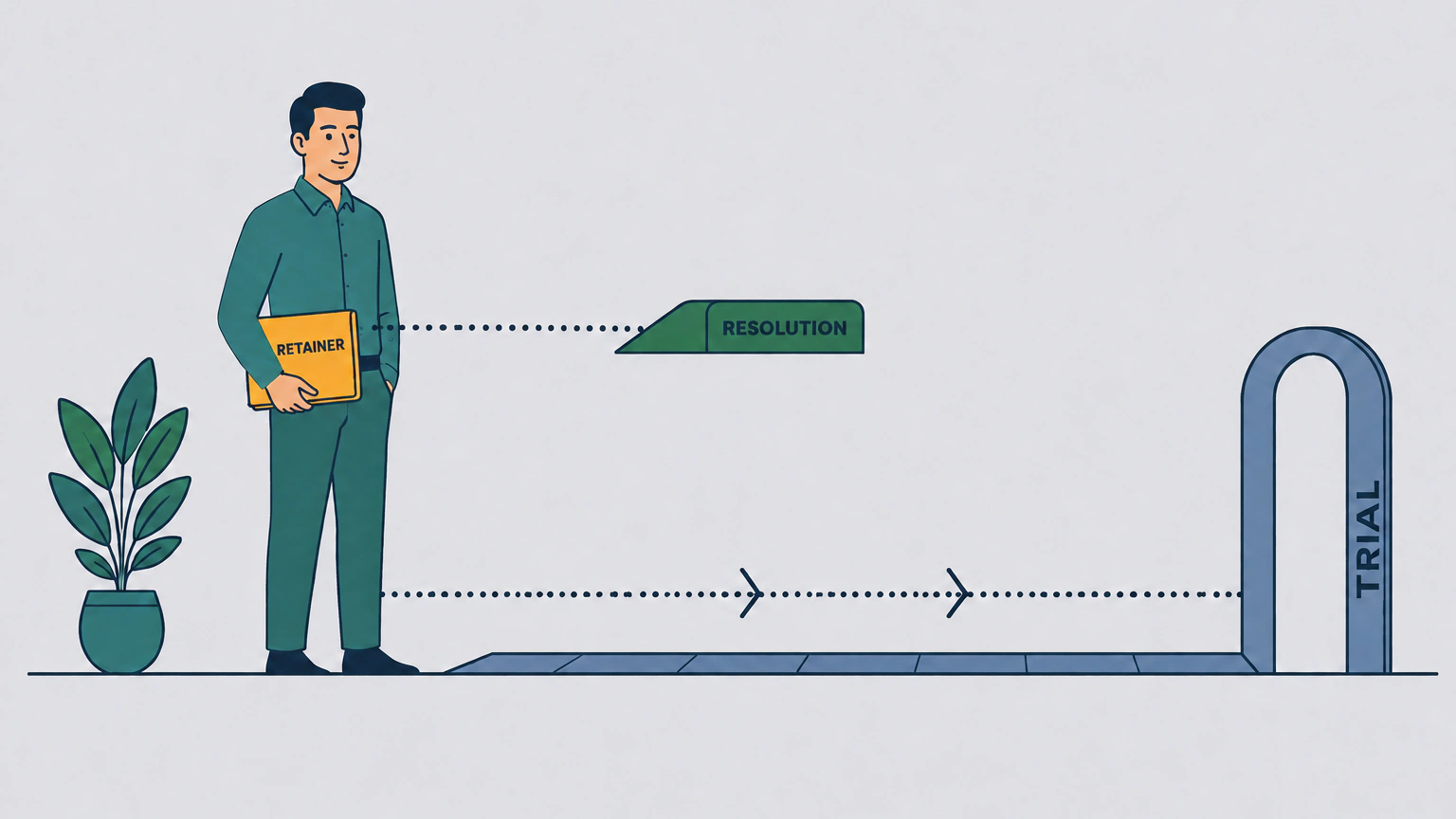
On this page
- What a criminal lawyer costs in Canada, and why the average is the least useful number
- The three ways your lawyer will price the work
- Where the money actually goes, stage by stage
- Help at the courthouse, and who qualifies for it
- When a licensed paralegal can take a criminal charge in Ontario
- What to settle before you sign the retainer agreement
- Common questions about criminal lawyer fees in Canada
What a criminal lawyer costs in Canada, and why the average is the least useful number
You've been charged, or someone you love has, and the money question is the one you can actually get your hands around today. So here's ours. Across 592 criminal defence cost profiles on our own listings, our page shows a fair price range of $3,678 to $6,304. It lists a minimum of $1,577 and a maximum of $18,910. Your fee depends on the work your case needs and what your retainer covers. The first two stops on that road can cost you nothing.
Our average across those 592 profiles is $5,780, and it's the least useful number we can give you. We'd rather say so than sell it to you.
A case that ends in a phone call between your lawyer and the Crown isn't the same product as a case that runs three days in front of a judge. Average the two and you get a number describing almost nobody. Hold onto the range instead, plus a sense of which end your file is heading toward.
We're not your lawyer, and a criminal charge isn't the place to guess. Use this to ask better questions, then get advice on your own file.
Where our figures come from, and what they cannot tell you
Those figures are ours. They're an aggregate of the 592 cost profiles sitting behind the page that lists criminal defence lawyers near you, and nothing more than that. Not a survey of Canadian firms, and not a government statistic. The panel also adapts to where you're browsing from, so read the numbers as ours rather than the country's. If you'd like to know whose they are, see who we are.
What they're good for is a sanity check. If a firm's quote sits far above our range, ask what extra work it includes. They can't tell you what your charge costs. A useful estimate usually needs someone to read your disclosure.
The three ways your lawyer will price the work
Ask five criminal lawyers how they charge and you'll hear three answers. They may offer a block fee for a defined stage, an hourly rate funded by a retainer, or a mix of the two. Your retainer agreement should say whether disbursements sit on top. For a first charge likely to resolve without a trial, a firm may quote a block fee for the stage in front of you. That gives you a number you can plan around. It's also where the fine print does the most work.
The block fee, and the moment it stops covering you
A block fee is a fixed price for a defined stage: bail, or first appearance through to a Crown pre-trial, or the trial itself. You agree to one price, and your lawyer carries the work the retainer says it includes.
The sentence that matters is the one in the retainer agreement describing where the stage ends. If the fee covers resolution discussions with the Crown, it stops when those talks fail and the file gets set down for trial. If it covers a trial, ask what happens on day four of a three-day trial. Nothing is going wrong when a lawyer asks for a fresh fee there. That's the model working. What goes wrong is finding out on the day.
Hourly billing, and the retainer that funds it
Hourly billing is what it sounds like. You're charged for the time your lawyer spends, and the money retainer you pay up front is a deposit against that time rather than the price of your defence. Ontario's By-Law 9 sends money advanced for work not yet done into the firm's trust account. Fees can come out after the lawyer does the work and sends you a bill. The firm may also reimburse itself for expenses properly incurred for you. Any balance left after fees and expenses is still yours.
Two things follow. Your retainer can run dry mid-case, and you may be asked to top it up as the work continues. And when an account lands that doesn't match the conversation you had, push back: here's how to dispute a lawyer's bill.
Disbursements, which can sit outside the fee
Disbursements are the money your lawyer spends on your behalf: transcripts, an expert report, a process server, court filing fees, couriers. Some retainer agreements bill them on top. That can push the final bill above the block fee even when the fee itself hasn't changed.
Ontario's rules don't treat them as an afterthought either. Rule 3.6-1 covers fees and disbursements in one breath, and the commentary asks a lawyer to tell you in writing, early, how both will be worked out. So the question isn't rude: ask what disbursements are likely on a file like yours, and roughly what they run.
Where the money actually goes, stage by stage
Cost often tracks distance. A criminal case can move through several stages, and it may end along the way: withdrawn, diverted, resolved by a plea, or pushed on to the next. Each stage carries its own work. Whether it carries a new fee depends on your retainer.
| Stage | What happens | What a block fee may cover at this stage | What may start a new fee |
|---|---|---|---|
| Bail hearing | If police keep you in custody, a justice decides whether you are released and on what conditions. You must be brought to court within 24 hours if a judge or justice of the peace is available | The hearing itself, the release plan and speaking to any surety | A bail review or a variation of your conditions later |
| First appearance and case management court | Your matter is called, the Crown confirms disclosure, and the court asks whether you have counsel or legal aid | Attendance and the scheduling work, often several short appearances | A change of plea position, or a new charge added |
| Disclosure review | The Crown hands over the evidence and your lawyer reads all of it, including video and expert material | Reading the package and advising you on what it shows | Large volumes of video, a second disclosure request, or an expert opinion |
| Crown pre-trial and resolution | Your lawyer negotiates with the Crown, aiming at a withdrawal, diversion or a plea | The negotiation and implementing a resolution in court | Talks failing and the file being set down for trial |
| Judicial pre-trial and trial | A judge narrows the issues, then the trial itself runs for one or more days | The judicial pre-trial, trial preparation and the booked trial days, if the retainer says so | Every extra trial day, and any pre-trial application |
Stages follow the Ontario Court of Justice's own StepByStep guide. Court names and timing differ outside Ontario, so check your provincial court's process page.
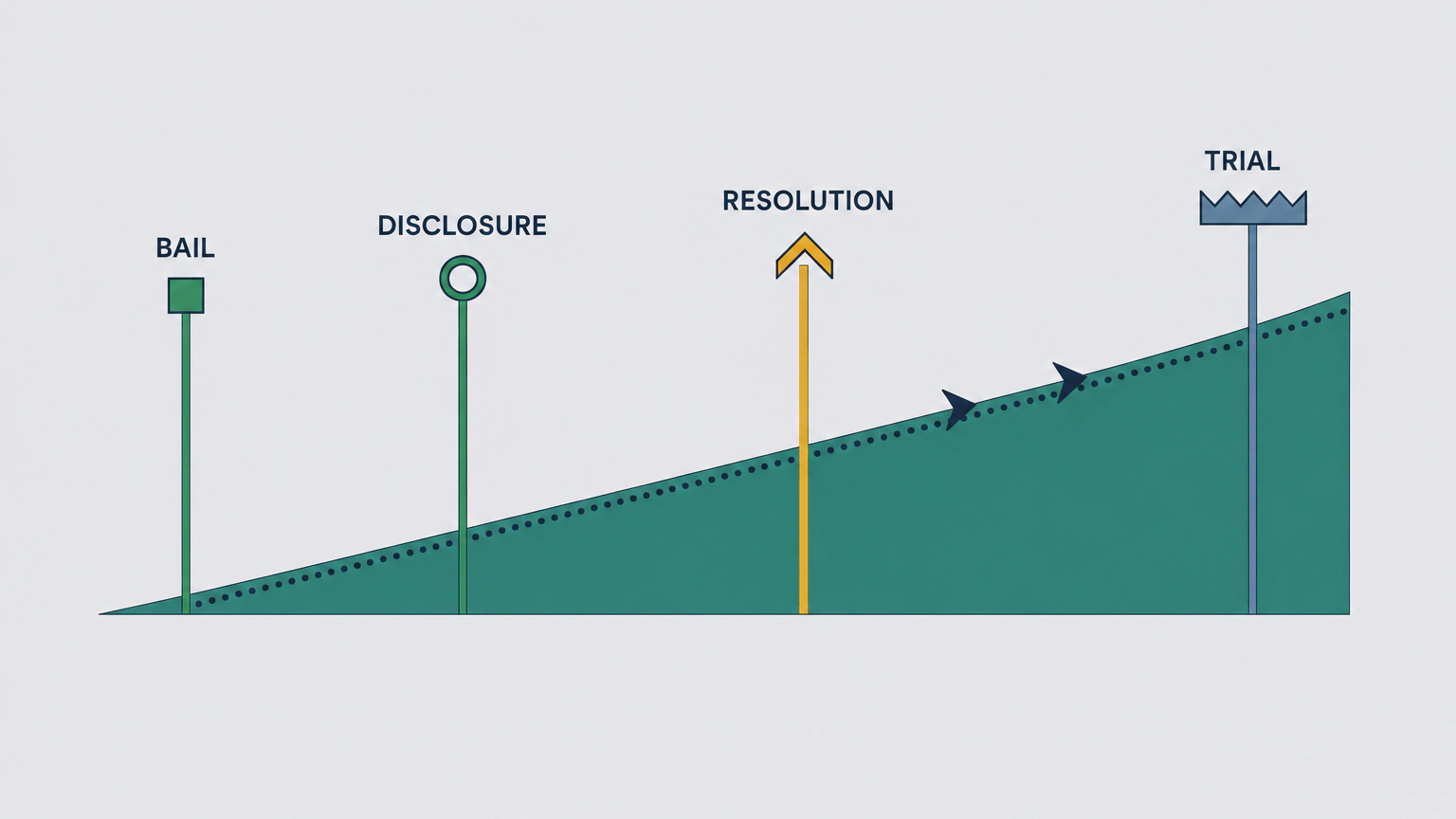
Look at where that ladder sits. Bail, first appearance, disclosure and the Crown pre-trial all happen before a trial. The trial line is where a separate fee may start.
The cheap end, where the case resolves before a trial date
Some criminal cases never reach a trial. They may resolve after a Crown pre-trial. That's where your lawyer and the prosecutor test the charge, discuss diversion, and consider whether a plea to something smaller makes sense. The Ontario Court of Justice says a matter stays in case management court until it is set for a preliminary inquiry or trial. It may also stay there "until you and the Crown agree on a resolution, such as a guilty plea or diversion".
Resolving a case before trial can keep the bill down. A lawyer who finds you a good resolution isn't a lazy lawyer. It can spare you the cost and uncertainty of a trial.
The expensive end, where a trial date gets set
A trial doesn't add a step to your file. It adds a project. Your lawyer prepares cross-examinations, goes back through every page and minute of video, may bring pre-trial applications, then may charge by the day for however many days the case runs. Trial dates get adjourned and rebooked too, and each round is real work.
A trial fee may be negotiated separately rather than carried over. That's why it's worth talking to more than one firm before you commit to that half of your case. Our listings of criminal defence lawyers in Toronto are one place to start if that's your courthouse.
Help at the courthouse, and who qualifies for it
Picture the hallway. It's your first court date, you haven't hired anyone, your matter is about to be called, and you're doing arithmetic in your head that isn't going well.
Two kinds of help can start in that hallway, and people mix them up constantly. One is duty counsel: a lawyer already at the courthouse who can help you today if you qualify. The other is a legal aid certificate: funding that helps pay a lawyer to represent you. Separate services, separate tests, and being turned away from one doesn't mean you're turned away from the other. Statistics Canada found that among people who acted on a serious legal problem without contacting a lawyer, 37% said they couldn't afford legal help.
Duty counsel, on the day, before you have hired anyone
Duty counsel are lawyers Legal Aid Ontario stations in the courthouse for people who don't have their own. At no cost, on the day, they can give you legal advice, explain your rights and how the court process works, and help you negotiate a resolution. In some cases they can also review your documents and represent you in court. At a bail hearing, the Ontario Court of Justice puts it simply: the lawyer speaking for you is either duty counsel or your own lawyer.
There's an income test, the same one the certificate uses. Over the line, you can still get legal information and referrals from duty counsel and legal aid workers, and those workers can handle an administrative appearance such as an adjournment. Walking in with nothing isn't the same as walking in with no options.
Red flag: Ask for the fee in writing before you pay anything. Ontario's Rules of Professional Conduct say a lawyer should give you, in writing and before or soon after the work starts, as much information about fees, disbursements and interest as is reasonable, including the basis on which the fee will be worked out. A firm that will not do that is telling you something.
A legal aid certificate, and why the cut-off is not one number
A certificate helps pay a lawyer to represent you. You apply to your provincial plan, and an intake worker tests your finances and your case. If you qualify, the plan issues a certificate you take to a lawyer who accepts legal aid work. Some plans may require you to repay part or all of the cost. In Ontario the criminal certificate line is $45,440 a year for families of up to four. It is $50,803 for five or more, with assets under $15,000 whatever your family size.
| Legal aid plan | How it measures your income | Household of one | Household of four |
|---|---|---|---|
| Legal Aid Ontario, criminal certificate | One income line covering households of one to four, plus an asset test | $45,440 a year, assets under $15,000 | $45,440 a year, assets under $15,000 |
| Legal Aid BC, standard criminal | Net monthly household income, with a higher line for criminal early resolution files | $2,320 a month, or $3,320 for early resolution | $4,640 a month, or $5,640 for early resolution |
| Legal Aid Alberta | Net income over the last 30 days and over the last 12 months, and you must meet both | $2,112 a month, or $25,346 a year | $4,023 a month, or $48,276 a year |
Each plan publishes its own figures in its own units, so do not convert one into another. Only an intake worker at the plan can confirm whether you qualify.
The three plans aren't measuring the same thing. Ontario tests one annual income line covering households of one through four. British Columbia tests net monthly household income, moves the line with household size, and sets a higher line again for criminal early resolution files. Alberta tests net income across two windows at once, the last 30 days and the last 12 months. Carry Ontario's $45,440 to a Legal Aid BC intake worker and you're holding an annual figure against a monthly test. Phone your province's plan.
When a licensed paralegal can take a criminal charge in Ontario
There's a second kind of licensed legal professional in Ontario, and on a defined list of charges they're allowed to appear for you in criminal court. Not one of the firm pages competing to answer this question mentions them, which makes sense, because those pages are selling you the other thing.
This is an Ontario answer and only an Ontario answer. The Federation of Law Societies of Canada counts 10,600 independent paralegals, all of them Ontario's, alongside over 136,000 lawyers across the country's 14 law societies. Ontario is the only province that licenses paralegals to work on their own, so our Ontario listings are the place to look if that's where your charge is. The same question, who is allowed to represent you, decides an immigration file too.
What Bill C-75 changed, and what Ontario did about it
The Criminal Code lets an agent, meaning someone who isn't a lawyer, appear on small summary matters. Section 802.1 draws the line by penalty: a defendant "may not appear or examine or cross-examine witnesses by agent if he or she is liable, on summary conviction, to imprisonment for a term of more than six months". Then Bill C-75 raised the default. Section 787(1) now sets the general summary penalty. A person faces "a fine of not more than $5,000 or to a term of imprisonment of not more than two years less a day, or to both". That lifted many summary charges above the six-month line and, on paper, shut agents out.
Ontario answered with Order in Council 1115/2019, in force since September 2019. It treats the Law Society of Ontario's own decision about who may appear as an approved program under section 802.1, and the Law Society publishes the resulting list. Assault, uttering threats, assaulting a peace officer, theft under $5,000, possession of property obtained by crime under $5,000, mischief to other property and being unlawfully in a dwelling-house are all on it. That list is public, and it carries a warning that later amendments can change it, so check the list itself rather than anyone's summary.
The charge most people ask about, and why it is not on the list
Impaired operation isn't on it. Section 320.14, the impaired driving and over-80 offence, appears nowhere on the Law Society's list, so a paralegal can't act for you on that charge. If it's yours, you're hiring a lawyer or applying for legal aid, and the sooner you know the less time you lose.
Four driving offences are on the list: dangerous operation, failure to stop after an accident, flight from a peace officer, and operation while prohibited. The low blood drug concentration offence in subsection 320.14(4) is also within paralegal scope. The Law Society lists it by its punishment provision, subsection 320.19(2). The line runs by the exact provision, not by how the charge sounds out loud.
Your disclosure package normally includes a one-page Charge Screening Form, and the Ontario Court of Justice says it usually shows whether the Crown is proceeding by summary conviction or by indictment. Then match the section number on your information against the Law Society's list, or ask a paralegal to do it before you pay anyone.
What to settle before you sign the retainer agreement
One rule does more work for you here than any negotiating tactic. Ontario's Rule 3.6-1: "A lawyer shall not charge or accept any amount for a fee or disbursement unless it is fair and reasonable and has been disclosed in a timely fashion."
Disclosed in a timely fashion. That's your sentence. It puts the money conversation at the start, in writing, and a lawyer who treats it as an awkward afterthought has the job backwards. Read the retainer agreement before you sign rather than after. It's the document that governs everything that follows.
Settle these before you sign:
- The exact scope: which stage the fee covers, in writing, and what happens at the next one
- Whether disbursements are inside the fee or billed on top, and roughly what they run
- Who actually appears in court for you, the lawyer you met or an associate
- How often you get an account, and what it itemises
- What happens to unused retainer money if the charge is withdrawn next month
- Whether the firm takes a payment plan, and whether interest is charged on an overdue account
- Whether the lawyer will put an estimate or a range in the retainer agreement
Take that list into your first consultation and work down it out loud. If a firm won't put its answers in writing, you've learned what you came to learn.
Common questions about criminal lawyer fees in Canada
How much does a criminal lawyer cost in Canada?
Across 592 criminal defence cost profiles on our own listings, our page shows a fair price range of $3,678 to $6,304. It lists a minimum of $1,577, a maximum of $18,910 and an average of $5,780. Those are our figures, not a national survey. Your own number depends on the work your case needs and what your retainer covers.
What is a block fee, and what happens when the case goes past it?
A block fee is a fixed price for a defined stage, such as bail, or everything up to a Crown pre-trial. Once the case passes that stage, the fee may stop covering you and a new one may be negotiated. Read where the retainer agreement says the stage ends before you sign.
Is a retainer refundable if the case ends early?
A money retainer is usually refundable after earned fees and properly incurred expenses are paid. Money advanced for work not yet done goes into the firm's trust account under Ontario's By-Law 9. The lawyer may take fees after doing the work and sending you a bill. If your charge is withdrawn next month, the remaining balance is still your money. Ask how a refund gets handled before you pay.
Does legal aid cover criminal charges?
It can, if you qualify financially and your charge meets your plan's coverage rules. Legal Aid Ontario's criminal certificate line is $45,440 a year for families of up to four, with assets under $15,000. Legal Aid BC measures net income by the month, while Legal Aid Alberta uses both 30-day and 12-month net income. Some plans may require repayment, so the answer changes with your province.
Can I talk to a lawyer at court if I have not hired one?
Yes. Duty counsel are lawyers stationed at the courthouse by Legal Aid Ontario. At no cost, they can give you advice, explain the process, help negotiate a resolution and sometimes speak for you in court. Over the income line, duty counsel and legal aid workers can still give you information and referrals. Legal aid workers can also help with an adjournment.
Can a paralegal handle an impaired driving charge in Ontario?
No. Section 320.14, impaired operation, doesn't appear on the Law Society of Ontario's list of summary conviction offences that regulated agents may take, so a licensed paralegal can't act for you on it. Dangerous operation, failure to stop after an accident, flight from a peace officer and operation while prohibited are all on that list.
Can I negotiate a criminal lawyer's fee?
You can ask, and asking costs you nothing. A firm may discuss a block fee instead of hourly billing, a payment plan, or staging the work so you buy one stage at a time. Ontario's rules require a fee to be fair, reasonable and disclosed in a timely fashion, so raising it is entirely proper.