

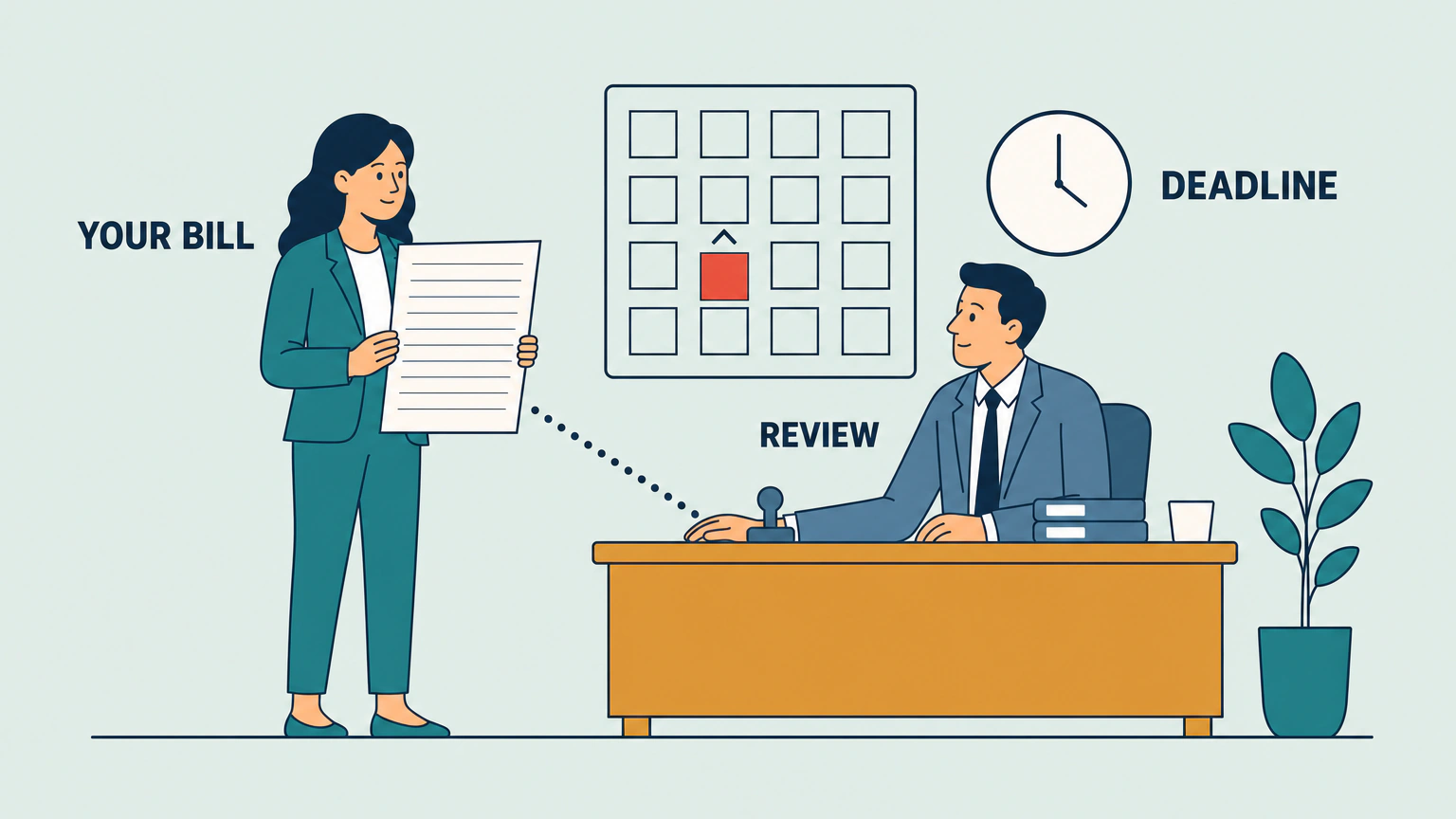
On this page
- Start here: what a law society will and will not do about your bill
- Step one: get a bill you can actually read
- The deadline in your province
- What actually happens at a review, and what it can change
- Is your bill actually unusual? A reference point before you commit
- Four situations that change the answer
- Red flags on a legal bill
- What to gather before you start
- Frequently asked questions
Start here: what a law society will and will not do about your bill
Why "complain to the law society" is the wrong first move
Regulators police conduct. Across these five provinces, most law societies will take a complaint about dishonesty, neglect, breach of fiduciary duty or misuse of trust money, and several run a compensation fund for money lost through a licensee's dishonesty. What most of them will not do is set a fee, or decide that yours was too high. New Brunswick is the exception, because its law society runs the review itself.
The one thing a law society complaint is genuinely for
If your lawyer took trust money without authority, abandoned your file or lied to you, that is conduct, and the regulator wants to hear it. File it alongside a bill review. Not instead of one.
Step one: get a bill you can actually read
What your bill is required to contain
A one-line invoice for professional services rendered is not the most you can ask for. Ontario's Solicitors Act treats an account as sufficient when it describes the work, gives the lump-sum charge and adds a detailed statement of disbursements. British Columbia's Legal Profession Act says nearly the same thing. Alberta's rules take it item by item: describe the services, show the fee, set out the disbursements separately.
Ontario adds a check you can run in seconds. The interest rate that applies to a bill has to appear on the bill you were delivered (s. 33(3)). If it isn't there, that is your first question.
Fees, disbursements and taxes are three different arguments
A disbursement is money the firm paid out on your behalf: filing fees, searches, couriers, expert reports. Arguing one was unnecessary is a different argument from arguing the hourly rate was too high, and both differ from arguing that recorded time was never spent. Keep them separate in writing.
The conversation to try before formal review
Ask for the itemized account and the time records in writing, set them beside the retainer agreement you signed when you hired the firm, and put your objection in writing too, entry by entry.
Once things turn formal, the firm has to hand this over anyway. In Alberta, a lawyer served with notice of a review must file the account, the time records and the retainer agreement, and a lawyer who doesn't forfeits the right to payment of the charges under review unless the review officer directs otherwise (r. 10.14(3)).
The deadline in your province
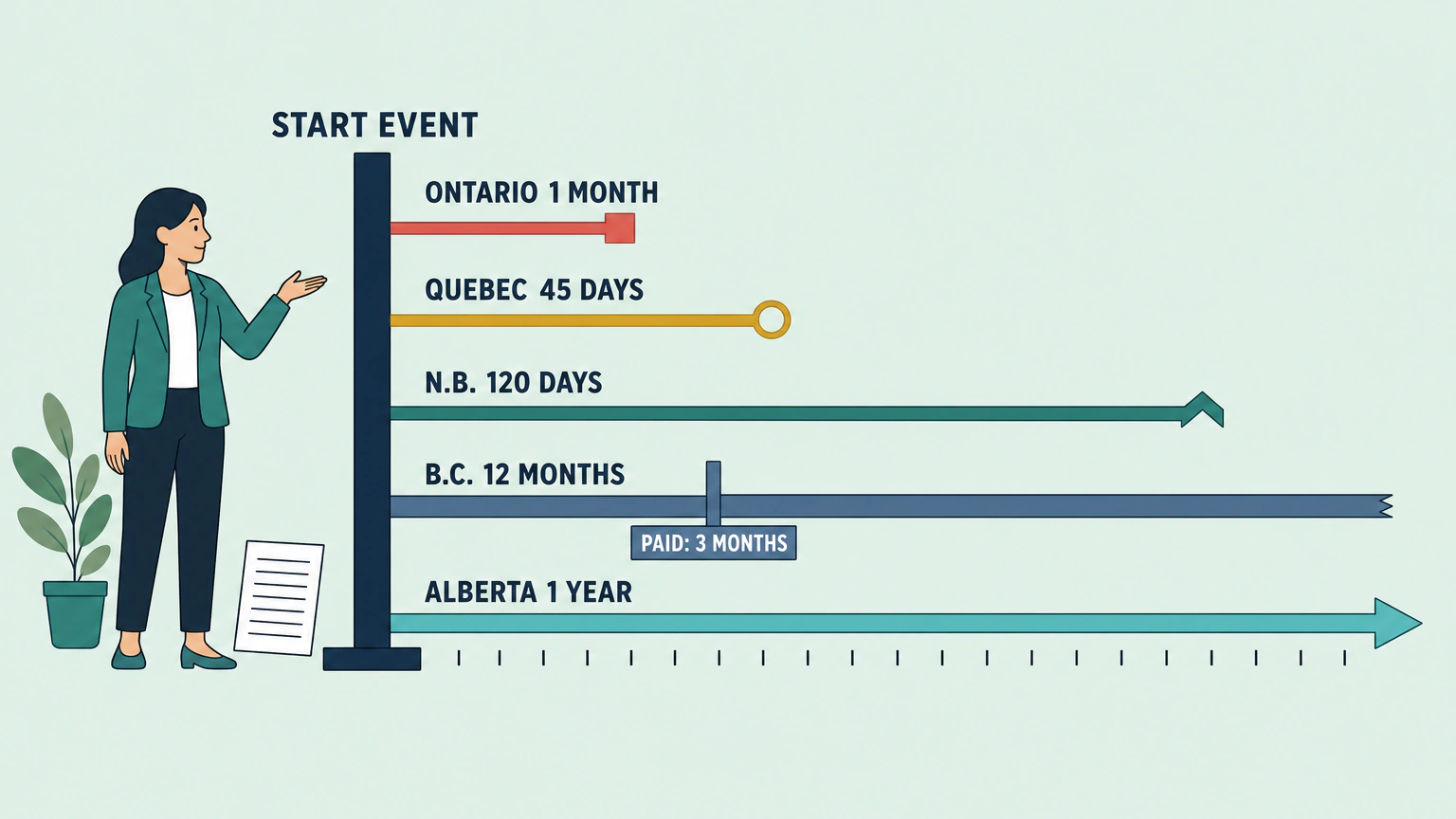
Read this part before anything else, because the strength of your argument stops mattering once the window shuts. The shortest of these windows is one twelfth of the longest.
| Province | Who reviews the bill | Deadline to start | If you are late |
|---|---|---|---|
| Ontario | Assessment officer of the Superior Court of Justice | If the retainer is undisputed and there are no special circumstances, 1 month from delivery, by requisition to a local registrar | Up to 12 months on application; beyond that, or after judgment, only on special circumstances |
| Quebec | Syndic of the Barreau du Québec (conciliation), then a council of arbitration | 45 days from receipt of the account; 30 days after the conciliation report to go to arbitration | Right to conciliation lapses; right to arbitration is forfeited |
| British Columbia | Registrar of the Supreme Court of British Columbia | 12 months from delivery or 3 months from payment, whichever comes first | Only by court order finding special circumstances |
| Alberta | Review officer at the judicial centre | Where r. 10.11 permits review in Alberta, 1 year from the date the account was sent | Review officer may extend or shorten a time period under r. 10.17(1)(h) |
| New Brunswick | Reviewing Officer appointed by the Law Society of New Brunswick | 120 days from receipt of the bill, or from payment if already paid | Only if the reviewing officer finds special circumstances |
These five are the provinces whose governing statute or rule we read ourselves. Every other province and territory runs its own process.
Ontario: one month to requisition, twelve months to apply
An assessment is a review of your account by an assessment officer of the Superior Court of Justice. If nobody is disputing the retainer and there are no special circumstances, the Solicitors Act hands you the cheap version, an order on requisition from a local registrar with no judge. That door stays open "within one month from its delivery" and no longer.
Miss it and you have lost the easy route, not the remedy: for up to twelve months you can still apply for a reference, and after that, or once your lawyer holds a judgment, only on special circumstances proved to the court. So missing the month costs you a motion. If the argument ended the relationship, compare law firms across Ontario.
Quebec: 45 days to conciliation, then 30 days to arbitration
Quebec sends you to the profession, not a court, and it moves fast. Under the Barreau's own regulation (CQLR c. B-1, r. 17), you apply for conciliation by the syndic, the Barreau's investigating officer, within 45 days of receiving the account. Already paid it, in whole or in part? The same 45 days.
If conciliation doesn't settle it, you have 30 days from the conciliation report to ask for arbitration, "failing which he or she shall forfeit the right to arbitration."
Once the syndic gives your lawyer notice, the lawyer cannot sue you for the fees, unless the syndic allows the proceedings because recovery would otherwise be jeopardized. And the size of the fight sets the size of the panel: one arbitrator below $7,000, ordinarily three at that amount or above, though all parties may request one.
British Columbia: 12 months, or 3 months if you have already paid
Two limits run at once, and the Legal Profession Act picks the winner in three words: "whichever occurs first". Twelve months from delivery. Three months from the day you paid.
So paying does not protect your window. It swaps it for a shorter one.
Once you are outside those limits, or once your lawyer has judgment, you need a court order and special circumstances. One rule works in your favour: apply for the review and a collection lawsuit cannot proceed until the registrar certifies or you withdraw. The Legal Professions Act [SBC 2024] c. 26 will eventually replace this regime, but Parts 1 to 17 of it are not in force, so the 1998 Act governs your bill today.
Alberta: one year from the date the account was sent
Alberta counts from the day the account was sent, not the day you opened it, and after one year the Rules of Court bar a review at either side's request. That assumes Alberta is the right place for the review at all, which r. 10.11 decides.
Watch one trap: a neighbouring subsection sets six months to challenge a retainer agreement after it has terminated. That is the agreement, not the account. Two clocks, two documents.
There is an escape hatch: a review officer can rule on whether a time period applies and extend or shorten it. You start with a notice of appointment in Form 42, before a review officer at the judicial centre.
New Brunswick: 120 days, and the law society runs it
Here your instinct is right. The Law Society of New Brunswick runs the review itself, under Part 14 of the Law Society Act, 1996 and its Rules for the Review of Lawyers' Bills.
By the society's own account, you have 120 days from the day the bill is received, or from the day it was paid if you have already paid it, and only a reviewing officer can find the "special circumstances" that stretch that period. The Reviewing Officer is an independent third party who can reduce the bill or confirm it, and where a paid bill is reduced, the lawyer is ordered to repay. The Law Society adds that you do not need to hire a lawyer to do this.
Every other province and territory: how to find your rule
We stopped at five because five is what we read. A guessed sixth would serve you worse than an admitted gap.
Open your province's official legislation site, find the law society statute or the rules of court, and search for "review", "assessment" or "taxation" of a lawyer's account. Then phone the registry or the law society and have somebody confirm the limit for you.
That last call matters more than it sounds. Newfoundland and Labrador's Law Society Act, 1999 lets a bill of fees be taxed before a master of the Supreme Court on five clear days' notice, makes anything above the taxed amount unrecoverable, refundable where it has already been paid, and open to appeal. What the section never states is a time limit. Which is exactly when you phone rather than assume.
What actually happens at a review, and what it can change
The lawyer has to justify the bill
People get this backwards. You are not there to audit the account. Your lawyer is there to prove it.
British Columbia spells the test out most fully, at s. 71(4). The registrar weighs all the circumstances: how complex, difficult or novel the issues were, the skill and specialized knowledge the work required, the lawyer's character and standing, the amount involved, the time reasonably spent, whether an hourly rate was reasonable, how much the matter mattered to you, and the result obtained. Alberta's rules list six factors of their own.
Your fee agreement does not settle it
The firm may point at the retainer you signed. That doesn't end it. In British Columbia the registrar's discretion "is not limited by the terms of an agreement between the lawyer and the lawyer's client", and Alberta puts both the retainer agreement and the charges up for review "despite any agreement to the contrary."
Signing the retainer did not sign away the review.
What you get if you win, and what it costs if you do not
In Ontario, whatever the assessment shows you overpaid comes back, with interest running from the day you paid it, and the officer's report is final and conclusive as to the amount unless it is set aside or varied. That last part cuts both ways. British Columbia is blunter still: anything the firm received or kept above the amount allowed must be refunded on demand.
Pro tip: in British Columbia, the size of the win decides who pays for it. The Legal Profession Act draws a bright line at s. 72(1). Knock one-sixth or more off the total bill and the lawyer pays the costs of the review. Knock off less than one-sixth and you pay them. Apply and then withdraw, and you pay as well. One-sixth is about 16.7%, but that cost-allocation rule alone does not determine whether a review is financially worthwhile. The registrar keeps a discretion in special circumstances. None of the other four provinces we read publishes anything like it.
Is your bill actually unusual? A reference point before you commit
Work out first whether the number is strange or merely large.
| Category | Our profile average | Displayed range | Cost profiles |
|---|---|---|---|
| Family law | $6,304 | $3,153 to $21,011 | 950 |
| Divorce and separation | $6,243 | $4,683 to $8,844 | 881 |
| Criminal defence | $5,780 | $3,678 to $6,304 | 592 |
| Probate and estate administration | $4,244 | $3,183 to $5,304 | 743 |
| Employment | $562 | $410 to $716 | 871 |
| Estate planning | $426 | $320 to $1,062 | 860 |
These are our own aggregates of our own cost profiles, not a survey of the Canadian legal market. The panel adapts to your location, so your figures may differ from ours.
Read the spread, not the average. Family law alone runs from $1,787 to $42,021 across 950 profiles, so a bill well above the average is not by itself a wrong bill. The category matters far more than the lawyer. Our profile averages are $426 for estate planning lawyers and $562 for employment lawyers. They reach $5,780 for criminal defence lawyers and $6,304 for family lawyers across Canada.
None of that decides a review. The reasonableness test does. These figures answer one question: whether your bill is worth the argument.
Four situations that change the answer
Four things move the deadline, the forum or both.
You have already paid the bill
Paying is not agreeing, and Ontario says so outright: "the payment of a bill does not preclude the court from referring it for assessment if the special circumstances of the case, in the opinion of the court, appear to require the assessment."
Quebec's 45 days apply to an account you have already paid. Where your lawyer took the money out of funds already held for you, the clock runs from the day you became aware of it.
But British Columbia starts a three-month clock on payment, while New Brunswick starts a new 120-day period from payment, so paying changes the date you must track.
Your bill came from an Ontario paralegal, not a lawyer
Ontario licenses paralegals to serve clients independently, and the assessment route was built for solicitors. That mismatch changes your address.
Steps to Justice, the public legal information service run by CLEO, sends a paralegal billing dispute to a lawsuit instead: Small Claims Court up to its limit of $50,000, and the Superior Court of Justice above that. The Solicitors Act reaches licensed paralegals for one purpose only, applying its contingency-fee provisions to them with the necessary modifications.
Your bill is under a contingency fee agreement
A contingency fee agreement pays your lawyer a share of what you recover instead of an hourly rate, and Alberta wraps it in protections an ordinary retainer never gets. Someone has to watch you sign it. A signed copy has to reach you within 10 days. And for 5 days after that service you can end the agreement with no liability for the lawyer's fees at all, though you still reimburse reasonable disbursements.
Then there is the line to look for on the account itself. Every account under the agreement must tell you that a review officer may assess both the account and the agreement. An account that omits it is of no effect, unless the court is satisfied that the omission was inadvertent and the client was not prejudiced, and then waives the non-compliance.
The lawyer has already sued you for the fees
In most of these jurisdictions the review goes first and the lawsuit waits. British Columbia halts the collection suit until the registrar certifies or the application is withdrawn. Quebec bars recovery proceedings once the syndic has given notice, unless the syndic allows proceedings because recovery would otherwise be jeopardized. Ontario bars the solicitor from prosecuting an action on the referred matters without leave.
Once a judgment has been obtained it gets harder, because British Columbia then wants special circumstances. Speed matters.
Red flags on a legal bill
Red flags: five things worth a question
- A lump sum with no detailed statement of disbursements attached, when the Ontario and British Columbia statutes and the Alberta rules all contemplate that detail.
- Interest charged on a bill that never showed the interest rate on its face, which Ontario requires.
- Time billed at a lawyer's rate for work the file shows a student or an assistant did.
- An account under a contingency fee agreement that never tells you a review officer can assess it, because in Alberta that omission can make the account of no effect.
- A firm that will not produce time records after you ask in writing.
Any one of them is a reason to request the itemized account. None is proof of anything on its own.
What to gather before you start
Collect these before you contact anyone.
- The signed retainer agreement, including any contingency fee agreement and any later amendment.
- Every account the firm has sent you, interim as well as final, with the delivery date of each.
- The date each bill was delivered, received or sent, as your province's rule specifies, and the date you paid any part of it, because those events can start clocks.
- The firm's itemized account and time records, requested in writing if you do not already have them.
- A separate list of disbursements with what each one was for.
- Any written estimate, fee quote or scope of work you were given at the outset.
- Your written objection, setting out the specific entries you dispute and why.
- The name of your province's reviewing body and its current time limit, confirmed by phone.
Frequently asked questions
Can I refuse to pay my lawyer's bill?
You can, but it is the weaker move. Refusing to pay is not the same as challenging the bill: the firm can sue you, and interest can keep running. Ontario bars an action for fees until a month after delivery, and British Columbia bars a collection suit for 30 days, unless the court permits an earlier suit where the client is about to leave the province. Use that time to ask for a review.
Can you sue a lawyer for overcharging?
It depends on the bill and the jurisdiction. Three questions have three different homes: a bill review can decide the amount, a law society complaint can decide whether conduct broke the rules, and a negligence claim can decide whether the work caused you loss. An Ontario paralegal billing dispute may instead proceed by lawsuit.
What happens if I genuinely cannot pay?
Say so early, and say it in writing. Alberta requires the review officer to consider the circumstances of the client, and in British Columbia the registrar can order that a party be permitted to pay money in instalments, on terms the registrar considers appropriate. We'd put it in writing the same week.
I already paid — is it too late?
Not necessarily, though paying can shorten your window rather than protect it. Ontario lets a court refer a paid bill for assessment where special circumstances require it, and Quebec's 45 days apply to accounts already paid. British Columbia starts a three-month clock from payment, while New Brunswick uses a 120-day period from payment. Work out which of those describes you first.
Will I get my file back if I challenge the bill?
In Ontario, yes, once the money question is settled. The Solicitors Act provides that on payment of whatever is found due, or if nothing is found due, the solicitor must on request deliver up all deeds, books, papers and writings belonging to the client. There, at least, the file is not leverage the firm gets to keep while you argue.
Can the law society refund my money?
Usually only in a narrow case. Several law societies operate a compensation fund for clients who lost money through a licensee's dishonesty, such as misappropriated trust funds. That is not a compensation-fund route for a bill you simply think is too high. In New Brunswick, though, the law society itself administers the review process, and a Reviewing Officer can order repayment if a paid bill is reduced.
Can my lawyer charge interest while we argue?
In Ontario, yes, within limits. Interest on unpaid fees runs from a date one month after the bill is delivered, and the rate that applies has to be shown on the bill you were delivered. The assessment officer can then disallow it or vary it. So interest is a reason to move quickly, not a reason to pay a bill you believe is wrong.
Do I have to hire another lawyer to do this?
No. The Law Society of New Brunswick states plainly that it is not necessary to hire a lawyer to apply for its review. Where the amount is large, some people do retain counsel, and an Alberta review officer can allow it.
The next step takes an afternoon. Find the date on your most recent account, count forward under your province's rule, then phone your court registry or law society and have them confirm that limit before you rely on it. If you are already past it, ask anyway: in four of these five jurisdictions a late review may still be possible, but only through an extension, permission or a special-circumstances route.
We are not your lawyer, and this is general information about a procedure rather than advice about your bill. Your own documents settle the part that matters most, like the day a bill was delivered or whether an account was interim or final. More about the site is on the who we are page.