

On this page
The short answer, and why it surprises people
Someone has handed you a number. A cheque from a bank, a line on an estate summary, a share of the house you grew up in. And someone else, a cousin or a teller or a friend who has done this before, has already given you the confident version: there's no inheritance tax in Canada, so it's all yours.
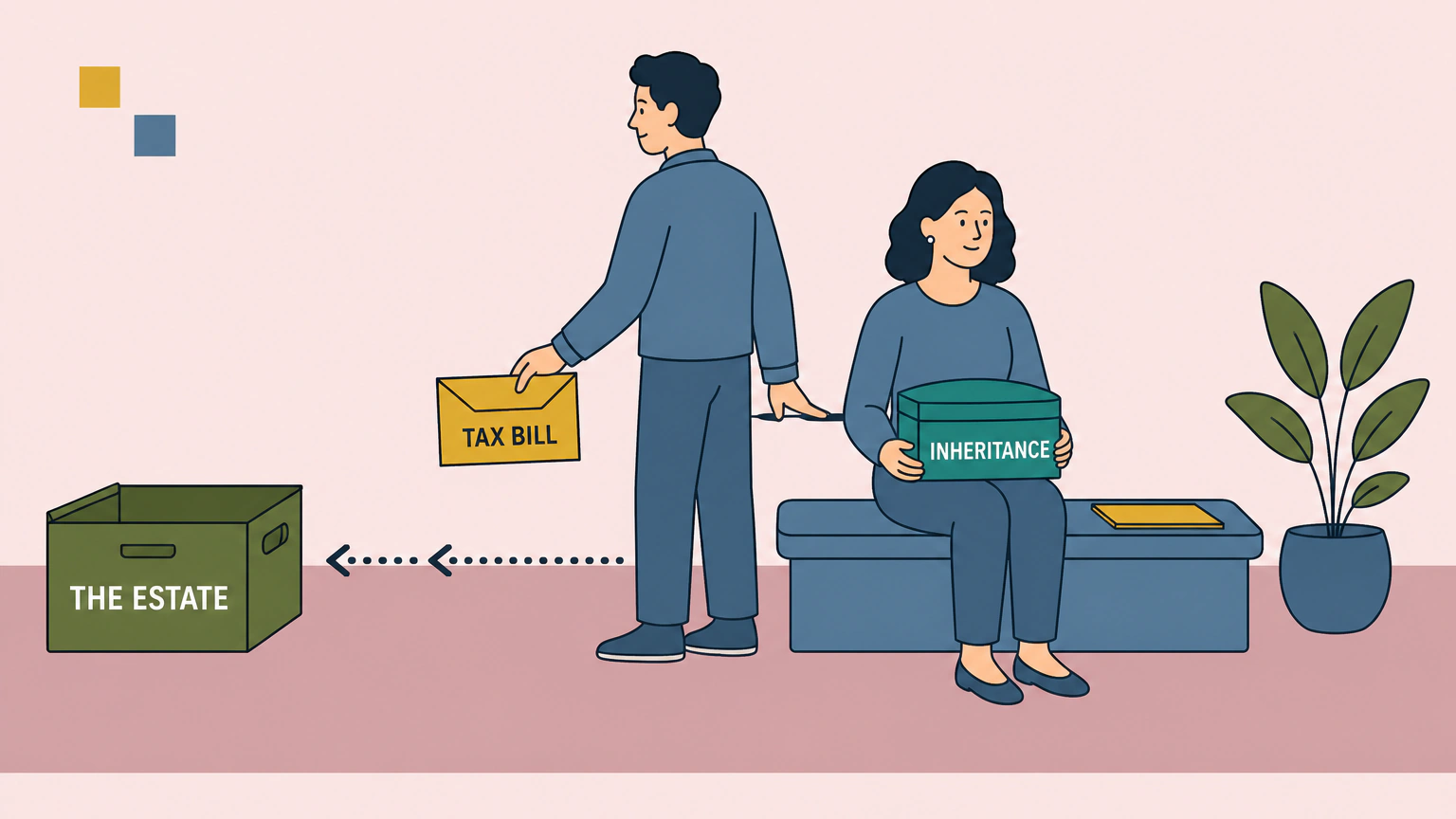
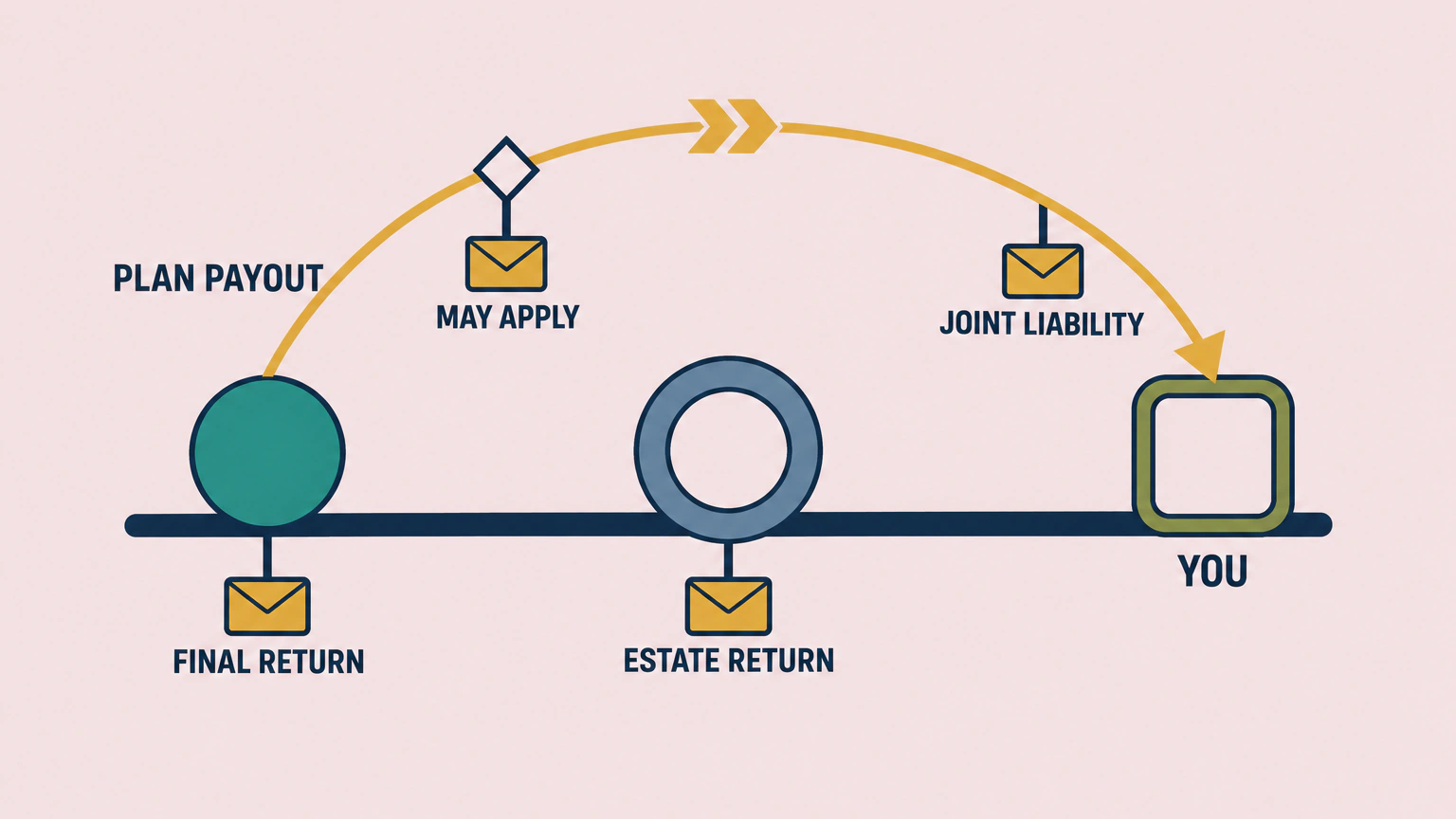
They're mostly right. Canada has no inheritance tax, and you usually do not report an inheritance as income. The estate normally pays what the person who died owed before it distributes the rest. A registered plan payout can carry joint liability. An executor can face a tax bill by paying too soon. Income earned after death and foreign asset reports can create duties of your own.
Here are the four, so you know where this is going. Money paid straight to you out of a registered plan. An estate you cleared out too fast, if you're the executor. A TFSA that kept earning after the death. Property sitting outside Canada. Each follows a different rule, and the useful check comes before you spend or distribute the money.
What Canada has instead of an inheritance tax
Canada does not charge a recipient simply for receiving most inheritances. Instead, the deceased's final return reports income to the date of death, and the estate reports income it earns afterwards. By the time most assets reach you, those returns have usually dealt with the tax attached to them.
The CRA says so in plain words. Its list of amounts you don't report as income includes "most gifts and inheritances", with one line attached that does the real work: "Income earned on any of the above amounts is taxable." The inheritance is clean. What it earns from the day it lands is yours to report.
None of this touches the separate question of whether you are an heir at all, which is provincial law and a different fight. Assume from here on that you are.
So the inheritance itself is usually tax free to the recipient. The next sections cover the places where a separate tax or filing duty can still appear.
Who gets the tax bill, and in what order
This part of the answer is federal. The Income Tax Act and the CRA apply across Canada, while provincial law still controls the estate process and some recipient names on the forms. Money can move through three tax stages after a death. Each stage has its own return, filer and deadline. Executors get into trouble when they collapse the three into one.
| Who files | Which return | What goes on it | When it is due |
|---|---|---|---|
| The person who died | Final T1 return | Income up to the date of death, deemed dispositions of capital property subject to rollovers and exemptions, and registered-plan amounts required by the death rules | Usually 30 April of the following year, or six months after death for a death from 1 November to 31 December. If the deceased or their cohabiting spouse or common-law partner carried on a business, the filing date is 15 June for a death from 1 January to 15 December, or six months after death for a death from 16 to 31 December. The balance-due date does not get the June extension |
| The estate | T3 trust return | Income the estate earned after death, and gains or losses on property it sells before distribution | Usually 90 days after the estate's tax year end, or 90 days after its final distribution if it ceased during the year. An estate that qualifies as a graduated rate estate can set its first year end on a date no later than one year after death |
| You, the beneficiary | Usually none for the inheritance itself | Most inheritances are not reported as income. You report later earnings and gains, while registered-plan and other special death payments can follow separate rules | Your own return, on the ordinary schedule |
Optional T1 returns exist for rights or things and certain business income, and they carry their own dates. Income earned by the estate after death belongs on a T3.
The final return, where capital property is sold on paper
The Act generally treats a person as having disposed of each capital property just before death. Section 70(5) says they are "deemed to have, immediately before the taxpayer's death, disposed of each capital property" at fair market value. Nothing has to change hands. A gain or loss can still land on the final return, unless a rollover or another exception applies.
That can catch the cottage, the rental, a nonregistered portfolio and shares in a private company. A principal residence is still deemed disposed of, although a designation may exempt some or all of its gain. The final return often needs Schedule 3 and Form T1255 when this rule applies. A qualifying transfer to a Canadian resident spouse, common-law partner or spousal trust can instead carry over the deceased's tax cost. The assets often must vest in the survivor or trust within 36 months. The CRA may allow more time, and the executor can opt out of the rollover.
The RRSP that can turn into one year of income
For an unmatured RRSP, the general rule treats the fair market value at death as an amount received just before death and includes it on the deceased's return. Say the plan holds $300,000. Without an available exception, reduction or transfer, that amount can land in one tax year instead of being spread over retirement.
A spouse or common-law partner may qualify for an exception or a tax deferred transfer. The recipient, election and transfer rules must be met. A child or grandchild who relied on the deceased for support may also qualify. The route depends on age, disability and where the funds go. Matured RRSPs and RRIFs have their own rules.
And here's the detail the rest of this page turns on. Who receives the plan amount can change which return reports it, whether a transfer or refund rule is available, and who may share liability for the year of death tax.
The estate's own return, for money that arrives after the death
An estate is a taxpayer. That surprises people, because it feels like a paperwork stage rather than something with income of its own. But money keeps moving between the date of death and the day assets are handed out. Interest accrues, dividends land, a tenant pays rent. If the executor sells something before distributing, there's a gain or a loss on that sale. All of it belongs to the estate, and it goes on a T3 trust return: not on the deceased's final return, and not on yours.
An estate can use graduated rates for up to 36 months only if it meets the Act's graduated rate estate conditions. It must be a trust made by the will. It must give the deceased's SIN on its returns, name itself on the first return and be the only estate to do so. A qualifying estate can set its first tax year end on a date no later than one year after death. Its T3 is often due 90 days later.
Probate fees are a separate bill, and your province sets it
Everything above is federal. This part isn't. Probate charges are provincial or territorial and separate from income tax. Ontario's Estate Administration Tax applies when an estate certificate is applied for and issued. Other jurisdictions use their own rules, which may connect the charge to residence, local assets or the type of grant.
An Ontario estate worth $50,000 or less pays nothing. Above that, the province charges $15 for every $1,000 of estate value, or part of a thousand, with the total rounded up. On the ministry's own worked example, an estate of $240,000 pays nothing on the first $50,000 and $15 per thousand on the remaining $190,000, which comes to $2,850.
We checked Ontario's rule and we haven't checked the other twelve. Every province and territory sets its own, and they don't match. Look up yours before you budget for it, because there's no national number to fall back on.
Four ways tax or a filing duty can still reach you
Now the part the confident version leaves out. The estate usually pays death-year tax, but that does not end every recipient or executor exposure.
Each situation follows a different rule. The useful question is what to check before money is spent or distributed.
You were named on the RRSP or the RRIF
Start with what makes this counterintuitive. An RRSP amount paid directly to a named recipient may bypass the estate process. The part reasonably regarded as already included in the deceased's income is often not taxed again to the recipient. But after death earnings, refunds of premiums and qualifying transfers can still appear on the recipient's return.
Meanwhile the tax that plan created sits on the final return, and the estate is expected to pay it. Usually it does, and that's the end of the story.
Section 160.2 can create joint liability as soon as the law's tests are met. It does not wait for the CRA to prove that the estate cannot pay. The Act says "the taxpayer and the last annuitant under the plan are jointly and severally, or solidarily, liable" for part of the annuitant's year of death tax. The Minister can assess that liability at any time.
Read the limits just as carefully. The formula starts with the extra tax caused by the plan amount in the year of death. It then splits that tax by the amount each recipient got. It is not automatically the whole estate's tax bill or the whole payout. It covers the part left out of the recipient's income because the death rules put it in the annuitant's income. Refunds of premiums to qualifying survivors follow separate inclusion, election and transfer rules. An independent adult child falls outside the qualifying survivor definition unless the financial dependence test is met.
The prevention costs nothing. Before you spend the payout, ask the executor two things: is the final return filed, and is the tax on it paid. And if you're on the other side of this, drafting your own paperwork, that same gap is worth an hour with an estate planning lawyer. Naming a beneficiary and naming an heir aren't the same act.
You are the executor and you paid people early
This one is written into the Act and repeated by the CRA in almost the same breath. Section 159(2) tells a legal representative to get a certificate before distributing anything. Section 159(3) says what happens if you don't: "the legal representative is personally liable for the payment of those amounts to the extent of the value of the property distributed". The CRA puts it as personal liability "up to the value of the amount of assets distributed".
The form is called CRA clearance, and the sequence trips people up. You don't request it alongside the returns. You file every required return, wait until each is assessed or reassessed, pay or secure the balances, file the required legal documents, then ask for it. It confirms the amounts covered by the request have been paid or secured before you pay out the assets it covers.
Budget the wait honestly. The CRA sends an acknowledgement letter within 45 days, and the assessment can take up to 120 days once it has every document it asked for. An audit or missing material can stretch that.
Here's why it's worth waiting even when the estate is simple. Once the certificate is issued, the CRA says the liability "then rests on the estate, trust, corporation, beneficiaries, or other people who have received the distributed assets". It moves off you. That's the reason executors wait, and nearly every guide on this subject leaves it out.
Red flag: Don't distribute on the strength of a notice of assessment alone. A certificate protects you when you distribute the assets it covers. If new assets turn up, you need fresh clearance before paying them out. If a recipient is pressing you to release money early, get advice on the amount to reserve and put the reason in writing. You cannot unring the bell once the money is gone.
The TFSA kept earning after the death
The date of death value paid to a designated recipient is usually not taxable. What happens to later earnings depends on the TFSA arrangement and whether there is a valid successor holder.
A deposit or annuity contract with no successor holder stops being a TFSA at death. Earnings paid after death are often taxable to the recipient. A trust arrangement can continue through its exempt period, with different rules for income paid or retained. If a spouse or common-law partner becomes a valid successor holder, the account and its shelter continue.
Quebec does not recognize a TFSA successor-holder designation. A surviving spouse or common-law partner there may still have other contribution treatment, but should not rely on the account carrying on automatically.
The money or the property sits outside Canada
Inheriting from abroad, or inheriting a foreign asset, doesn't create Canadian tax when you receive it. The receipt is as clean as any other inheritance. What it can create is a filing duty, and the penalty attached to it is for failing to file, not for owing anything.
A Canadian resident often files Form T1135 if the total cost of specified foreign property tops $100,000 at any time in the year. The test is aggregate cost amount, not current market value. Property acquired by inheritance starts with a cost amount equal to its fair market value when received, while later market growth alone does not change that cost. Personal use property is left out only when it is used mainly for personal use or enjoyment. A holiday home therefore needs a check of the facts.
What you owe later, on what you inherited
Receiving most inheritances does not itself create income tax. But a registered plan payment can carry joint liability, and an inherited asset can create income or a gain after it becomes yours.
Your cost is often the value on the day they died
When section 70(5) applies to capital property, the person who acquires it usually gets a cost equal to fair market value just before death. A qualifying spousal or common-law partner rollover can instead carry over the deceased's tax cost, and other specific rules can also change the result.
If the fair market value rule applies, the recipient's later gain starts from that value, not from the deceased's old purchase price. Under a rollover, the old cost can still matter.
Record the date of death value of inherited assets and keep the appraisal, statement or other support. Also keep the executor's or preparer's explanation of any rollover or other rule used to set your tax cost. Those records can matter years later.
The cottage, the rental and the shares
If the house received a fair market value cost at death, a sale soon afterwards may produce little or no gain. Market movement, selling costs and the cost rule that applies still have to be checked before assuming the result.
Hold the property and the picture changes, slowly. Every year of growth from that date-of-death value is a gain waiting on the eventual sale. Move into it and you raise a principal residence question that turns on your own years of use. That's a conversation to have with a professional.
Keep an inherited rental and the rent is your income from the day the property is yours, reported like other rental income. For a house or shares acquired at fair market value under section 70(5), the later gain often starts from that value. A rollover can carry a different cost.
If you are the executor, two dates and one certificate
If you're at a kitchen table with a new file, start with the dates that apply. Then plan for CRA clearance. The normal final return is due on 30 April of the next year. For a death from 1 November to 31 December, it is due six months after death. A different date applies if the deceased or their cohabiting spouse or common-law partner ran a business. It is 15 June for a death from 1 January to 15 December. It is six months after death for a death from 16 to 31 December. A T3 is often due 90 days after the estate's year end, or after final distribution if the trust ceased. Ask for it after the returns are assessed or reassessed and the balances are paid or secured. It protects a payout of the assets it covers.
We're not your lawyer or your accountant, and an estate is one of the few jobs where a cheap mistake is expensive to undo. If anything here is close to your situation, take the file to a professional before you sign or pay anything out.
The rest is bookkeeping and patience. This is the order we'd work in.
- Tell the CRA the date of death early, and get yourself recognized as the legal representative before you need anything.
- Work out which final return deadline applies, including the separate rule when the deceased or their cohabiting spouse or common-law partner carried on a business.
- Get a written date-of-death value for every asset and keep what supports it. Beneficiaries will need those numbers for years.
- Check the RRSP, RRIF and TFSA beneficiary or successor designations, the plan type and the province. Those facts change which reporting, transfer and liability rules apply.
- File every required return, wait for each assessment or reassessment, pay or secure the balances and file the required legal documents before requesting CRA clearance.
- Budget the wait. The CRA acknowledges a request within 45 days, and the assessment can take up to 120 days.
- Do not distribute before the certificate arrives. If something must go out early, keep a reserve and record why in writing.
- If new property turns up after the certificate is issued, get another one before you distribute it. This is where a lawyer who handles estate administration usually saves more than they cost.
What it costs to get this filed properly
A deemed sale, an estate T3 and CRA clearance request can involve different records and deadlines. Compare the cost of help with the tax risk before deciding what to handle yourself.
Across the quotes people have asked for through us, what a tax preparer charges runs $311 to $671, based on 567 cost profiles. Step up to an accountant who has filed a T3 before and the range is $369 to $790, based on 686 cost profiles. Those are our own figures, an aggregate of quotes on our own platform. They aren't a national market rate, and they aren't a quote for your estate.
Now look at the other side of the ledger. Section 159(3) exposure runs up to the value of everything you distributed. Ontario's probate charge on a $240,000 estate is $2,850 on its own. And section 160.2 exposure can be substantial if a registered plan payout has already been spent.
So the next move is the cheap one, and it's the same move whichever chair you're in. Before a dollar leaves the estate, ask whoever is filing whether the final return is done and whether the certificate has been requested. If the answer is no, leave the money where it is for now.
Questions people ask
Do I have to claim an inheritance on my taxes in Canada?
Usually not. The CRA's list of amounts you don't report as income names most gifts and inheritances. You report what an asset earns after it becomes yours, including interest, dividends and rent, plus any taxable gain when you sell. Registered plan and other special death payments can follow different rules.
Who pays the taxes on an RRSP when a person dies?
The estate usually pays tax reported on the deceased's final return. An RRSP or RRIF death payment can be reported differently when a spouse, common-law partner or other qualifying survivor meets the rules. A direct recipient can also be jointly liable under section 160.2 for part of the year of death tax when that section's conditions are met, whether or not the CRA has first tried to collect from the estate.
Can an estate pay the tax instead of the beneficiary?
Yes. The estate normally pays tax reported on the final return before paying out assets. But section 160.2 joint liability does not wait for the estate to become unable to pay, and CRA clearance does not replace the registered plan rules. The safe estate sequence is to file every return, obtain the assessments or reassessments, pay or secure the balances, obtain clearance, then pay out the assets it covers.
Do I pay tax on an inherited house when I sell it?
If section 70(5) gave you a cost equal to fair market value at death, your later gain usually starts from that value. A qualifying spousal or common-law partner rollover can instead carry the deceased's tax cost, so the original cost may still matter. Confirm the cost rule used before calculating the sale.
How long does a clearance certificate take from the CRA?
The CRA sends an acknowledgement letter within 45 days, and says the review itself can take up to 120 days once it has every document it asked for. An audit, a missing return or an unclear asset stretches it further. Plan the estate around several months of waiting after the returns are assessed, and tell the beneficiaries that number early.
What happens to a TFSA when the holder dies?
The date of death value paid to a designated recipient is usually not taxable. Without a valid successor holder, a deposit or annuity contract stops being a TFSA, while a trust arrangement can continue through an exempt period under separate rules. A valid spouse or common-law partner successor holder continues the shelter, but Quebec does not recognize that designation.
What happens if an executor distributes assets before the taxes are paid?
The executor can become personally liable for unpaid amounts, up to the value of assets paid out without the needed clearance. A clearance certificate protects the executor when distributing the assets it covers. If new assets turn up later, fresh clearance is required before they are distributed.