

On this page
- The short answer, and what you're actually charged with
- What counts as careless driving
- What a conviction carries today
- Ticket or summons: read what you were handed
- If someone was hurt or killed
- Where the criminal line sits
- The 2026 changes: a bigger fine and a roadside suspension
- What to do before the 15 days run out
- Questions people ask
The short answer, and what you're actually charged with
You're holding a careless driving ticket or summons in Ontario, probably after a collision, and a search on the charge turned up the word "jail". The first thing you want to know is whether this is a crime.
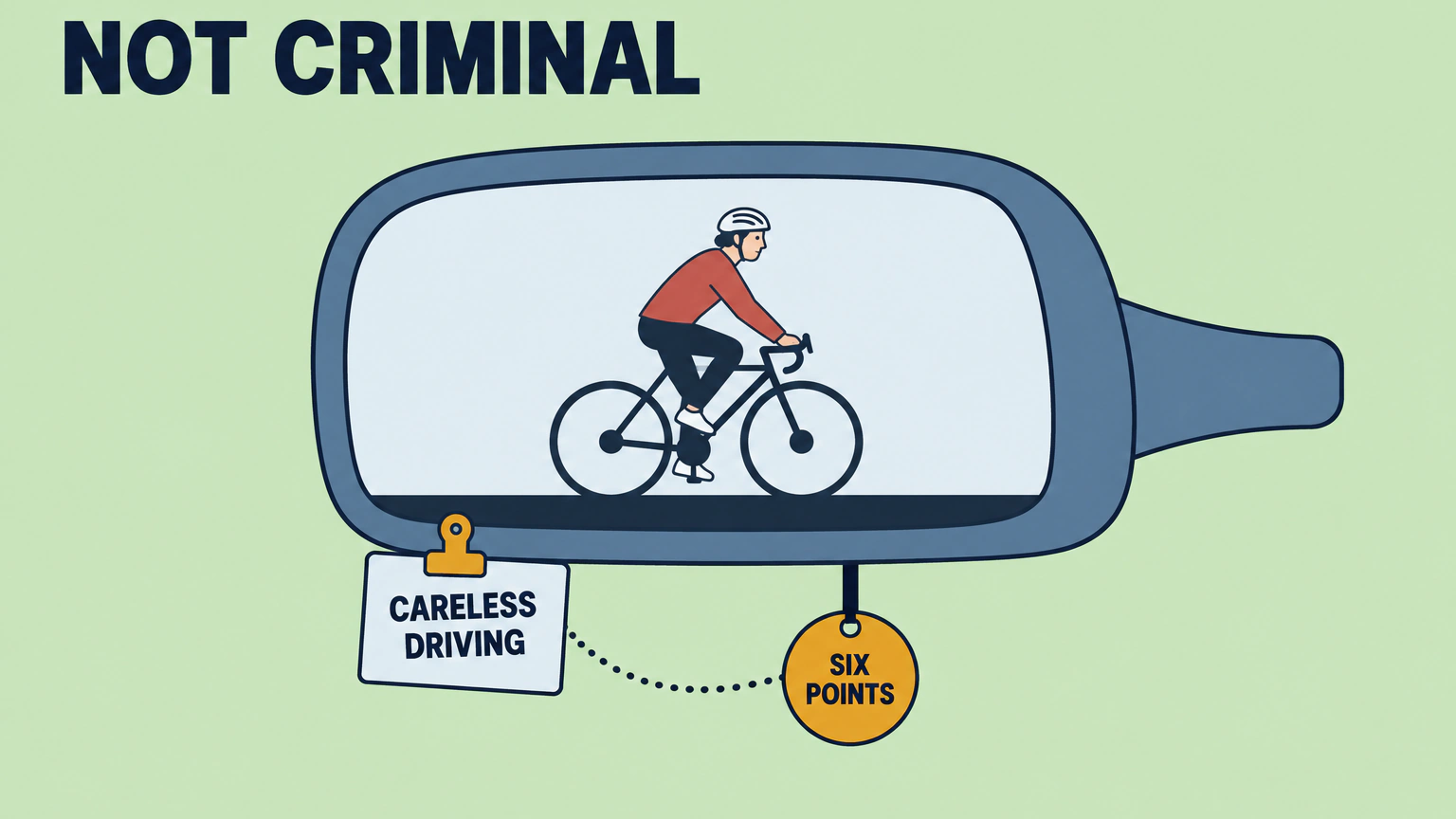
No. Careless driving isn't a criminal offence in Ontario: it's a charge under the Highway Traffic Act, and a conviction today carries a fine of $400 to $2,000 and six demerit points, with up to six months in jail and a licence suspension of up to two years at a court's discretion. If you were handed a ticket, paying the $490 on it is a guilty plea, so decide what you're doing before you pay.
The charge is section 130 of that Act. It's heard in provincial offences court, so a conviction isn't a criminal conviction and leaves no criminal record. It goes on your driving record instead. It's still one of the Act's heavier charges: six points, a licence suspension a court can order, and jail written into the section.
There's also a more serious version, careless driving causing bodily harm or death, and we'll come to it. Right now your decision is narrower: pay, meet the prosecutor, or ask for a trial. On a ticket, you have 15 days to choose.
What counts as careless driving
The offence is defined in one sentence of the Act. That sentence changed in December 2024.
The words in the Act, and how courts read them
Section 130(1) makes it an offence to drive "without due care and attention or without reasonable consideration for other persons using the highway or specified place". That's two tests. One is attention: you weren't paying the attention the moment called for. The other is about other people: you didn't leave them the room they were owed.
Another rule stretches the test about other people. You're treated as driving without reasonable consideration if you drive "in a manner that may limit" your "ability to prudently adjust to changing circumstances". That's how following too closely, or driving too fast for an icy road, ends up here.
The section never mentions a collision. Police can lay the charge without one. Even after one, the charge still has to be proved against those words. Canada's Supreme Court has said a brief lapse can be enough: "Even good drivers are occasionally subject to momentary lapses of attention. These may, depending on the circumstances, give rise to civil liability, or to a conviction for careless driving."
Ontario courts treat careless driving as a strict liability offence. The prosecutor has to prove the careless driving itself. Then it's open to you to show you took all reasonable care.
Two things changed in December 2024
First, where it applies. Until 4 December 2024 the offence covered driving "on a highway", which the Act defines as roads, streets, bridges and similar places "intended for or used by the general public for the passage of vehicles". It now covers a "specified place" too. In plain words, that's any parking lot, parking structure or garage, public or private, with the driveway or road linking it to the street; any lot drivers are invited or allowed into, paid or free; and any private commercial or industrial lot the public is normally kept out of. If a page tells you a parking-lot collision can't be careless driving, it's describing the law before December 2024.
Second, how long police have. Where no other limit is set, a provincial offence has to be charged within six months. Careless driving now has its own limit: no proceeding "more than two years after" the events. A ticket still has to be handed to you within 30 days of the offence, though. So a charge that arrives months after a collision comes as a summons, started under Part III of the Provincial Offences Act.
What a conviction carries today
The Act sets a range and a court picks a penalty inside it, so these are limits, not a forecast. They're also today's limits. A 2026 law raises the fine once it takes effect, and that day hasn't come.
| Careless driving | Careless driving causing bodily harm or death | |
|---|---|---|
| Where it is in the Highway Traffic Act | Section 130(1) and (2) | Section 130(3) and (4) |
| Fine | $400 to $2,000 | $2,000 to $50,000 |
| Fine if it happened while a community safety zone was in effect | $800 to $2,000 | $4,000 to $50,000 |
| Jail | Up to six months | Up to two years, or up to six months if a community safety zone was in effect |
| Licence suspension a court can order | Up to two years | Up to five years |
| Demerit points | Six, unless the court suspends your licence or the novice-licence rule applies | Six, unless the court suspends your licence or the novice-licence rule applies |
| Can you pay a set fine and skip court? | Yes, if you were given a ticket: $400 set fine, $490 total payable | No. There is no set fine, so it always goes to court |
| Time limit for laying the charge | Two years | Two years |
One condition sits behind the heaviest of those penalties. Jail, and any fine above $1,000, need a charge started under Part III, and a ticket can't lead to either. Which kind you have depends on the paper in your hand.
What the total on a ticket is made of
The set fine for careless driving is $400. The $490 total payable on the ticket adds an $85 victim fine surcharge and $5 in court costs. Ontario puts the surcharge on top of fines for provincial offences, and it grows with the fine: $125 on a fine of $501 to $1,000, and on a fine over $1,000 it's a quarter of the whole fine.
The set fine is what you pay to plead guilty out of court. Before a justice, the fine is the justice's call, within limits that depend on how the charge was started. If the offence happened while a community safety zone was in effect, the minimum doubles to $800 and the maximum stays at $2,000. The bodily harm or death version has no set fine at all.
Six demerit points, and what six points gets you
Careless driving carries six demerit points, among the highest on Ontario's scale. They're recorded from the date of the offence, not the conviction, and they count for two years.
For a fully licensed driver, six to eight points brings a letter from the Ministry of Transportation. At nine, the Ministry can call you in for an interview, and it can suspend your licence if you don't attend or don't satisfy it. At fifteen, your licence is suspended, for 30 days the first time. So one conviction on a clean record means a letter, and a second worth three points or more inside two years puts you at nine.
One rule almost nobody mentions: if the court suspends your licence as part of the sentence, the points aren't recorded.
Careless driving can suspend a novice licence for at least 30 days
Novice drivers face a separate rule. If you hold a G1, G2, M1 or M2 licence, the rule covers any Highway Traffic Act offence worth four or more points. It suspends your licence for 30 days on a first conviction and 90 days on a second. A third cancels it, and you start again at G1 or M1 with no credit for time you'd already put in. The 90-day suspension and cancellation apply only when no more than five years separates the conviction from the previous one. The points-based rule doesn't apply if you also hold a full licence for the other vehicle class. That means a full M with G1 or G2, or a full A through G with M1 or M2. Careless driving is worth six, so it counts when the rule applies. The points themselves aren't recorded when that rule suspends or cancels your licence.
If you're a parent helping a son or daughter through this, that's why they shouldn't pay before getting advice. The Ministry states the suspension's effective date in its notice.
What it does to your record and your insurance
The conviction shows on Ontario's standard three-year driver record, the one employers usually ask for. It lists your Highway Traffic Act convictions for the past three years, and you can order your own for $12.
Insurers aren't bound by the demerit table. They sort convictions into their own classes, and the brokers who explain those classes don't agree on the label. Ratehub calls careless driving "a major driving violation" that insurers treat "with the same severity as a criminal offence". My Hunter, an Ontario brokerage, says most insurers rate it as a "Serious/Criminal conviction". Either way, it's treated like a criminal conviction. We don't print a percentage, because none of the published ones comes from a regulator.
If there was a collision, fault for insurance is decided separately, under Ontario's Fault Determination Rules. Those rules ignore weather, road conditions and visibility. A careless driving charge doesn't settle fault either way. If the collision has turned into a claim, talk to a lawyer who handles car accident claims.
Ticket or summons: read what you were handed
The two documents look alike and mean different things, and the paper itself tells you which one you're holding. A ticket shows a set fine and a total payable. A summons shows a court date and no amount.
| What you were handed | Can you pay it and skip court? | Most a court can fine you today | Is jail possible? |
|---|---|---|---|
| A ticket with a set fine | Yes. $490 in total, and paying is a guilty plea | $1,000 if you ask for a trial and lose | No |
| A summons, with the charge started under Part I | No. You or your representative must go to court | $1,000 | No |
| A summons, with the charge started under Part III | No. You or your representative must go to court | $2,000, or $50,000 if someone was hurt or killed | Yes. Up to six months, or up to two years if someone was hurt or killed. The maximum is six months if a community safety zone was in effect |
Paying a ticket is pleading guilty
The Provincial Offences Act is blunt. When the court office accepts your payment, that "constitutes" "a plea of guilty", a "conviction" and a fine in the set amount.
The court lists three options on a ticket. You can pay, which is that plea. You can go to the court office to plead guilty and speak to the penalty, or, on tickets that offer it, ask for a meeting with the prosecutor. Or you can ask for a trial. A meeting can end with the charge withdrawn or with a plea to a less serious charge, and going doesn't give up your right to a trial.
Then there's the clock. Do none of these within 15 days of getting the ticket and a clerk can enter a conviction without a hearing, with a little more in costs. If that happens through no fault of yours, you have 15 days from learning of it to apply to have it struck out.
Whatever you choose, ask for disclosure: the officer's notes, witness statements, diagrams and photos. It's free, and you only get it if you ask.
Red flag: paying isn't the quiet option. Paying the $490 feels like the end of it. Legally it's a guilty plea, and the moment the court office accepts your payment you're convicted of careless driving. Six demerit points follow. The conviction shows on your driver record for three years, and your insurer may see it. If the novice-licence rule applies to you, it brings a suspension or cancellation instead of points. Decide what you're doing first, and pay only if that's what you've decided.
A summons means court, and how the charge was started matters
A summons has no set fine to pay. You, or someone acting for you, must be in court on the date shown. If nobody attends on a trial date, the court can go ahead without you or issue a warrant for your arrest.
One fact decides the stakes. A charge started by a ticket, or by a summons served under Part I of the Provincial Offences Act, can't carry jail, and the most a court can fine you is $1,000. A charge started under Part III, where an officer lays a formal charge called an information before a justice, carries the Highway Traffic Act's full range, jail included. You can't always tell from the paper which one you have, so ask the court office named on the summons which Part your charge was started under.
Careless driving causing bodily harm or death has no set fine, so it never arrives as a ticket you can pay. The same Part I rule matters even more for uninsured driving, where it can cut a $5,000 minimum fine to $1,000, as our guide to what driving without insurance costs explains.
If someone was hurt or killed
You may be the driver who was charged. You may be the person who was hurt, or family of someone who died. This is the version of the charge you need to understand.
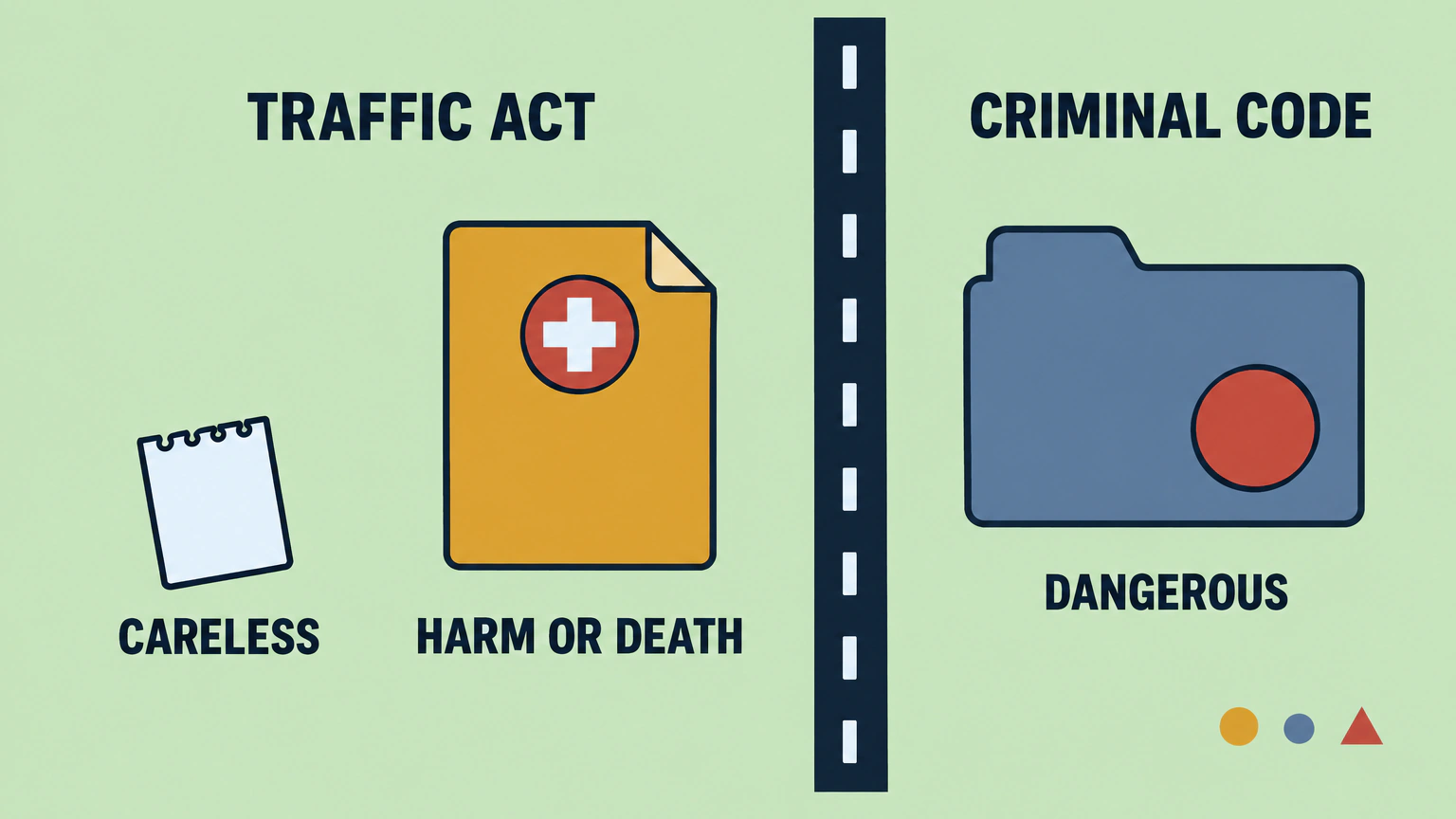
Since 1 September 2018, Ontario has had a second, heavier version of the offence: careless driving that "causes bodily harm or death to any person". The usual penalties are $2,000 to $50,000, up to two years in jail and up to five years' licence suspension, with the same six demerit points. If the offence happened while a community safety zone was in effect, the jail maximum is six months. The Act tells the sentencing court to treat it as worse when the person harmed was vulnerable, "including by virtue of the fact that the person was a pedestrian, cyclist or person working upon the highway".
It's still a Highway Traffic Act offence, not a crime. Many families find that hard to accept after what they've lost, and we understand why.
For the driver, this version always goes to court, and it's the one where a lawyer, not only a paralegal, is worth a consultation. For anyone who was hurt, the charge is the province's case against the driver. A claim for your injuries is a separate matter, and a personal injury lawyer is the person to ask about it.
Where the criminal line sits
The criminal charge next door is dangerous operation, which most people still call dangerous driving. Section 320.13 of the Criminal Code makes it an offence to drive "in a manner that, having regard to all of the circumstances, is dangerous to the public". The difference is one of degree, and the Supreme Court of Canada has put it in a sentence worth quoting whole: "Simple carelessness, to which even the most prudent drivers may occasionally succumb, is generally not criminal."
The criminal charge needs a "marked departure" from what a reasonable driver would do. A momentary lapse may sit on the careless side, while driving that's far outside the norm may cross the criminal line.
Crossing it is expensive. A conviction means a criminal record. The basic charge carries up to ten years in prison when the Crown proceeds by indictment, the more serious of its two routes. That rises to fourteen years where someone is hurt, and to life where someone dies. On a first conviction, Ontario also suspends your licence for a year.
Two terms get mixed up here. "Reckless driving" isn't a charge in Ontario's Highway Traffic Act, and people who use it usually mean careless driving or dangerous operation. Racing and stunt driving is a separate Highway Traffic Act charge.
A plea to careless driving leaves no criminal record. If you're facing the criminal charge, start with what a criminal defence lawyer costs.
The 2026 changes: a bigger fine and a roadside suspension
In June 2026 Ontario passed the Keeping Criminals Behind Bars Act, 2026. The government calls its road-safety changes Andrew's Law, and for careless driving they do two things.
They raise the fine to $1,000 to $5,000. And they have police take your licence on the spot if the alleged careless driving was on a highway. An officer who believes on reasonable and probable grounds that you've driven carelessly on a highway "shall request" that you surrender your licence. It's then suspended for seven days, or for 30 days in the bodily harm or death version. There's "no appeal from, or right to be heard before" that suspension. The Act also says it "does not constitute an alternative to any proceeding or penalty", so the charge and the court case go ahead anyway.
Now the status, stated exactly. These changes take effect on a day the government has yet to name. Until then, today's fines and penalties are the ones that apply to you.
| Today | Once the 2026 amendments are in force | |
|---|---|---|
| Fine for careless driving | $400 to $2,000 | $1,000 to $5,000 |
| Fine for careless driving causing bodily harm or death | $2,000 to $50,000 | No change |
| Your licence when you're charged with careless driving | Being charged doesn't suspend it | Suspended at the roadside for seven days if the alleged driving was on a highway |
| Licence when you're charged with the bodily harm or death version | Being charged doesn't suspend it | Suspended at the roadside for 30 days if the alleged driving was on a highway |
| Challenging the roadside suspension | Doesn't arise | No appeal and no hearing |
Once the changes take effect, the higher fine range applies from that day forward. A careless driving charge for conduct on a highway also brings the roadside suspension. So check the date on anything you read about this law before you rely on it.
What to do before the 15 days run out
You don't have to do this alone, and some people shouldn't. In Ontario a licensed paralegal can represent you in provincial offences court, and so can a lawyer. The Law Society of Ontario's referral service will give you a name, and that person offers a free consultation of up to 30 minutes. If you hold a novice licence, hold a summons, drive for a living, or were in a collision where someone was hurt, talk to one before you choose. You'll find defence lawyers near you in our listings.
We're not your lawyer or your paralegal. With six points and your insurance on the line, an hour with one before the 15 days are up is worth it.
- Find the date you were handed the ticket and count 15 days from it. That's your deadline to choose an option, and doing nothing is treated as not disputing the charge.
- Read the front and the back. A ticket shows a set fine and a total payable. A summons shows a court date and no amount.
- If it's a summons, ask the court office named on it whether the charge was started under Part I or Part III. Jail is only possible under Part III.
- Don't pay until you've decided. The court office accepting your payment is a guilty plea and a conviction.
- Ask for disclosure: the officer's notes, witness statements, diagrams and photos. It's free, and you only get it if you ask, so contact the court office early.
- If your ticket offers a meeting with the prosecutor, ask for one within the 15 days. Going doesn't give up your right to a trial.
- Write down what happened while you remember it: the time, the road, the weather, the traffic and who saw it.
- If you hold a novice licence, drive for work, hold a summons, or anyone was hurt, talk to a licensed paralegal or a lawyer before you choose.
Questions people ask
Is careless driving a criminal offence in Ontario?
No. It's an offence under section 130 of Ontario's Highway Traffic Act, heard in provincial offences court, so a conviction isn't a criminal conviction. The criminal charge is dangerous operation under section 320.13 of the Criminal Code. Careless driving is still serious: six demerit points, a fine, and a court can suspend your licence or, on a charge started under Part III, send you to jail.
How many demerit points is careless driving in Ontario?
Six. They're recorded from the date of the offence and count for two years. They aren't recorded if the court suspends your licence as part of the sentence. If the novice-licence rule applies to you, the points aren't recorded because its suspension or cancellation takes their place. The rule has exceptions for drivers who also hold a full licence for the other vehicle class.
Can you go to jail for careless driving in Ontario?
Yes, in some cases. The Act allows up to six months, and up to two years where someone was hurt or killed. If the offence happened while a community safety zone was in effect, the maximum is six months. Jail isn't possible on a ticket, or on any charge started under Part I of the Provincial Offences Act. If you were handed a summons, ask the court office which Part your charge was started under.
Can you be charged with careless driving in a parking lot in Ontario?
Yes, since 4 December 2024. Section 130 now covers driving "on a highway or in a specified place", and a specified place includes any parking lot, structure or garage, public or private, plus the driveway that connects it to the road. It also takes in lots the public is normally kept out of. Pages that say otherwise describe the law before that date.
How long does careless driving stay on your record in Ontario?
There are two clocks. Demerit points count for two years from the offence date. The conviction itself appears on the standard three-year driver record, which lists Highway Traffic Act convictions for the past three years. Insurers decide for themselves how far back they look, so ask your broker or insurer what their window is.
Is careless driving the same as reckless driving in Ontario?
No. Ontario's Highway Traffic Act has no reckless driving charge, and the word "reckless" doesn't appear anywhere in it. People who say reckless driving usually mean careless driving, or the criminal charge of dangerous operation under the Criminal Code. Racing and stunt driving is a separate Highway Traffic Act charge with its own penalties.
Do you have to go to court for a careless driving ticket in Ontario?
Not if it's a ticket and you pay it, but paying is a guilty plea. You go to court if you ask for a trial, or to finish an agreement you reach with the prosecutor. A summons is different: you or your representative must attend on the date shown. A licensed paralegal or a lawyer can go for you.