

On this page
The short answer, and what kind of charge this is
The ticket is in your hand. Or the summons is, or the letter saying your policy lapsed last Tuesday. You searched the fine, found a number with five digits in it, and your stomach dropped.
Yes, it's illegal. All four provinces we checked prohibit uninsured driving, though they don't always charge the driver. It's a provincial charge, not a Criminal Code crime. Ontario's Act sets a first-conviction fine of $5,000 to $25,000, with a 25% surcharge on top. If there's a crash and you're legally responsible, another large cost can come later, when whoever paid the other side comes to you for the money.
That split between provincial and criminal is worth a moment. Each province writes this offence into its own insurance or traffic Act and runs it through its own procedure. Ontario's Provincial Offences Act says outright that its purpose is a procedure "that reflects the distinction between provincial offences and criminal offences". You aren't being charged under the Criminal Code, and a conviction here isn't a criminal conviction. If a Criminal Code driving charge is also in play, that's a separate track, and what a criminal defence lawyer costs is the place to start.
One more thing Ontario readers ask. No, you don't get demerit points. Ontario records them only for the offences listed in the table to its demerit point regulation, and no insurance offence appears there. The penalty is a fine, with a possible suspension and impoundment instead of points.
What a conviction costs in four provinces
We read four provinces from their own statutes: Ontario, Alberta, British Columbia and Quebec. Everything here is what a court is allowed to impose, not a forecast of what a court will do with your file. Each range is a band the judge or justice chooses inside, and the bottom of the band is as real as the top.
| Province and law | First conviction | Repeat conviction | What else the law allows |
|---|---|---|---|
| Ontario, Compulsory Automobile Insurance Act, s. 2 | $5,000 to $25,000, plus a victim fine surcharge of 25% of the fine | $10,000 to $50,000, plus the same 25% surcharge | A licence suspension of up to one year, and the vehicle impounded for up to three months |
| Alberta, Traffic Safety Act, s. 54 | $2,500 to $10,000, plus a surcharge set by regulation. If unpaid, 45 days to 6 months in jail | $5,000 to $20,000 if it happens within 5 years of the first. If unpaid, 60 days to 6 months in jail | Disqualification from driving until you show proof of insurance, cancelled registration on every vehicle you own, and roadside seizure of the vehicle |
| British Columbia, Motor Vehicle Act, s. 24 | Ticket: $598, or $573 if paid within 30 days. In court: $300 to $2,000, or 7 days to 6 months in jail, or both | The section sets no separate range for a repeat | Arrest without a warrant, and in court you must prove you were insured |
| Quebec, Automobile Insurance Act, s. 186 | Owner who uses the car or lets someone else drive it: $325 to $2,800 | The section sets no separate range for a repeat | In court the owner must prove the insurance existed, and a judge may suspend the convicted person's driver's licence for up to one year |
We checked these four provinces against their statutes. In Ontario, a charge started under Part I of the Provincial Offences Act can't carry a fine above $1,000. Anywhere else, look up your own province's insurance or traffic Act and find the section that makes driving uninsured an offence.
Ontario: the Act starts at $5,000, and a quarter goes on top
Section 2 of the Compulsory Automobile Insurance Act is short and blunt. A first conviction carries a fine of "not less than $5,000 and not more than $25,000". A second one runs from $10,000 to $50,000. "In addition", the Act says, the driver's licence may be suspended for up to a year, and the court may order the car impounded for up to three months. Both are the court's call rather than automatic.
You may have read that an Ontario licence is suspended for a minimum of 30 days. There's no minimum in the Act. What it sets is a ceiling: not more than one year.
Then the surcharge. Ontario adds a victim fine surcharge to provincial fines, at a rate set by regulation under the Provincial Offences Act. On any fine over $1,000, that rate is a flat 25% of the fine itself. So a $5,000 fine was never really $5,000.
| How the charge ends | Fine | Surcharge | Total |
|---|---|---|---|
| First conviction, lowest fine | $5,000 | $1,250 | $6,250 |
| First conviction, highest fine | $25,000 | $6,250 | $31,250 |
| Repeat conviction, lowest fine | $10,000 | $2,500 | $12,500 |
| Repeat conviction, highest fine | $50,000 | $12,500 | $62,500 |
| Charge started under Part I, highest possible fine | $1,000 | $125 | $1,125 |
How an Ontario charge can top out at $1,000
That last row can move your number by a factor of five.
An Ontario provincial offence can be started in more than one way. Part I of the Provincial Offences Act is the certificate-of-offence route, which starts with an offence notice or a summons. Part III begins when an officer lays an information, and it carries the Act's full range.
Section 12(1) caps the Part I route. Where the prescribed penalty includes a fine of more than $1,000 and the proceeding was started under Part I, the fine provision "does not apply". The most the court can impose is "the maximum fine prescribed for the offence or $1,000, whichever is the lesser".
Same conduct. A $5,000 floor one way, a $1,000 ceiling the other.
So find out which one you're holding before you decide anything. The court office named on your document can tell you, and so can a licensed paralegal reading it. One timing point while you're there: Ontario can start a proceeding for this offence any time within three years of the date it happened, so a charge can land long after the stop.
Alberta: the fine is only part of it
Alberta's Traffic Safety Act sets a first-conviction fine of $2,500 to $10,000, with a surcharge on top under the Victims of Crime and Public Safety Act. A second contravention within five years runs $5,000 to $20,000. One commercial ticket-fighting page gives that repeat window as ten years. The Act says five. Jail enters only in default of payment: 45 days to six months the first time, 60 days to six months after that.
The fine isn't always the part that reshapes your week. The Registrar may disqualify you from driving until you produce proof of financial responsibility, and may cancel the registration on every motor vehicle you own, not just the one you were stopped in. A peace officer with reasonable grounds may seize or immobilize the vehicle. Alberta can also handle the contravention as an administrative penalty rather than a prosecution, with the amount set by regulation.
British Columbia and Quebec: lower fines, and the burden is on you
British Columbia's numbers are smaller. Driving uninsured is a $598 ticket, or $573 if you pay within 30 days. Dispute it and lose, and the Motor Vehicle Act lets the court impose $300 to $2,000, or seven days to six months in jail, or both. Police may also arrest an uninsured driver without a warrant.
Quebec splits the job. The province's public scheme compensates bodily injury, but the owner of a car operating in Quebec still has to carry liability insurance for property damage, with a minimum compulsory amount of $50,000. An owner who uses an uninsured car, or lets someone else use it, faces $325 to $2,800 under the Automobile Insurance Act.
One thread runs through both, and through Alberta too. In court, proving the insurance existed is your job, not the prosecutor's. Quebec's Act puts it flatly: "the burden is on the defendant or accused to prove that he has contracted the compulsory liability insurance."
Who the law actually charges
Borrow a car, or lend one, and the question of who's in trouble shifts at the provincial border.
Ontario's main offence is written for the owner or lessee, meaning someone leasing or renting for 30 days or more, who drives the car or lets somebody else drive it. Alberta's reaches anyone who drives an uninsured vehicle, plus the registered owner who permits it. British Columbia's reaches any person who drives. Quebec reaches the owner, and it can also fine the driver unless the driver acted in good faith and had reason to believe liability insurance was in place.
Borrowing a car, or lending yours
Most borrowing is fine, and Ontario's Insurance Act is the reason. An owner's policy insures the named person and "every other person who with the named person's consent drives" the car. Consent is the hinge. Take your sister's car with her blessing and her policy stands behind you.
The trap has a name, and it's the excluded driver. Ontario lets an insurer write a named person out of a policy, usually to hold a premium down. Once that's done, the car is deemed uninsured under the Compulsory Automobile Insurance Act for as long as that person is driving, unless they're a named insured under another policy of their own. An insured car, with a valid slip in the glovebox, counts as uninsured the moment the wrong person turns the key.
Alberta comes at it from the other direction. Driving a vehicle without the registered owner's consent is deemed to be driving an uninsured vehicle.
So ask one question before you take anyone's keys. "Am I excluded on your policy?"
Insured, but the card was at home
A different charge, and a far smaller one.
If the policy was live and you simply couldn't produce the proof, that's its own offence. Ontario: a fine of not more than $400 for failing to carry or surrender the insurance card. Alberta: a $203 specified penalty for failing to produce the financial responsibility card. British Columbia: an $81 ticket, or $56 if you pay within 30 days.
Fix it on paper, fast. Ask your insurer or broker for written confirmation of the policy dates covering the day you were stopped. In Ontario, a statutory declaration from an insurer's officer or employee is admissible proof of whether the car was insured, and it cuts both ways. In Alberta, British Columbia and Quebec, the law puts the job of proving it on you.
Red flag: a card isn't a policy. A card only proves what the policy behind it says. In Ontario, having or showing an insurance card you know, or ought to know, is false or invalid is a separate offence, and a first conviction carries a fine of $10,000 to $50,000. Alberta treats showing a card for a policy that isn't in force as driving uninsured. If you're unsure whether a policy is real or still active, call the insurer named on the card before you drive.
What changes if there's a crash
A fine has a ceiling. A crash doesn't.
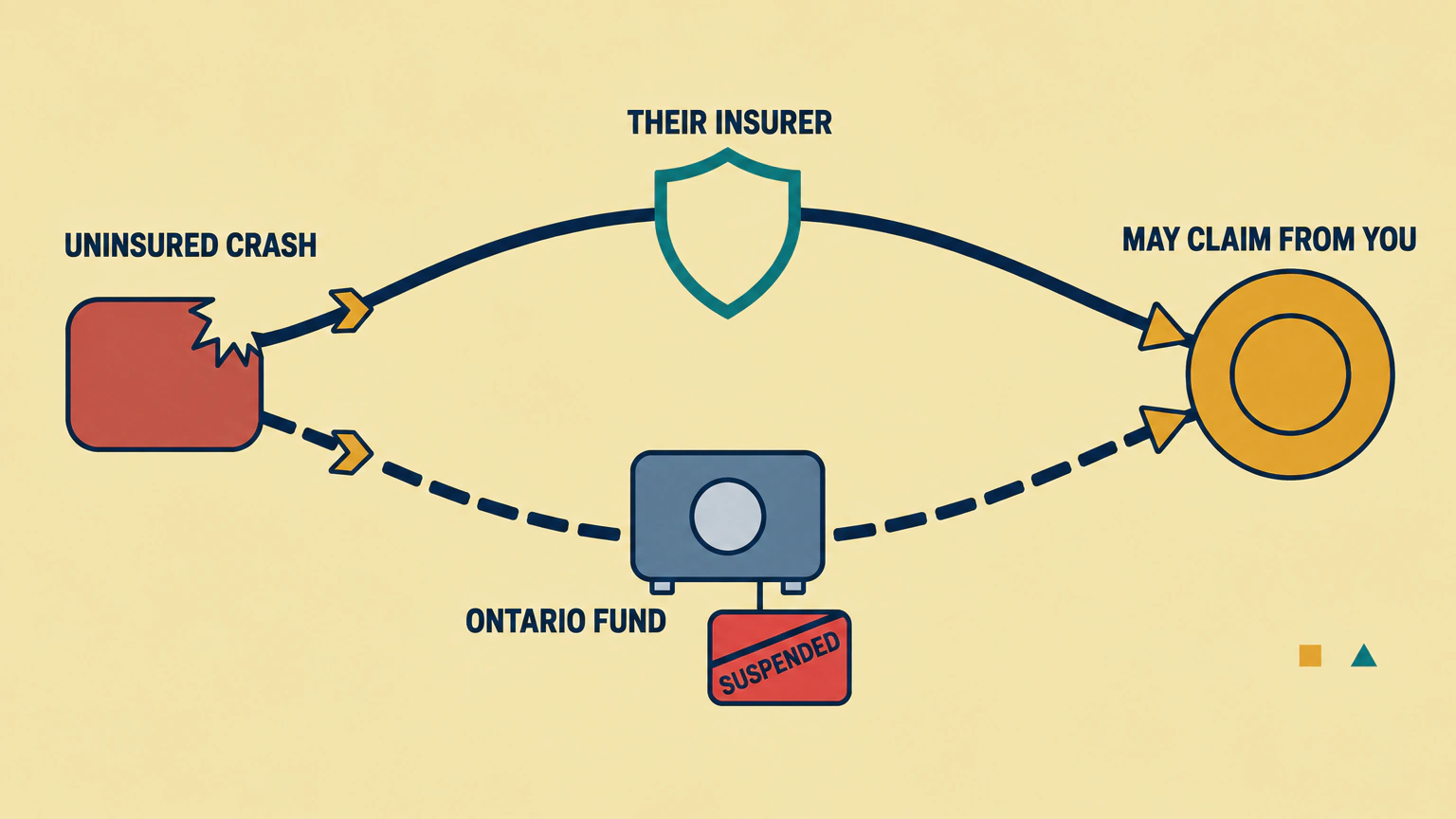
This is the part that can decide whether your finances recover. If you're legally responsible, the other side may recover through their own insurer or Ontario's Fund. If either one pays, it can then pursue you.
From here on, everything is Ontario, from the crash to the last instalment. That's where the demand is, and where we could follow every step through the legislation. If your crash happened elsewhere, look up your own province's rules. The shape is often similar. The numbers and the licence consequences are not.
If an insurer or the Fund pays, it can pursue whoever is responsible
Route one: the injured person has a policy of their own. Ontario requires every motor vehicle liability policy to pay what its insured "is legally entitled to recover from the owner or driver of an uninsured automobile". Their insurer pays them, and then the Insurance Act lets that insurer step into their shoes and pursue whoever is legally responsible.
Route two: no policy responds. An injured person with a claim against an uninsured owner or driver can apply to the Motor Vehicle Accident Claims Fund, Ontario's payer of last resort. For accidents since 1 March 1981, the Fund pays no more than $200,000 for any one accident, and no more than $10,000 of that for property damage. Once it pays, the Minister steps into the injured person's shoes and can pursue whoever is legally responsible.
The Fund won't cover what an insurer is already on the hook for. It fills a gap. It doesn't duplicate one.
If the fight is over a wrecked car rather than a broken body, the amount may sit inside your province's small claims limit, a cheaper and faster room to argue in.
Ontario can keep your licence until you start paying the Fund back
When the Fund pays, the Registrar suspends the driver's licence of the person who was notified. The suspension holds, and no new licence or renewal is issued, until that person has either repaid the Fund in full or started making instalment payments. Fall ten days behind on an instalment and the Registrar suspends it again.
The letter matters as much as the money. Before paying, the Minister sends notice by registered mail to the owner and the driver, at the last address the Ministry of Transportation has on file. If that person doesn't reply within thirty days disputing liability, the Fund can pay without hearing your side of it.
Thirty days, to an address you may have moved out of two years ago.
So open the mail, and update your address with the Ministry today rather than after a crash.
Your own injury benefits shrink
There's one more cost, and this one lands on your own body.
Ontario's accident benefits normally pay regardless of who caused the crash. Not all of them, though, and not to a driver who knew or ought reasonably to have known the car wasn't insured. For that driver, the insurer isn't required to pay the income replacement benefit, the non-earner benefit, lost educational expenses, the expenses of visitors, or housekeeping and home maintenance.
Read that list again slowly. The benefit that replaces your paycheque while you can't work is on it. So is the one that pays somebody to keep your household running while you heal.
The exclusion doesn't reach the medical and rehabilitation benefits, so treatment survives. What goes is everything that keeps the rent paid while you recover.
If you were hurt, or someone else was and is now claiming against you, a lawyer who handles car accident claims is worth a call.
Charged? What to do this week
The first week after a charge is mostly paperwork and dates, and both are more manageable than they feel at 11 p.m. Work through this in order.
- Park the car until a policy is in force. In Ontario, and in Alberta within five years, a repeat conviction's minimum fine doubles.
- Read the charge document for the Act, the section and the court date or response deadline, and put that date in your calendar.
- In Ontario, ask the court office or a paralegal which Part of the Provincial Offences Act your charge was started under. Part I caps the fine at $1,000.
- If you were insured that day, get written confirmation of your policy dates from your insurer or broker.
- If you were driving someone else's car, ask the owner whether you're an excluded driver on their policy.
- Before you pay a ticket, find out what paying means. In British Columbia, paying any part of it counts as pleading guilty, and so does doing nothing for 30 days.
- Book a consultation with a licensed paralegal (Ontario) or a lawyer before your first court date.
- If there was a crash, open every letter from an insurer or the Motor Vehicle Accident Claims Fund. If you don't dispute the Fund's notice within 30 days, it can pay the claim without you.
Who can stand up with you depends on where you are. In Ontario, a licensed paralegal can represent you in a Provincial Offences Act proceeding, usually the cheaper route for a ticket. A lawyer can do it anywhere. If you aren't sure who to call, start with a defence lawyer near you. We aren't your lawyer or paralegal, and an hour with one before your court date is money well spent.
Getting insured again is its own problem, and Ontario gives you two levers. An insurance agent has to complete and submit an application to an insurer when you ask. And if no insurer will write you a policy, the Facility Association exists for that case: a plan for owners, lessees and licensed drivers who couldn't get a policy any other way.
Questions people ask
Do you get demerit points for driving without insurance in Ontario?
No. Ontario records demerit points only on conviction for an offence listed in the table to its demerit point regulation, and no Compulsory Automobile Insurance Act offence appears in that table. The penalty is the fine, plus a licence suspension of up to a year and an impoundment of up to three months, both at the court's discretion.
Can you go to jail for driving without insurance?
Ontario's insurance Act does not make jail part of the sentence for this offence. But the Provincial Offences Act can eventually allow committal after a fine defaults and other collection efforts fail, subject to a hearing. Alberta provides 45 days to six months only when the fine isn't paid. British Columbia allows seven days to six months at sentencing, alone or with a fine, and police may arrest an uninsured driver without a warrant.
Does driving without insurance go on your criminal record?
No. It's a provincial offence, prosecuted under provincial procedure rather than the Criminal Code, so a conviction here isn't a criminal conviction. Ontario's Provincial Offences Act describes its own procedure as one that "reflects the distinction between provincial offences and criminal offences". The fine and the licence consequences are real, but they sit outside the criminal system.
Can I drive someone else's car if I'm not on their insurance?
In Ontario, usually yes. An owner's policy covers "every other person who with the named person's consent drives" the car, so consent is what counts, not being named on the paperwork. The exception is an excluded driver: while that person drives, the car counts as uninsured unless they hold a policy of their own. In Alberta, driving without the registered owner's consent is deemed driving an uninsured vehicle.
What if I had insurance but couldn't show the card?
That's a separate and much smaller charge: up to $400 in Ontario, a $203 specified penalty in Alberta, an $81 ticket in British Columbia. Get written confirmation of your policy dates from the insurer and bring it with you. In Alberta, British Columbia and Quebec, the law puts the burden of proving the insurance on you, so arrive with the proof rather than the argument.
Can a no insurance ticket be dismissed?
A charge can be contested, and nobody honest will promise you an outcome. The insurer's own record matters because, in Ontario, an insurer's statutory declaration is admissible evidence either way. The Part of the Provincial Offences Act matters for the penalty, not guilt: Part I caps the fine at $1,000. A licensed paralegal can help you sort out both points in Ontario.
What should I do if an uninsured driver hits me?
In Ontario, claim on your own policy first. Every motor vehicle liability policy has to pay what you're legally entitled to recover from the owner or driver of an uninsured automobile, so your own insurer is the first door to knock on. If no policy covers you and you have a claim against the uninsured owner or driver, apply to the Motor Vehicle Accident Claims Fund. For injuries, talk to a personal injury lawyer before you settle anything.