

On this page
- What you can sue for in your province or territory
- What "the limit" actually counts
- Over the ceiling? Your options
- Who can stand up for you
- What it costs to file, and what you can get back
- What small claims court will not hear
- The clock: how long you have to file
- Before you file: a readiness checklist
- Frequently asked questions
- Where these ceilings come from
What you can sue for in your province or territory
Take one $60,000 unpaid invoice across the country and watch it change identity. In Alberta it's an ordinary small claim. In Ontario it's a Superior Court action. In Quebec it's four times the ceiling. Highest limit to lowest, the spread is $85,000 wide.
The ceilings, verified against official sources
| Province or territory | Court | Ceiling | Outside the ceiling | Instrument and how current |
|---|---|---|---|---|
| Alberta | Court of Justice, Civil | $100,000 | Not stated | AR 176/2018, s. 2; current 1 Aug 2023 |
| Ontario | Small Claims Court | $50,000 | Interest and costs | O. Reg. 626/00, s. 1(1); e-Laws currency 7 Aug 2026 |
| Saskatchewan | Provincial Court | $50,000 | Not stated | Small Claims Regulations, 2017, s. 3(1), as amended by SR 101/2023; effective 1 Apr 2024 |
| British Columbia | Provincial Court | $35,000 | Interest and costs | B.C. Reg. 179/2005, s. 1; current to 4 Aug 2026 |
| Northwest Territories | Territorial Court | $35,000 | Interest and expenses | Territorial Court Act and Civil Claims Rules |
| Nova Scotia | Small Claims Court | $25,000 | Interest and legal costs | Courts of Nova Scotia; general damages capped at $100 |
| Newfoundland and Labrador | Provincial Court | $25,000 | Interest and expenses | Provincial Court of NL |
| Yukon | Small Claims Court | $25,000 | Interest and costs | Small Claims Court Act, s. 2 |
| Manitoba | Court of King's Bench | $20,000 | Interest, costs and disbursements | King's Bench practice direction 9 Dec 2024; general damages capped at $2,000 |
| New Brunswick | Small Claims Court | $20,000 | Not stated | Courts of New Brunswick |
| Nunavut | Nunavut Court of Justice | $20,000 | Costs, expenses and court-ordered interest | Small Claims Rules, r. 3.1(2) |
| Prince Edward Island | Supreme Court, Small Claims Section | $16,000 | Not stated | Judicature Act Small Claims Regulations, s. 2 |
| Quebec | Court of Québec, Small Claims | $15,000 | Interest | Code of Civil Procedure, art. 536, à jour au 1 avril 2026; indexed by art. 539.1 |
| British Columbia | Civil Resolution Tribunal | $5,000 | Interest and s. 49 expenses | B.C. Reg. 232/2018, s. 3; current to 4 Aug 2026 |
Every province and territory is in there. Before you file, open the court, statute or regulation named beside your own jurisdiction and confirm the figure yourself. These numbers move.
One caveat on Quebec. Its ceiling climbs on autopilot. Article 539.1 adds $1,000 on 1 September of the year after accumulated Consumer Price Index adjustment reaches that much, announced by a notice published in the Gazette officielle du Québec by 1 August. It moves by notice, not by amendment, so there is no bill to watch for and no debate to follow. For now the figure is $15,000, in the Code and in the small claims tariff alike.
Why the figure you found somewhere else may be out of date
Three of these ceilings moved inside three years. Saskatchewan on 1 April 2024. Manitoba on 1 January 2025. Ontario on 1 October 2025. A guide written in 2023 was probably right the day it went up. It's wrong now. And nothing on the face of it looks wrong.
Red flag: three warning signs that a limit you read is stale.
- It gives you a figure and names no regulation, statute or court page behind it.
- It carries a year in its title but nothing about when the law itself was last consolidated.
- It calls an increase "upcoming", or says the limit "will increase". That phrasing outlives the change and keeps reading as current for years.
What "the limit" actually counts
The ceiling is not the total you feel you are owed. Two differences sit between those two numbers, and either one can put you back under the line.
Interest, costs and disbursements usually sit outside the ceiling
Ontario's Courts of Justice Act measures the amount claimed "exclusive of interest and costs", and British Columbia's Small Claims Act uses the same formula. Quebec's Code says "excluding interest". Manitoba leaves out interest, costs and disbursements. Nova Scotia's ceiling is calculated "not including interest and legal costs".
So do the subtraction before you decide you are over. A three-year-old $52,000 debt may be $46,000 of principal and the rest interest. That is a small claim.
The general damages cap hiding inside the limit
Two provinces bury a second, much lower cap inside the first. Nova Scotia allows general damages of no more than $100 inside its $25,000 ceiling. Manitoba allows up to $2,000 inside its $20,000.
General damages are the part of a claim not tied to a specific, itemised monetary loss, and their legal scope depends on the claim. If that is where most of your money sits, the headline ceiling is not the figure that governs you.
Over the ceiling? Your options
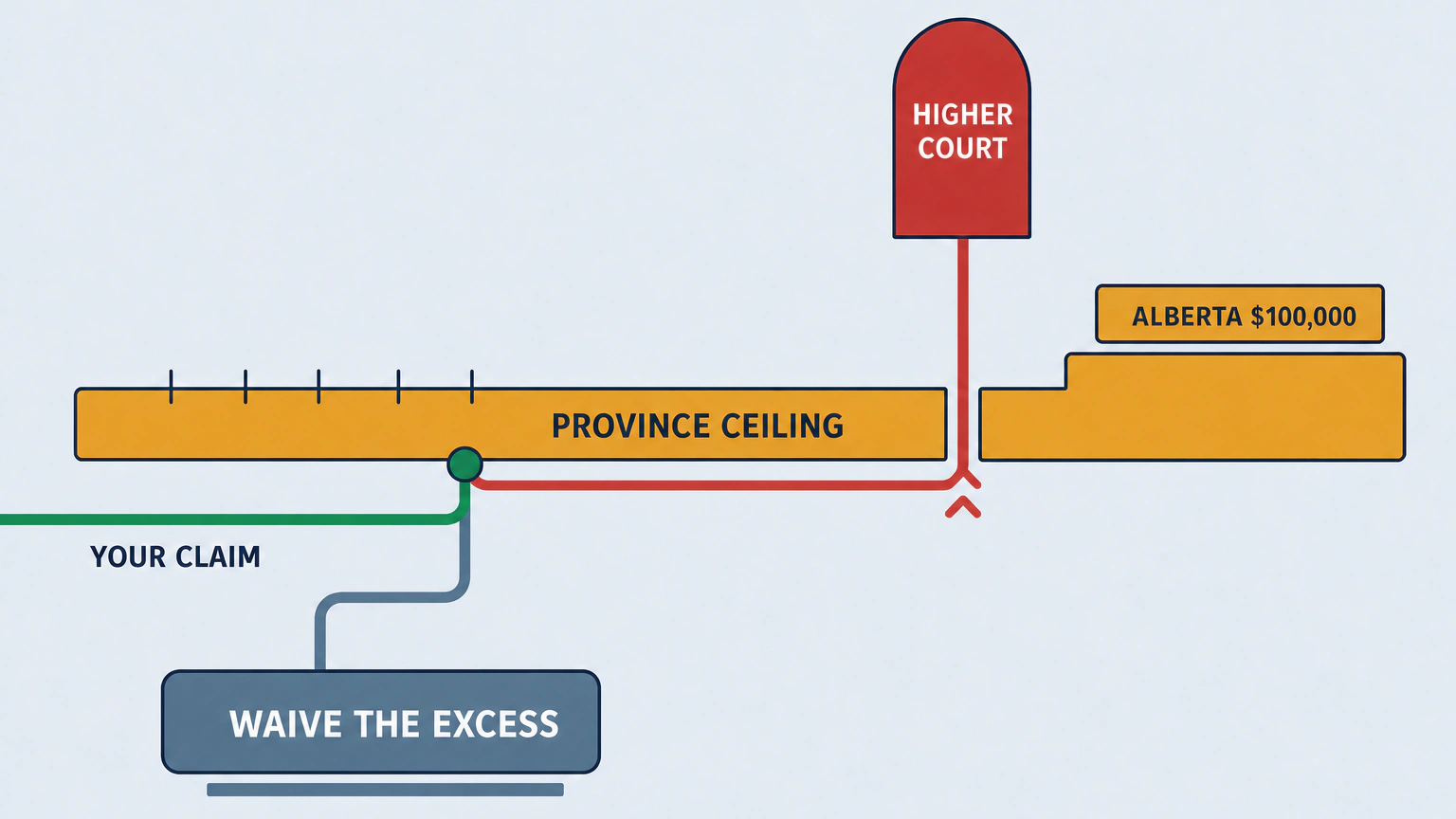
Two moves, pulling in opposite directions. Shrink the claim to fit the court you want, or move to the court that fits the claim.
Move one: waive the excess and stay put
Ontario, Saskatchewan and Manitoba each say it plainly: you may give up the amount above the ceiling and stay in small claims court. Ontario's guide frames it as filing for $50,000 or less "if you are willing to waive the amount over $50,000". Manitoba's page says the same above $20,000. Saskatchewan announced it alongside its increase.
Know what you're signing, because the trade is permanent. Waive $4,000 off a $54,000 Ontario claim and it's gone even if you win everything else. That stings, and it should: you're buying a simpler procedure and a cheaper filing with money you are genuinely owed. For a lot of claims it's still the right trade.
The splitting trap, and why Quebec spells out the penalty
Everyone reaches the same idea at the same moment: split a $24,000 claim into two of $12,000 and file both. It is the one move that can cost you the whole claim.
Pro tip: Quebec allows reduction but bars splitting one claim.
Quebec lets a plaintiff voluntarily reduce the amount claimed to $15,000 or less. What it forbids is dividing a larger claim into two or more smaller ones, "under pain of dismissal of the application". The carve-out is for money that genuinely falls due in pieces: instalment credit contracts, and contracts of sequential performance such as a lease or an employment contract. Check what your own jurisdiction does with a divided claim before you divide one.
Move two: file in the higher court
The higher court answers to a different name almost everywhere. Ontario sends you to the Superior Court of Justice. Alberta, Saskatchewan and Manitoba use the Court of King's Bench. British Columbia uses the Supreme Court.
Quebec splits it by amount. Below $75,000 the Court of Québec has exclusive jurisdiction. From $75,000 to below $100,000 the plaintiff may choose the Court of Québec or Superior Court. At $100,000 and above it is Superior Court.
Going up costs you. Expect more formal procedure and greater exposure to the other side's costs. Ontario also closes the back door: an action within Small Claims Court jurisdiction may not be started in the Superior Court except with leave. This is a point at which to consider civil litigation lawyers in your province.
Who can stand up for you
Representation changes at the border more sharply than the money does. The rule that decides who is licensed to represent you applies here too: authority comes from the regulator and the jurisdiction, not from a job title.
| Province | Represent yourself? | Someone else? | Source |
|---|---|---|---|
| Ontario | Yes, and the province says so | A lawyer, or a paralegal licensed by the Law Society of Ontario | Ontario, "Small claims court: suing someone"; LSO |
| Quebec | Usually. Natural persons must self-represent unless the court authorizes lawyers for a complex point of law | A spouse, relative, person connected by marriage or civil union, or a friend, under a non-remunerated written mandate | Code of Civil Procedure, art. 542 |
| Alberta | Yes, and some parties do | A lawyer or an agent, at your own expense | Alberta Court of Justice, Civil |
| Other provinces and territories | Check your own court | Rules vary. Check your own court | Your own court's rules |
Ontario: yourself, a lawyer, or a licensed paralegal
Ontario's Small Claims Court is a branch of the Superior Court of Justice, and the province's own guide is blunt about what that means for you: you do not need a lawyer or a paralegal.
If you want help anyway, there is a middle tier. The Law Society of Ontario licenses paralegals for specified legal services, and small claims court is first on its published list of what they may handle.
Quebec: self-representation is the rule
In Quebec you stand up yourself. That is the rule for natural persons, and the only way around it is a court that authorizes lawyers because the case raises a complex point of law.
You may send someone in your place, but the list is short and the terms are strict. A spouse, a relative, a person connected to you by marriage or civil union, or a friend, on a written non-remunerated mandate that states why you cannot appear yourself. Nobody is paid for it. A lawyer cannot be your mandatary, and neither can a collection agent.
Alberta and the rest
The Alberta Court of Justice describes its civil division as a simple, affordable route, and describes the reality plainly: some parties choose not to hire a lawyer, while others bring a lawyer or an agent at their own expense.
Everywhere else we did not read the rule, and we would rather admit the gap than guess at it. Phone your own court and ask who is allowed to speak for you before you count on anyone.
What it costs to file, and what you can get back
Filing is cheap. Getting the cost of help back is capped.
Ontario's filing fees and the frequent-claimant surcharge
Ontario charges you by how often you sue. Under 10 claims a year at one court location and you are an infrequent claimant. Reach 10 at that location and you are a frequent claimant, at roughly double the price.
| Step | Infrequent claimant (under 10 claims a year, same location) | Frequent claimant (10 or more) |
|---|---|---|
| Filing a claim | $108 | $228 |
| Request for default judgment | $94 | $128 |
| Setting a trial or assessment hearing date | $308 | $403 |
Those are Ontario's fees and nobody else's. Every jurisdiction sets its own. Notice where the line falls in practice: a business filing a dozen claims in a calendar year at one court location has crossed into the higher tier without ever deciding to.
Ontario caps what you can recover for representation at 15%
The Courts of Justice Act is short about this. An award of costs, other than disbursements, "shall not exceed 15 per cent of the amount claimed", unless the court is penalising unreasonable behaviour.
So on a $50,000 claim the general statutory ceiling is $7,500, and on a $20,000 claim it is $3,000. Read the word ceiling literally. Those are the most a court could award, not what you should expect to be handed.
What representation actually costs
Two of our own cost categories sit close to this kind of work. For landlord and tenant lawyers the typical range is $994 to $2,348. For business and corporate lawyers it is $903 to $1,806. Those are our aggregates of our own listings rather than a survey of the Canadian market, and the panels adapt to where you are, so your figures may differ from ours.
Now set them against the cap. On a $20,000 claim the general statutory ceiling is $3,000 rather than a guaranteed award. On a $4,000 claim it is $600. Do that arithmetic before you hire anyone, because on a small enough claim the help costs more than the court can hand back. If the fight is over a faulty product or a service that never arrived, consumer protection lawyers are worth a call first.
What small claims court will not hear
The ceiling is only half of the jurisdiction question. Every province also fences off whole subjects, whatever the amount.
- Nova Scotia: land ownership, wills and estates, malicious prosecution, wrongful imprisonment, defamation.
- Saskatchewan: title to land, slander, libel, bankruptcy, false imprisonment, malicious prosecution (all to King's Bench).
- British Columbia: libel, slander and malicious prosecution.
- Quebec: the lease of a dwelling, support applications, defamation, and claims assigned to you for payment.
- Manitoba: residential tenancy, land, trusts and estates, family matters, wrongful dismissal, malicious prosecution, false imprisonment, defamation.
Defamation and land title turn up on nearly every list. Residential tenancy is the one that genuinely varies by jurisdiction: Nova Scotia's Small Claims Court hears Residential Tenancy appeals, and lawyer-client fee disputes as well, which is where you would start to dispute a lawyer's bill.
The clock: how long you have to file
Work out this date before you work out anything else. Ontario's Limitations Act, 2002 sets a basic limitation period of two years, and the two years generally run from discovery rather than from the day the loss happened.
Discovery is the earlier of two dates. The first is the day you knew all four of these things: that the loss had occurred, that an act or omission caused it, that it was the act of the person you want to sue, and that a proceeding would be an appropriate remedy. The second is the day a reasonable person in your position ought to have known them. And the Act starts you off presuming you knew on the day the act took place, unless you prove otherwise.
Limitation statutes are provincial. Each jurisdiction sets its own periods, its own discovery rules and its own exceptions. Miss the deadline and the merits stop mattering.
Before you file: a readiness checklist
Work down this list before you fill in a single form.
- Write down the exact amount owed, principal separate from interest.
- Compare it against your province or territory's ceiling above, and check where interest sits.
- If part of the claim is for general damages, check whether your jurisdiction imposes a subcap.
- Confirm the claim is not on your province or territory's excluded list.
- For an Ontario claim, work out when you knew of the loss, its cause, who caused it and that a proceeding was appropriate: those facts usually determine discovery.
- If you are over the ceiling, decide whether waiving beats what you give up.
- Gather the contract, invoices, receipts, photographs and any message acknowledging the debt.
- Send one written demand with a deadline and keep a copy where that is required or practical.
- Confirm the current filing fee on your court's website.
- Decide on representation last, after weighing its cost against what you can recover.
Frequently asked questions
What happens if my claim is over the small claims limit?
You have two ordinary routes. Waive the amount above the ceiling and stay put, where the local rules allow that, or file the full amount in the higher court. Ontario, Saskatchewan and Manitoba expressly permit waiver, and waiving is permanent, so what you give up does not come back. Which higher court is right depends on your jurisdiction, and in Quebec on the amount claimed.
Do I need a lawyer for small claims court?
Usually not. The procedure is built to be used by people representing themselves, and Ontario's guide states you need neither lawyer nor paralegal. Quebec goes further and makes self-representation the rule for natural persons, with a narrow exception where the court authorizes a lawyer for a complex point of law. Whether paid help is worthwhile depends on the amount, the complexity and your local cost rules.
Can a paralegal represent me in small claims court?
In Ontario, yes. The Law Society of Ontario licenses paralegals for specified legal services, and small claims court is first on its published list of what a paralegal may handle. In Quebec, no. A paid representative is prohibited there, whatever the title on the business card. Everywhere else, ask your own regulator before you hire anyone.
Can I sue a business in small claims court in Canada?
Yes. Unpaid work, faulty goods, a deposit nobody returned and a service nobody delivered are ordinary small claims subjects. Two practical things decide whether the claim goes anywhere. You need the business's correct legal name, which your corporate registry confirms, and you need an address where it can be served.
Can I claim my legal fees back in small claims court?
Only partly. In Ontario an award of costs, other than disbursements, cannot exceed 15 per cent of the amount claimed unless the court is penalising unreasonable behaviour, so a $20,000 claim carries a $3,000 recovery ceiling. Nova Scotia calculates its $25,000 limit without interest or legal costs.
How long do I have to file a small claim?
In Ontario, two years from the day the claim was discovered, under the Limitations Act, 2002. Discovery means the day you knew, or ought reasonably to have known, of the loss, its cause, who caused it, and that suing was appropriate. Periods vary by province and territory, so confirm your own rather than borrowing Ontario's.
Can a company represent itself in small claims court?
It depends on the province or territory, and Quebec is the one that spells it out. A legal person may be represented only by an officer or employee in its sole service who is not a lawyer. It may act as a plaintiff in the small claims division only if no more than 10 people were under its direction or control at any time during the 12 months before the application.
Where these ceilings come from
Every ceiling on this page came out of an official statute, regulation, rules document or court page rather than out of somebody else's guide. Alberta's regulation was cross-checked against the court's own civil page, and Saskatchewan's $50,000 against the current court page and the government's announcement of the increase. The rest came from the official Manitoba, Nova Scotia, Newfoundland and Labrador, New Brunswick, Prince Edward Island, Yukon, Northwest Territories and Nunavut sources, and Ontario's guide supplied the filing fees.
One honest limit before you go. We are not your lawyer, and this is general information about Canadian court procedure rather than advice about your claim. If you are unsure whether your claim fits, or a deadline is close, take it to your court office or someone licensed in your jurisdiction before you file.