

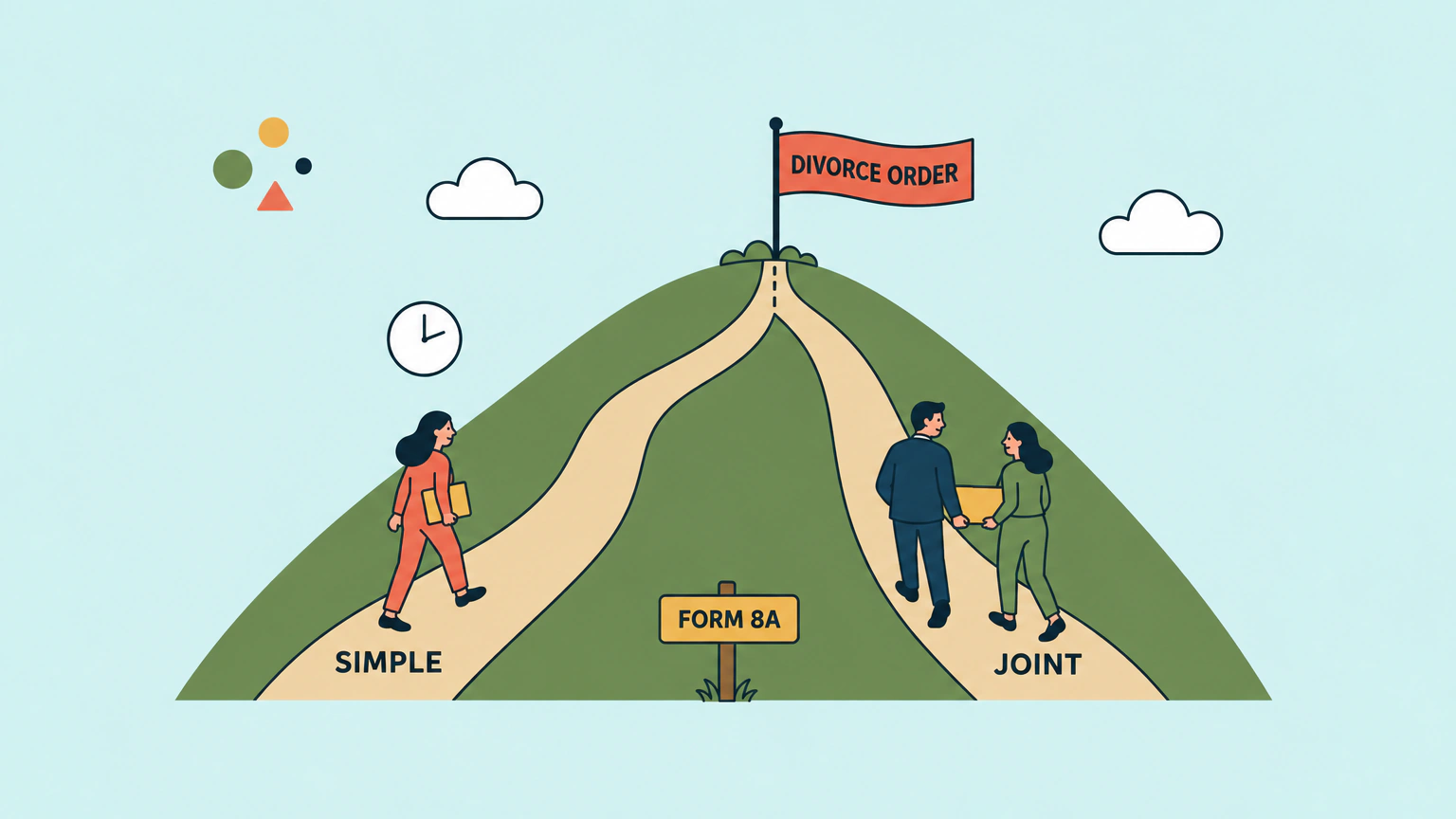
To file for divorce in Ontario, start a case in the Superior Court of Justice on Form 8A. You can apply together with your spouse (joint) or on your own (simple), and the standard court fees total $669. On the one-year separation route, a judge can't grant the divorce until you've been separated for a full year. The divorce usually takes effect on the 31st day after the order, but an appeal can delay that date. Once it takes effect, you can get the certificate you'll need if you ever remarry.
The details that matter are which application is yours, what to gather, what it costs, how your spouse gets served, and what a judge checks on paper. One line in the affidavit also warns that a divorce starts a deadline on your property.
On this page
- Three things the court checks before granting a divorce
- Joint or simple: which application is yours
- The papers to gather before you file
- Filing it and paying the court
- Serving your spouse, if you're filing alone
- From your affidavit to the certificate
- The property deadline warning in Form 36
- Doing it yourself, or getting some help
- Questions people ask
Three things the court checks before granting a divorce
Three things have to be true before a judge will end a marriage. You're legally married. At least one of you has been "habitually resident" in Ontario, the Divorce Act's phrase for living here, for a full year before the case starts. And the marriage has broken down.
For an uncontested divorce, the one-year separation route avoids having to prove adultery or cruelty to a judge.
Only the Superior Court of Justice, which includes its Family Court branch, can grant a divorce in Ontario.
A full year apart, counted to the day the judge signs
The Act says you must have "lived separate and apart for at least one year immediately preceding the determination of the divorce proceeding". Determination means the judge's decision, so the year is counted back from the day the judge signs. Your filing date only has to show you were already living apart.
That cuts both ways. You can file inside the year, and a judge still can't sign a day early.
A try at reconciliation won't reset the count. You can move back in together for up to 90 days, in one stretch or several, and the year keeps running.
Pro tip: Filing on your own and the year isn't up yet? You can start the case now, as long as you're already living apart. Serve your spouse, let the 30 days run, and swear your Form 36 once the full year has passed. The registry check runs while you wait. On a joint application both affidavits go in first, so wait out the year.
Living under one roof can still count as separated
Plenty of couples separate and keep sharing an address, to save money or to keep the children's lives steady. Justice Canada says so directly: "Some couples choose to separate but still live in the same house."
What matters is that you've stopped living as a married couple, in a way someone looking in would recognize. It takes only one of you to decide. The Act counts any period when you lived apart and "either of them had the intention to live separate and apart from the other".
Write down the date and what changed that day. Form 36 has you swear to the date, and a judge with doubts may ask.
Joint or simple: which application is yours
Ontario's Ministry of the Attorney General has two names for an uncontested divorce. "Joint" means you both sign. "Simple" means you file alone and your spouse becomes the respondent, the person the case is brought against. Both use Form 8A. Both are for a divorce and nothing else, unless you're applying jointly and have agreed on the rest.
| Joint application | Simple application | |
|---|---|---|
| Who signs Form 8A | Both of you | You alone; your spouse is the respondent |
| Serving your spouse | Not needed | Required, by someone 18 or older who isn't you |
| Waiting for a response | None | 30 days after service, or 60 outside Canada and the U.S. |
| Form 36 affidavits | One each, filed with the application | Yours alone, filed after the response time runs out |
| Court fees | $669 when you file | $224 when you file, $445 with your affidavit |
| Other orders in the same case | Allowed, if you agree on them | None: it claims a divorce only |
| Best when | You agree on everything and both will sign | Your spouse won't sign but isn't fighting the divorce |
If you're asking for more than the divorce
Form 8A stops working the moment one of you wants a judge to decide something you haven't agreed on: support, property, or the children's arrangements. That takes Form 8. Support claims usually need Form 13, while property claims need Form 13.1. A claim only for the guideline table amount of child support is an exception. Both of you must also attend a free Mandatory Information Program session within 45 days of the case starting. Divorce-only cases and cases going ahead on consent are exempt.
A contested case isn't one you finish on paper. Talk to family lawyers who handle support and property, or to a lawyer for parenting arrangements if the children are the open question. Courts can grant the divorce on its own while the other issues are still being decided.
The papers to gather before you file
A clerk checks that your documents are complete before issuing your application, and again before the file goes to a judge. The ministry publishes its own checklists for a simple divorce and a joint divorce. Between them, these are the divorce papers Ontario's courts expect.
- Form 8A, the divorce application, signed by you, or by both of you if you're applying jointly.
- Your original marriage certificate or marriage registration certificate, with a certified translation if it isn't in English or French.
- Form 36, the affidavit for divorce, sworn before a commissioner. On a joint application, each of you swears your own.
- A typed draft of Form 25A, the divorce order you're asking the judge to sign.
- Proof that your spouse was served. That is usually Form 6B, sworn by whoever served them. Simple applications only.
- If you have children: the support arrangements, the paying parent's income, and any separation agreement or court order that sets child support.
- If you married outside Canada: proof of any earlier divorce, or of a previous spouse's death.
- The continuing record's cover page and table of contents, unless the court directs an electronic record instead. Court staff can help you set up the record.
- Two stamped business-size envelopes, one addressed to you and one to your spouse, unless you're filing electronically.
- For online filing: an Ontario.ca Login, your forms saved as PDF or Word files, and a Visa or Mastercard, credit or debit.
Your name has to match your marriage certificate
Both ministry checklists open with the same instruction: list your names on every form "exactly as they are shown" on your marriage certificate. If you took a new name when you married, or changed it since, explain that in your Form 36. An unexplained mismatch can delay the file.
If the original is lost, where you married decides what to do. Married in Ontario, order a copy from ServiceOntario. Married in another province or territory, order it from that government. Married outside Canada, file the certificate with a certified translation if it isn't in English or French, plus proof of any earlier divorce or of a previous spouse's death.
Filing it and paying the court
You file in the Superior Court of Justice, usually in the municipality where you or your spouse live. Joint or simple, you can do it at the counter or online. The Toronto region has used the Ontario Courts Public Portal since October 14, 2025. Everywhere else uses Justice Services Online, where the family service is called Family Submissions Online.
Ontario's online filing page lists what you need: an Ontario.ca Login, each form saved as its own PDF or Word file, and a Visa or Mastercard, credit or debit. Court staff review a divorce application within three business days, then email to say it was accepted or why it wasn't.
| Fee | Amount | When you pay it |
|---|---|---|
| Filing the application | $214 | When you file Form 8A |
| Federal divorce registry fee | $10 | With the filing fee, except when legal aid covers the divorce and provincial filing fees are waived |
| Placing your case before a judge | $445 | Joint: at filing. Simple: with your Form 36 |
| Total for the divorce | $669 | $214 + $10 + $445 |
| Certificate of divorce (optional) | $25 | When you request it, after the divorce takes effect |
Ontario's fee regulations schedule the provincial amounts to be indexed to Ontario's inflation rate on January 1, 2027. Filing online costs the same as filing at the courthouse.
If you've seen $632 quoted elsewhere, that was the total before January 1, 2023. Ontario has scheduled the provincial fees for an inflation adjustment beginning January 1, 2027. They won't increase if the relevant Consumer Price Index change is negative, and a fee can stay unchanged if the minister finds an increase would exceed full cost recovery.
The $10 buys a search. Once your application is issued, the court asks the federal Central Registry of Divorce Proceedings to confirm that neither of you has another divorce case open in Canada. A judge can't grant the divorce until that report comes back.
If you can't afford the fees
If $669 is out of reach, ask for a fee waiver. Applying costs nothing, and you can send the request online with your filing. You qualify in any one of three ways.
The first is where your money comes from: your household lives mainly on Ontario Works, ODSP, Old Age Security with the Guaranteed Income Supplement, the Canada Pension Plan or the War Veterans Allowance. The second is legal aid: Legal Aid Ontario has approved you for this case.
The third is a three-part money test, and you have to pass every part. Household income before tax is under $33,100 a year for one person ($49,600 for two, $57,300 for three, $68,700 for four, $80,200 for five or more). Liquid assets, meaning cash and anything quickly turned into cash, are under $2,800. Net worth is under $11,100. These limits are due to be adjusted for inflation on January 1, 2027.
The regulation says two people "are not spouses" for this test if they're living separate and apart because the relationship broke down. Your spouse's income and assets stay out of your numbers.
The $10 federal fee is still due unless legal aid covers your divorce and your provincial filing fees are waived. A waiver won't cover the cost of having your papers served. If you miss the tests but still can't pay, you can ask a judge to look at your finances directly.
Serving your spouse, if you're filing alone
Joint applicants can skip this part. There's nobody to serve.
On a simple application, your spouse has to be formally given the case: a copy of the issued Form 8A, a copy of your continuing record (the running file of your case) with its table of contents, and a blank Form 10, the Answer. The ministry's checklist says to do it as soon as possible, and no later than six months after the application was issued.
Service starts a clock. Your spouse has 30 days to file an Answer, or 60 if served outside Canada and the United States. They don't have to sign or reply. If nothing comes back, the uncontested path is open.
Who can hand over the papers, and how
The person who serves the papers must be at least 18, and it can't be you. The Family Law Rules say an application must be served "by a person other than the party required to serve the document". A friend, a relative or a process server will do.
The method counts too. The Rules call it special service. The server can hand the papers to your spouse, or to your spouse's lawyer if the lawyer accepts service in writing. They can mail them with an acknowledgment card, which is valid only if your spouse signs it and it comes back. Or they can leave them in an addressed envelope with an adult who lives at your spouse's home, then mail a copy that day or the next.
Service can be proved by Form 6B, a written acceptance, a signed return postcard or a lawyer's or paralegal's Form 6C certificate. Without proof of service, your file doesn't reach a judge.
When your spouse can't be found, or files an Answer
Two things turn a simple divorce into something harder.
The first is a spouse you can't find. A judge can order substituted service, meaning another way of getting the papers to them, or rule that service isn't required. Either takes a motion, and the judge will want detailed evidence of what you did to find your spouse. That's usually the point to hire a family lawyer, and it's the reason to get divorced while you still know where your ex lives.
The second is an Answer. If your spouse files one inside the window, the case is contested and the uncontested route closes.
From your affidavit to the certificate
Once the answer window closes with no Answer, a simple applicant files the sworn Form 36, proof of service, a typed draft order and the $445. Paper filers also include two stamped envelopes. Joint applicants file their two Form 36 affidavits, draft order and $669 with their application.
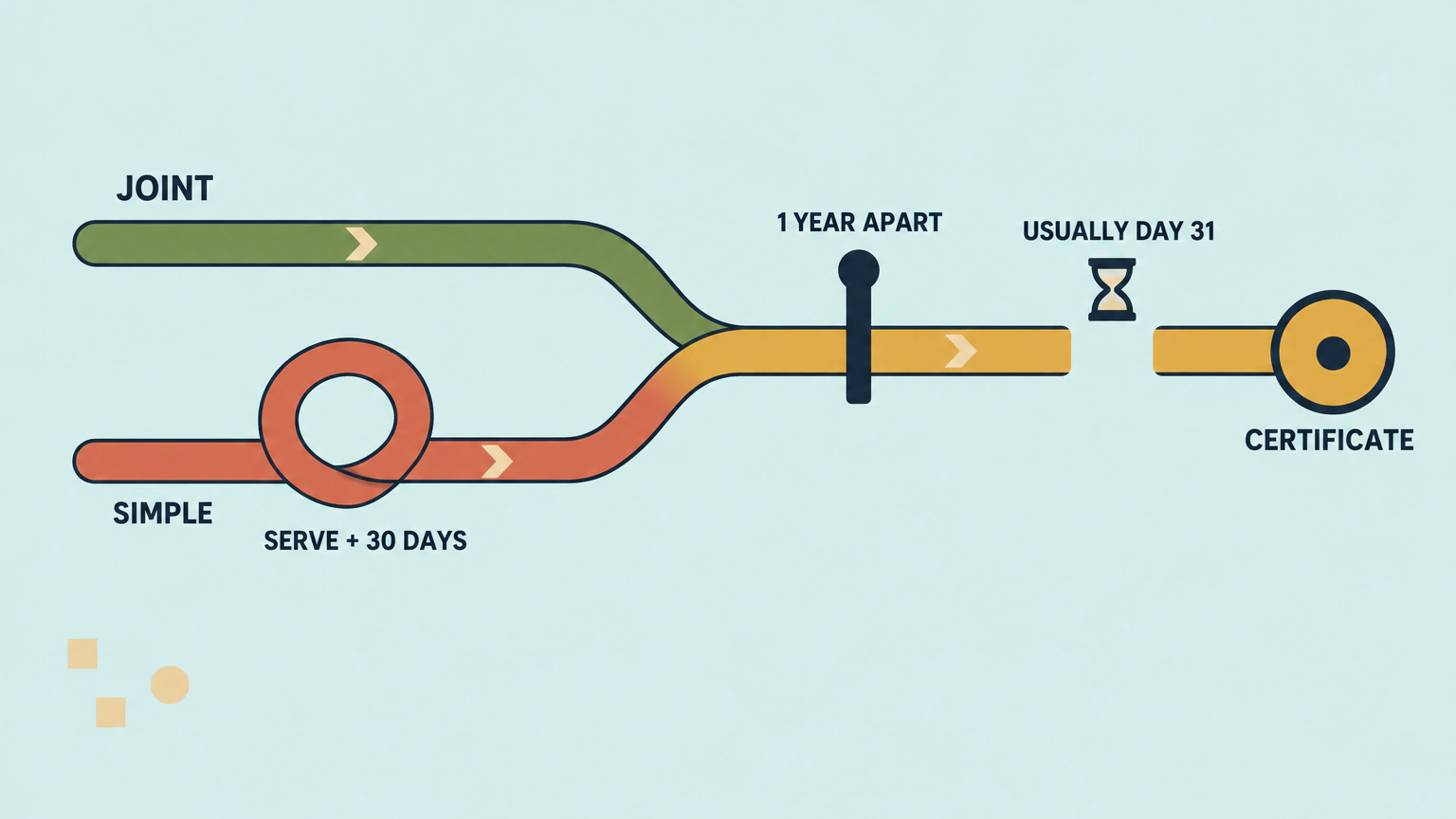
Then you wait for the registry. The ministry's checklists say the federal clearance can take four to six weeks, and the clerk holds the file until it arrives. After that the clerk hands your papers to a judge. There's no hearing for either of you to attend.
What the judge looks for on paper
A judge has three options under the Rules: grant the divorce as you drafted it, send the papers back for corrections, or change the order or refuse it. Before changing or refusing, the judge has to let you file another affidavit or come to court and explain.
Child support can stop the divorce. The Divorce Act tells a judge to check that "reasonable arrangements have been made for the support of any children of the marriage". The child support guidelines are the measure. A judge must hold the divorce until those arrangements are made. Form 36 therefore asks for the paying parent's income, the guideline table amount and what's actually being paid.
Other avoidable problems include service that broke the rules, an affidavit that wasn't properly sworn, and a name that doesn't match the marriage certificate. The ministry's checklists say every family court office has commissioners who'll swear your affidavit for free.
When the divorce takes effect, and the certificate you'll need to remarry
The judge's signature doesn't end the marriage that day. A divorce usually takes effect on the 31st day after the judgment. An appeal can delay that date. A court can shorten the wait only in special circumstances, and only if both spouses agree and undertake not to appeal, or any appeal has been abandoned. Until the divorce takes effect, you're still married.
Once the divorce takes effect, either of you can ask the filing court for Form 36B, the certificate of divorce. It costs $25 and can be requested online, in person or by mail. Ontario's marriage licence page says: "A divorce order issued by a judge is not the same as a certificate of divorce which acts as the proof of a divorce."
| What you're waiting for | How long | Where the rule comes from |
|---|---|---|
| One of you living in Ontario before you file | At least 1 year | Divorce Act, s. 3(1) |
| Being apart before the judge signs | At least 1 year | Divorce Act, s. 8(2)(a) |
| Trying to reconcile without restarting that year | Up to 90 days in total | Divorce Act, s. 8(3)(b)(ii) |
| Staff review of an online filing | Within 3 business days | Ontario's online filing service |
| Serving your spouse, simple application | As soon as possible, within 6 months of issue | Ministry of the Attorney General checklist |
| Your spouse's time to file an Answer | 30 days, or 60 outside Canada and the U.S. | Family Law Rules, r. 10 |
| The federal registry clearance | About 4 to 6 weeks | Ministry of the Attorney General checklists |
| The divorce taking effect | Usually the 31st day after the order, later if an appeal is pending | Divorce Act, s. 12 |
| Bringing a property claim | Earliest of 2 years after divorce, 6 years after separation with no reasonable prospect of resumed cohabitation, or 6 months after the first spouse's death | Family Law Act, s. 7(3) |
The property deadline warning in Form 36
Paragraph 7 of the affidavit is one sentence long. It has you swear you're aware that a claim to divide property may be legally impossible "six years after the date of separation or two years after the divorce, whichever comes first."
Form 36 gives a short warning about two of the Family Law Act's three deadlines. The six-year deadline applies after the spouses separate with no reasonable prospect of resumed cohabitation. The third deadline is six months after the first spouse's death, and the earliest deadline applies. On a motion, a court can extend a deadline if there are apparent grounds for relief, the delay was in good faith and no one suffers substantial prejudice. The divorce itself starts the two-year clock.
Think about what that does to a quick, cheap divorce. If the house, the pensions or the savings are still unsettled when the divorce takes effect, you may have two years left to ask a court to divide them. You may have less if six years have passed since you separated with no reasonable prospect of resumed cohabitation. That's unfair to the spouse who trusted it could wait. One line in a four-page form is all the warning you get.
We'd settle property first, or get it into a signed separation agreement, before letting a judge sign the order. For the home itself, we've set out what Ontario's law does with the family home.
Red flag: Before you swear Form 36, read paragraph 7. It says a property claim may be impossible "six years after the date of separation or two years after the divorce, whichever comes first." The Act adds a condition to the six-year limit: it applies only after separation with no reasonable prospect of resumed cohabitation. A fast divorce starts that two-year clock even if the house, pensions and savings are still unsettled. Settle property first, or put it in a signed separation agreement, before a judge signs your order. If that isn't done yet, talk to a family lawyer.
Doing it yourself, or getting some help
You can file a joint divorce without a lawyer. You can also file a simple divorce yourself if your spouse won't contest it. This route fits when there are no children or child support is already settled, and no property is left to divide.
The ministry names two free sources of help. The Guided Pathways from CLEO (Community Legal Education Ontario) ask you questions and build the Ontario divorce forms from your answers. The Law Society Referral Service gives you the name of a lawyer who offers a free first consultation of up to 30 minutes.
A divorce stops being paperwork when your spouse can't be found or files an Answer, when child support isn't settled, when property is still open, or when you married outside Canada. That's when a family lawyer earns the fee. Ask whether they'll handle only the part that's stuck. You can find a divorce lawyer near you in our directory, and if the account ever looks wrong, we've explained how to challenge a lawyer's bill in Ontario.
We're not your lawyer. If your spouse is contesting, child support isn't settled or property is still open, a family lawyer is worth the call before you file.
Start with two small things tonight. Write down the date you separated, and find your marriage certificate.
Questions people ask
Can I file for divorce in Ontario before we've been separated a year?
Yes, if you're already living apart when you file. The Divorce Act counts the year up to the judge's decision, not your filing date, so a judge can't sign early. The head start helps a simple application: you can serve your spouse and let the answer window run inside the year. On a joint application, both affidavits go in with the application, so wait for the full year.
Can I get divorced in Ontario if my spouse won't sign?
Yes. That's what a simple application is for. You file alone, someone else serves your spouse, and if no Answer comes back within 30 days you file your affidavit and the judge decides on paper. Your spouse's signature isn't needed. If your spouse files an Answer, the case becomes contested. If you can't find them at all, you'll need a court order about service first.
How much does it cost to file for divorce in Ontario?
The court fees come to $669: $214 to file the application, a $10 federal registry fee and $445 to put the case before a judge. A certificate of divorce is $25 more if you want one. A fee waiver covers the court's own fees. The $10 fee also drops out if legal aid covers your divorce and your provincial filing fees are waived. Serving costs aren't covered.
How long does a divorce take in Ontario?
It depends on your courthouse, but the fixed parts are known. You need a full year apart before a judge signs. On a simple application your spouse gets 30 days to answer. The federal registry check takes about 4 to 6 weeks, according to Ontario's own checklists. Without an appeal, the divorce usually takes effect on the 31st day after the order.
Can I file for divorce online in Ontario?
Yes, for both joint and simple applications. In the Toronto region you use the Ontario Courts Public Portal, and everywhere else Justice Services Online. You'll need an Ontario.ca Login, your forms as PDF or Word files, and a Visa or Mastercard, credit or debit. Staff review your filing within three business days, and the fees are the same as at the counter.
Do I have to go to court to get divorced in Ontario?
Usually not. On a joint application, or a simple one your spouse doesn't answer, a judge reviews your papers without either of you there. The judge can send them back for corrections, or ask for more evidence or for you to come in and explain. That can happen over child support arrangements or how your spouse was served.
When can I remarry after a divorce in Ontario?
Once the divorce takes effect, you can remarry. That is usually the 31st day after the judge signs the order, but an appeal can delay it. Until then you're still married. To get a marriage licence you'll need proof of the divorce, and Ontario says a judge's divorce order isn't the same as a certificate of divorce. You can order the certificate from the courthouse where your case started for $25.