

On this page
- First, the answer
- What five provinces do with the home you brought in
- Two groups, and which one you are in
- Whose name is on title matters less than you think
- Three things that move the answer
- Quebec, and everywhere we did not check
- The clock you probably have not been told about
- Your first month
- What it costs to sort out
- Questions people ask
First, the answer
You're at the kitchen table doing arithmetic you never wanted to do, and the house is sitting in the middle of it. Maybe you bought it years before the wedding. Maybe your name is the only one on the deed. Somebody has already told you what that means, and they sounded certain.
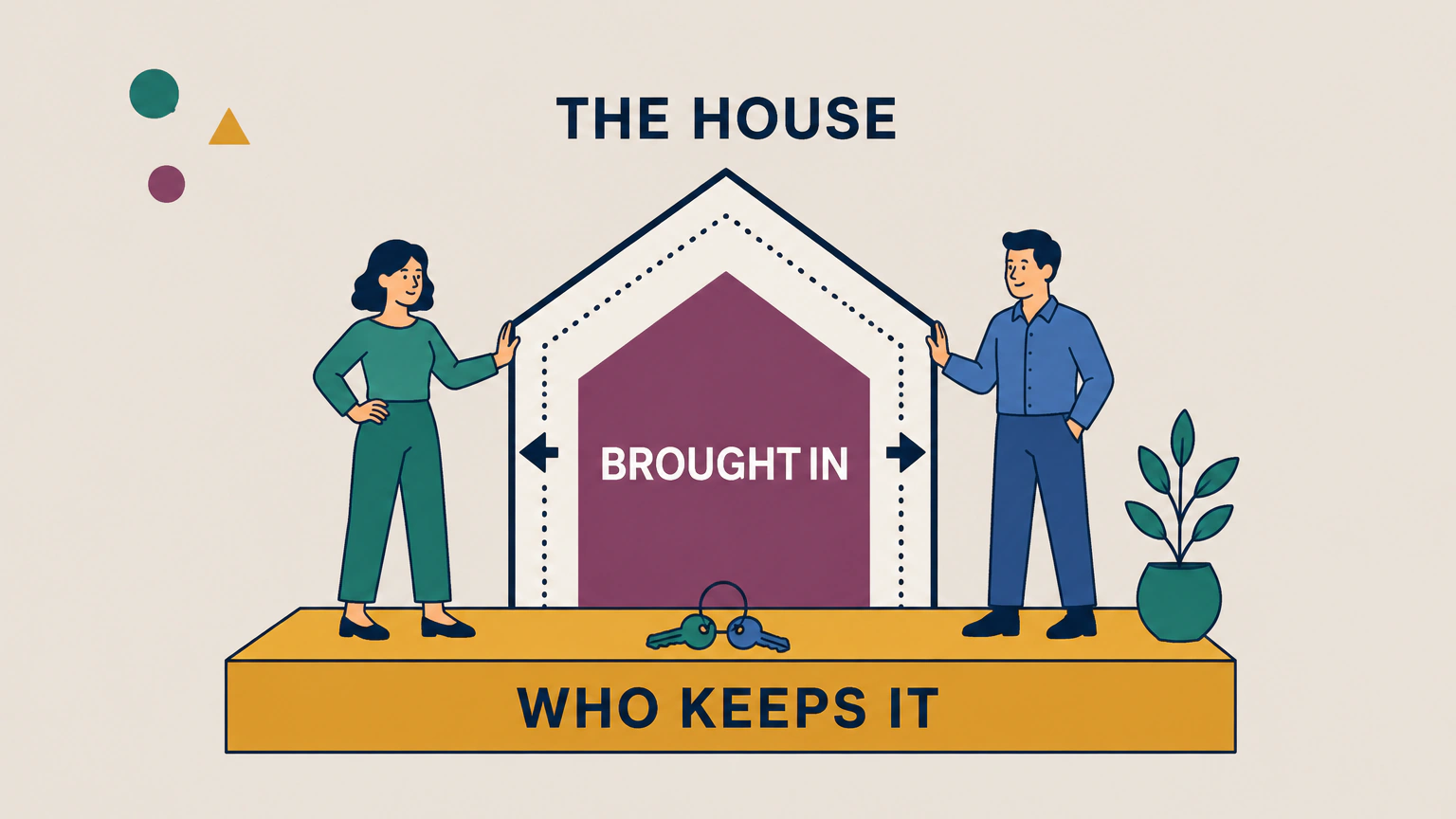
Whether owning the house first still counts for anything comes down to your province. Ontario and Saskatchewan put the family home into the split at full value, however you came by it. British Columbia, Alberta and Manitoba generally let you keep its starting value and share only the growth.
Divorce itself is federal. Property is not. Each province sets its own property rules, and on this one question they disagree with each other, sometimes flatly. So a page that answers "who gets the house in a divorce in Canada" with one rule is really answering it for one province and hoping you live there.
We read five of those Acts. Each has its own answer for a home a spouse brought in, in the statute's own words, and its own rules for who sleeps there next month.
Two different questions, and people mix them up
Two very different things get called "who gets the house", and they're decided separately.
The first is about value. Once everything either of you owns has been counted, who ends up with the money the house represents is a property-division question. Your province's family property Act answers it.
The second is about the front door. Who lives there next month, who leaves, who pays the mortgage meanwhile: that's possession, and a different part of the same Act answers it.
They routinely land in opposite places. A spouse who owns nothing on paper can have the legal right to stay. A spouse who owns everything can be ordered out for a year. Keep the two threads apart, because mixing them is how people talk themselves into a decision they can't undo.
What five provinces do with the home you brought in
Five provinces, read against their own statutes. The two that put the whole house on the table come first, then the three that let you keep what you brought. If your province isn't one of the five, the same reading works on your own Act, and it's the first thing worth taking to a family lawyer in your province.
| Province and Act | The home you owned before | What actually gets shared | Where it says so |
|---|---|---|---|
| Ontario, Family Law Act | Goes in at full value. The date-of-marriage deduction covers "property, other than a matrimonial home" | Half the difference between the two spouses' net family properties, with the home's full separation-day value inside yours | FLA ss. 4(1), 4(2) paras 1 and 5, 5(1) |
| Saskatchewan, The Family Property Act | Goes in at full value. The exemption covers family property "other than a family home or household goods" | The family home or its value, distributed equally unless an extraordinary circumstance or unfairness to the spouse with custody applies | FPA ss. 21(1), 22(1), 23(1) |
| British Columbia, Family Law Act | Stays yours. Property acquired before the relationship began is excluded property | Only the increase in the home's value since the relationship began, as an undivided half interest each | FLA ss. 81, 84(2)(g), 85(1)(a) |
| Alberta, Family Property Act | Stays yours, at its market value on the marriage date or the day you began living interdependently | Only the growth above that exempt value, distributed as the court considers just and equitable rather than automatically in half | FPA ss. 7(2)(c), 7(2.2), 7(3)(a) |
| Manitoba, The Family Property Act | The Act usually leaves it out, but reaches it if you bought it while already living together just before marriage or specifically for the relationship | When the Act leaves the home out, the appreciation during the marriage is added to your inventory and then equalized | FPA ss. 4(1)(c), 4(2), 4(3)(a), 13 |
We checked these five provinces against the statute. Quebec runs a different system, the family patrimony under the Civil Code of Québec. In any other province, start with its own family property Act and read what it says about the home before anything else.
Ontario: the one asset you cannot deduct
Ontario never orders a house cut in half. It does something less intuitive and, for a lot of people, more expensive. Each spouse adds up everything they own on the day they separate, subtracts their debts, then subtracts the value of what they brought into the marriage. Usually, whoever ends up with the smaller total gets half the difference.
The whole argument lives in that last subtraction. The Family Law Act lets you deduct "the value of property, other than a matrimonial home, that the spouse owned on the date of the marriage." Four words, buried in a definition, and they're why twenty years of ownership can come to nothing.
Say you walked into the marriage with a paid-off house worth $400,000, and on the day you separate it's worth $900,000. Your spouse's pre-marriage savings come off their total. Your house doesn't come off yours. All $900,000 stays in your column, and the payment you owe is calculated on it.
It reaches past the family bungalow, too. Ontario's definition catches every property ordinarily occupied as the family residence at separation, so the cottage everyone used in July can be a matrimonial home as well.
Saskatchewan: the family home sits outside the exemption
Different statute, same destination. Saskatchewan's Family Property Act does exempt what you owned when the relationship started, but the exemption applies to family property "other than a family home or household goods." The house is written out of the protection in the same breath that creates it.
Then the Act goes further. Where the family home is in play, a court "shall distribute the family home or its value equally between the spouses," and the way out is narrower than for anything else. For the rest of the property a judge weighs a long list of fairness factors. For the home there are two doors: an extraordinary circumstance, or unfairness to the spouse who has custody of the children.
One more thing surprises people. Saskatchewan's Act reaches couples who never married, once they've lived together as spouses continuously for two years. Same rules, same home.
British Columbia: you keep the value from the day you moved in
British Columbia runs the opposite way, and it's clean. Property a spouse acquired before the relationship began is excluded property. What gets shared is "the amount by which the value of excluded property has increased" since then. On separation each spouse has a right to an undivided half interest in the family property, as a tenant in common.
So the $400,000 you brought in is excluded property. The $500,000 of growth is family property, and the starting point is an equal split.
The starting date holds a trap that costs people real money. A relationship begins on the earlier of the day you moved in together and the day you married. A couple who lived together five years before the wedding measures from the move-in date, which usually means a lower starting value and a bigger shared increase.
Unmarried couples are in the same regime after two years together. The Act's other route to spouse status, having a child together, expressly does not apply to property division.
Alberta: the value is exempt, the growth is the court's call
Alberta protects the value you brought in. The market value of pre-marriage property on the applicable date is "exempted from a distribution". That date is the marriage, the day you began living interdependently, or the day you acquired the property, whichever comes later.
The growth is where Alberta parts company with everyone else. The difference between that exempt value and what the property is worth at trial goes to the court, which distributes it "in a manner that it considers just and equitable" after weighing a list of statutory factors. That's a discretion, not a formula. Property acquired during the marriage is the part the Act presumes gets split equally.
Of the five, this is the one where nobody can promise you a number. And "family home" in Alberta's Act does less than the name suggests: it drives possession orders, not the exemption.
Manitoba: the Act does not reach what you owned before
Manitoba puts it as plainly as a statute can. The Family Property Act "does not apply to any asset acquired by a spouse ... while unmarried."
Two exceptions matter, because both are common. The Act does reach an asset you bought before the wedding if you were already living together in a conjugal relationship immediately beforehand, or if you bought it specifically in contemplation of moving in together or marrying. A house bought three months before the wedding, for the two of you, is exactly what gets pulled back in.
Where the exclusion holds, the appreciation still counts. Any increase in value while you were married and living together is added to your inventory of assets, and the two inventories are then equalized.
Five Acts, and a pattern you can see from a distance.
Two groups, and which one you are in
These five provinces split in two on this question.
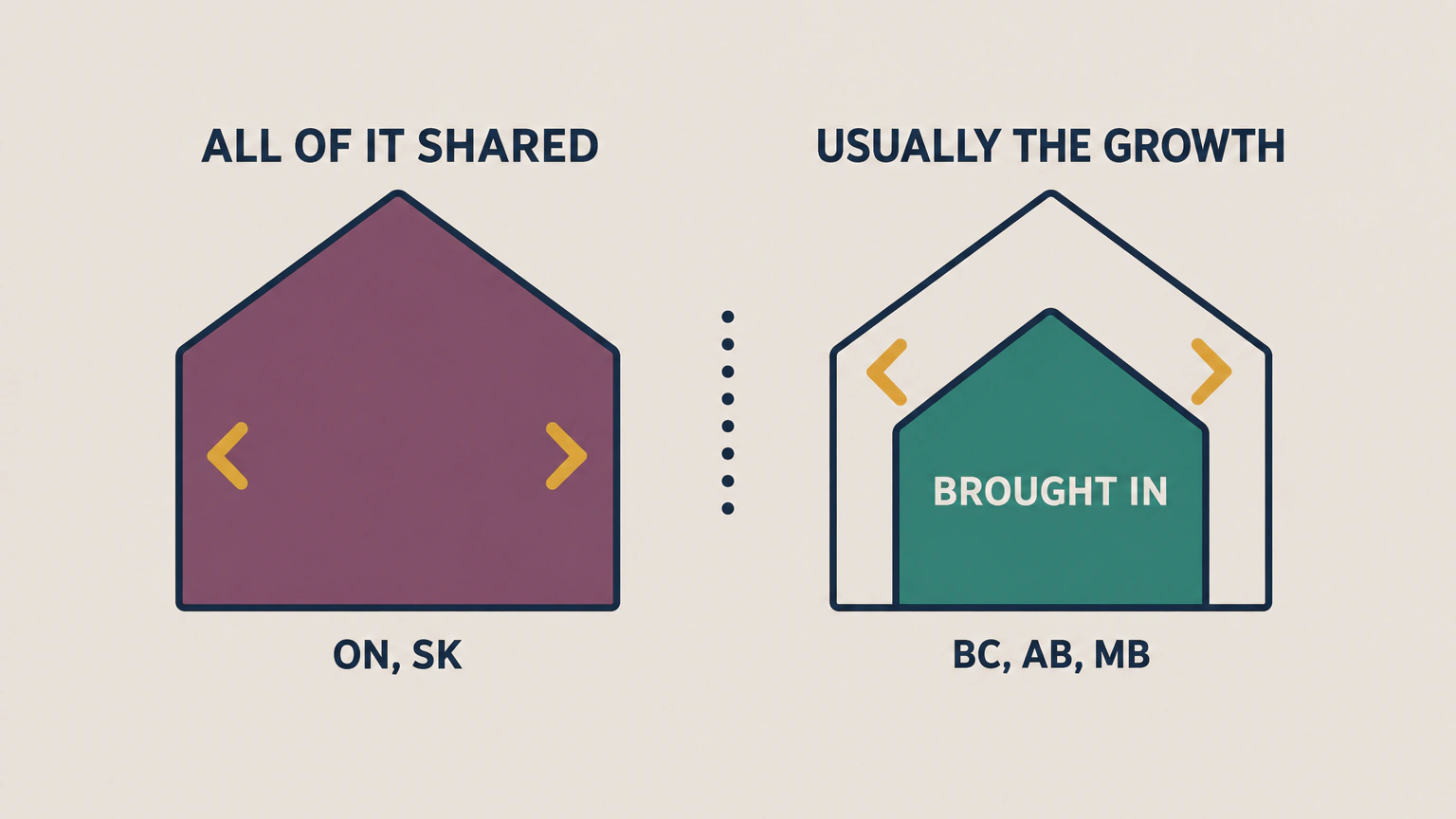
Ontario and Saskatchewan put the whole house on the table. British Columbia, Alberta and Manitoba put only the growth on it. That sounds like a technical difference. It isn't.
Take the same couple twice. One house, bought for $400,000 before the relationship started, worth $900,000 on the day they separate, no mortgage left, every other asset set aside.
In British Columbia, $400,000 stays with the owner and the $500,000 of growth is family property, so the other spouse's half interest is worth $250,000. In Ontario, the full $900,000 sits inside the owner's total, and on those bare facts the other spouse's half of the difference is $450,000.
Same house, same twenty years, roughly $200,000 between the two answers.
Whose name is on title matters less than you think
Someone has probably told you the house is theirs because the deed says so, or told you that you have to leave, for the same reason. Both are the same mistake, and it's worth taking apart before it turns into a decision. Title controls who can sign things. It doesn't decide who lives there, and it doesn't decide who ends up with the value.
You both have the right to be there, and neither of you can sell alone
In Ontario, both spouses have an equal right to possession of a matrimonial home. Not the owner. Both. That right lasts while you're still spouses, whatever the deed says.
The bigger surprise is the lock on the bank's door. No spouse may dispose of or encumber an interest in a matrimonial home unless the other joins in the instrument or consents, a court has authorized it, or the other spouse released their rights in a separation agreement. Ignore that and the transaction can be set aside, so the buyer or the lender can lose the deal too. Saskatchewan gives both spouses an equal right of possession in the family home the same way.
That covers more than a sale. A remortgage is an encumbrance. So is a line of credit secured against the house. A buyout or a transfer of title is work for a real estate lawyer alongside your family lawyer, and it comes after the property question is settled.
When a court orders one of you out
Courts can separate the two questions completely, and they do.
In Ontario, regardless of who owns the matrimonial home, a court can order that one spouse have exclusive possession of it for whatever period the court directs. It can order that spouse to make periodic payments to the other. It can order either of you to cover repairs, maintenance and the other liabilities that come with the place. Alberta's Act carries the same power over the family home, and that includes ordering a spouse out.
None of that changes who owns anything. Exclusive possession decides the next few months. The property division decides the money. The spouse who stays may still owe the payment.
Red flag: Moving out doesn't settle who keeps the house and doesn't end your right to be there, but it does change the facts on the ground. Get the arrangement written down before you go, not after. And don't sign a transfer, a new mortgage or a line of credit against the home while this is unresolved. In Ontario your spouse has to join in or consent, and the transaction can be set aside if they didn't.
Three things that move the answer
The province sets the baseline. The first of the three is the most common version of this question we see.
The inheritance that went into the house
Ontario excludes gifts and inheritances that arrive during the marriage, then quietly takes the exclusion back for the house. The wording covers "property, other than a matrimonial home, that was acquired by gift or inheritance from a third person after the date of the marriage." The paragraph after it excludes property an inheritance can be traced into, and it carries the same four words.
Put your mother's legacy into the down payment on the family home and, in Ontario, the protection is gone. If you keep it in a separate, traceable investment account that you still own at valuation, it stays excluded. The money didn't change. The address did.
Saskatchewan doesn't give inheritances a blanket exemption during the relationship, and its pre-relationship exemption also carves out the family home. British Columbia starts the other way: an inheritance and property derived from it are excluded, so your contribution normally stays yours while the increase is shared.
A domestic contract, signed before or during
A written agreement is the one lever that works in all five provinces we read.
Ontario keeps out of net family property anything "the spouses have agreed by a domestic contract is not to be included." British Columbia's equal-entitlement rule opens with the words "subject to an agreement or order that provides otherwise." Saskatchewan exempts family property, including a family home, that an interspousal contract deals with. Alberta's Part 1 steps aside for property covered by an enforceable written agreement. Manitoba's Act doesn't apply to an asset disposed of by a spousal agreement, and where the agreement says nothing about an asset, the Act applies to it as though no agreement existed.
The formalities are strict, and they're where homemade contracts fail. Saskatchewan and Alberta both require each spouse to acknowledge in writing, apart from the other, that they understand the agreement and are giving up claims. That has to happen in front of a lawyer who isn't acting for the other side. Saskatchewan courts can also set a contract aside if it was unconscionable or grossly unfair when it was signed. A template you both sign at the kitchen table is none of that.
If you never married
Where you stand depends on the province, and the gap is wide.
British Columbia and Saskatchewan bring unmarried couples into the same property regime after two years together, so their rules apply to you unchanged. Manitoba reaches common-law partners who registered their relationship or lived together for three years. Alberta has its own test for adult interdependent partners.
Ontario is the outlier that catches people. The family property Part of Ontario's Act covers married spouses only, because the Act defines a spouse as someone who is married. Twenty years of cohabitation in Toronto gives you no equalization claim, and what's left are harder, slower arguments about trusts and contributions.
The other half of that worry is what happens when one of you dies. We wrote up what happens if your partner dies without a will province by province, and those answers surprise people just as much.
Quebec, and everywhere we did not check
Quebec has no family property Act at all. It runs the family patrimony, a creature of the Civil Code of Québec, and it isn't a Quebec-flavoured version of the same machinery. Reading Ontario's rules and mentally translating them will give you the wrong answer.
We read five statutes, and the Civil Code wasn't one of them. What we can tell you comes from Éducaloi, Quebec's public legal-information service: the family's homes are on the list of what the family patrimony includes, and property belonging to only one spouse can still be in it. Éducaloi also says the value of what's in the patrimony is normally divided equally when a marriage ends. That's the starting point, and a Quebec lawyer or notary is the next step.
For any other province, the method transfers even where the answer doesn't. Find your province's family property Act by name. Then read two things first: whether the exemption for what you brought in has a carve-out for the home, and what date the home's value is measured at. Those two answers tell you which group you're in.
The clock you probably have not been told about
Every one of these Acts has a deadline, and they're nothing like each other.
Ontario runs to the earliest of three dates: two years after a divorce or a judgment of nullity, six years after the spouses separate with no reasonable prospect of getting back together, or six months after a death. Whichever arrives first is the deadline. A court can extend it if the delay was in good faith, there are apparent grounds for relief and no one suffers substantial prejudice.
British Columbia gives two years, running from the divorce or nullity order for married spouses and from the date of separation for unmarried ones. The clock stops while you're in family dispute resolution with a professional, which is unusually forgiving.
Alberta gives two years from the decree, declaration or judgment, or two years from separation where the claim rests on separation instead. A single attempt at reconciliation of up to 90 days doesn't count against the separation clock. Saskatchewan gives unmarried spouses 24 months after the cohabitation ends.
And Manitoba gives 60 days from the day the divorce takes effect. Not two years. Sixty days. A court can extend it if you didn't know about the divorce or its date, or for circumstances beyond your control, but that's a rescue, not a plan. It's the shortest deadline of the five.
Your first month
You're exhausted and the list is already too long, so we've kept this short. Most of it is just gathering paper, and all of it is cheap now and expensive later.
- Write down the date you separated. Valuation dates and several of the deadlines run from it.
- Find out what the home was worth on the day you married or moved in together.
- Get a current market value too. In BC, Alberta and Manitoba the gap between the two is what gets shared.
- Pull the title search. Whose name is on it changes less than you think, but you need to know.
- Do not transfer, sell or borrow against the home until the property question is settled or your spouse has consented.
- List anything that went into the house from outside the marriage: an inheritance, a gift, a pre-marriage deposit.
- Check whether you signed a marriage contract or cohabitation agreement, and find the copy you actually signed.
- Ask a family lawyer in your own province before your deadline, not after. Manitoba's is 60 days.
What it costs to sort out
Money is why a lot of people never make the call, and Statistics Canada has measured it. In its 2021 survey of serious legal problems, about a third of people contacted a legal professional at all. More than a third of those who acted without one said they couldn't afford the help.
Here's our own number, for what it is. Across 881 cost profiles on our divorce and separation directory, the average is $6,243, with a fair price range of $4,683 to $8,844. That's our directory aggregate rather than a national market average, and what any file costs turns on how much of it gets fought over.
Set it against what it buys: a house worth $200,000 more or less depending on which group your province is in, a 60-day window in Manitoba, and a bank about to register a charge that can be set aside.
We're not your lawyer, and a house is the last thing to guess about. Take your own numbers to someone who practises family law in your province before you sign anything. If the bill that follows looks wrong, that's a separate and fixable problem, and we've written up how to challenge the bill when it arrives.
So start with your own province's Act and those two questions. Then find divorce and separation lawyers near you and bring them the date you separated, the two valuations and the title search.
Questions people ask
If I owned the house before we married, do I still have to share it?
In Ontario and Saskatchewan, yes. Both Acts carve the family home out of the deduction for what you owned before, so its full value at separation goes into the division. In British Columbia and Alberta, the starting value is protected by the default rule. Manitoba usually does the same, but not if you bought the home while already living together or specifically for the relationship.
Does it matter whose name is on the title?
Less than you'd expect. Ontario gives both spouses an equal right to possession of the matrimonial home no matter who owns it, and Saskatchewan does the same with the family home. Title still controls who can sign a sale or a mortgage, so it matters for paperwork. It doesn't decide who ends up with the value.
Can my ex force me to sell the house?
In Ontario, not on their own unless you've released your rights in a separation agreement. Otherwise, a sale needs your consent or a court order, and a court can order property partitioned or sold to satisfy an equalization payment. Get advice before you agree to list it.
Can I sell or remortgage the house without my spouse signing?
In Ontario, no. A spouse can't dispose of or encumber an interest in a matrimonial home unless the other joins in or consents, a court authorized it, or rights were released in a separation agreement. A transaction done anyway can be set aside. The rules differ elsewhere, so ask before you sign anything at the bank.
I used my inheritance for the down payment. Is that protected?
In Ontario, usually not. The exclusion for gifts and inheritances stops at the matrimonial home, and it stops again for anything traced into one. Saskatchewan treats inherited property under its general family-property rules, and its pre-relationship exemption carves out the family home. British Columbia excludes an inheritance and property derived from it, while the increase is family property.
Who has to move out when you separate?
In Ontario and Saskatchewan, nobody has to move unless you agree or a court orders it. Both provinces give spouses an equal right to possession of the family home regardless of ownership. A court can grant one spouse exclusive possession for a set period. Moving out voluntarily doesn't end your right to be there.
How long do I have to make a property claim after we split up?
It depends on your province, and one of them is brutal. Manitoba gives 60 days from the day the divorce takes effect. Ontario runs to the earliest of two years after the divorce, six years after separation, or six months after a death. British Columbia and Alberta each give two years, measured differently depending on the claim.