

On this page
- The answer depends on which province you were living in
- Where you stand in five provinces
- The number of years is different for every question you ask
- What may pass outside the estate
- If your province leaves you out, you are not finished
- What to do in the first two weeks
- The cheapest document you will ever sign
- Questions people ask
The answer depends on which province you were living in
Somebody has already said it to you. A teller, a relative at the funeral, a voice from a pension office: you were never married, so you are not next of kin. Nobody has told you whether that is even true.
If your common law partner dies without a will, whether you inherit anything depends on the provincial law that applies to the estate and whether you meet its test. In British Columbia, Alberta and Manitoba, a qualifying partner counts as a spouse and can take the entire estate. In Ontario, the word "spouse" for intestacy stops at marriage, and a partner of thirty years is not on that list, though a support claim against the estate may be possible, generally within six months after the grant. Quebec sits between those two, and only since the summer of 2025.
That's why no honest page answers this for "Canada". Who inherits is governed by provincial law, and each province applies its own statutory definition or cross-reference for "spouse". "Common law" is not one status you either have or don't have. It means one thing to the Canada Pension Plan and something else to the Act that decides your partner's estate. We read the statute for five provinces: British Columbia, Alberta, Manitoba, Ontario and Quebec.
What "no will" actually sets in motion
Dying without a will is called dying intestate, and it does not mean nobody gets anything. It means the province supplies the will your partner never wrote. Its law sets the order of heirs. Whether a person or an asset falls within those rules can still require evidence, or a court's decision.
What your partner promised you in the kitchen last spring does not settle who inherits. An unsigned note may not be enough either: whether a document can be treated as a will depends on the law that applies. The court will appoint someone to gather the money in, pay the debts and hand out the rest.
So everything turns on one question: is your name on the list?
Where you stand in five provinces
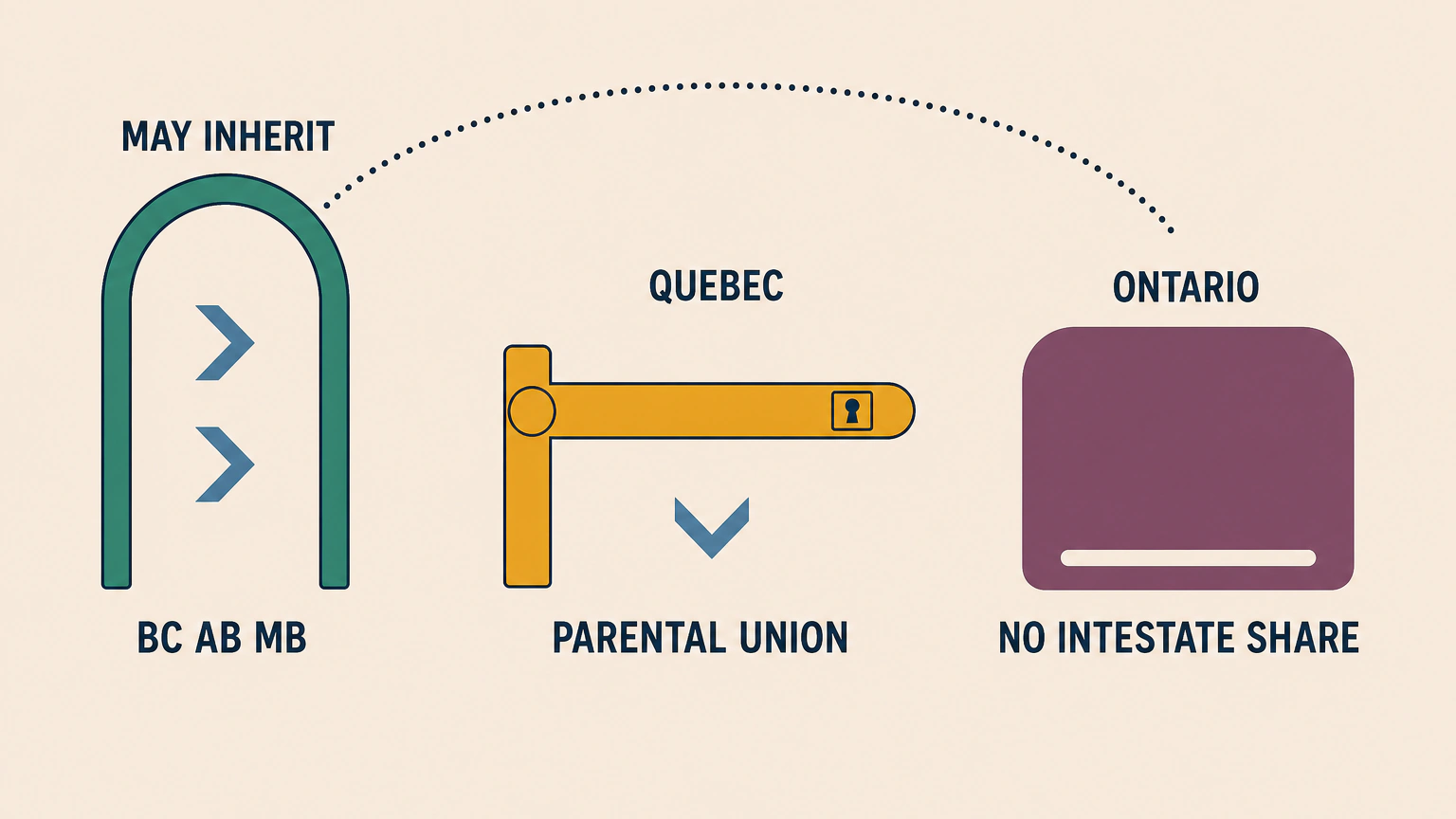
B.C., Alberta and Manitoba recognize qualifying unmarried partners. Ontario's intestacy rules do not. Quebec now recognizes parental-union spouses.
| Province and Act | Do you count as a spouse? | What has to be true | What you receive |
|---|---|---|---|
| British Columbia, Wills, Estates and Succession Act | Yes | Lived together in a marriage-like relationship for at least 2 years (s. 2(1)(b)) | The spousal share is the whole estate if there are no descendants (s. 20). With descendants: household furnishings plus $300,000 if all are the couple's own, $150,000 if not, plus half the residue (s. 21). If 2 or more spouses qualify, s. 22 governs how they divide that share |
| Alberta, Wills and Succession Act with Adult Interdependent Relationships Act | Yes, as an adult interdependent partner | 3 continuous years of a relationship of interdependence, or some permanence with a shared child, or a valid adult interdependent partner agreement (AIRA s. 3(1)) | Whole estate if no descendants (s. 60) or all descendants shared (s. 61(1)(a)). Otherwise the greater of $150,000 or 50% of the net estate (s. 61(1)(b)). Sections 62 and 63 can change the result where a spouse also survives |
| Manitoba, The Intestate Succession Act | Yes, as a common-law partner | Registered under the Vital Statistics Act, or 3 years of cohabitation, or 1 year with a shared child (s. 1(1)) | The partner's share is the whole estate if there is no issue (s. 2(1)) or all issue are shared (s. 2(2)). Otherwise it is the greater of $50,000 or half, plus half of any remainder (s. 2(3)). Section 3 can change priority where relationships overlap or ended |
| Ontario, Succession Law Reform Act | No | Nothing does it. SLRA s. 1(1) takes "spouse" from Family Law Act s. 1(1), which covers only married couples | Nothing under the intestacy rules. A separate claim against the estate may be possible under Part V: see the section below |
| Quebec, Civil Code of Québec | Only in a parental union | The couple became parents of the same child after 29 June 2025, with no minimum time living together (art. 521.20), or they were already parents on that date and opted in under the transition | One third where there are descendants (arts. 653 and 666); two thirds where there are no descendants but privileged ascendants or collaterals (arts. 672 and 673); otherwise the whole succession (art. 671). A de facto spouse outside a parental union has no intestate share |
These five provinces are the ones we checked against the statute. If another province's law may apply to the estate, start with its intestacy rules and its definition of "spouse".
British Columbia: two years in a marriage-like relationship
British Columbia uses a fixed two-year cohabitation test and states it in one line. Two people are spouses under the Wills, Estates and Succession Act if they "had lived with each other in a marriage-like relationship for at least 2 years" (s. 2(1)(b)). No registration, no agreement, no children required.
What that buys depends on whether your partner had descendants. If there are none, the whole intestate estate is yours (s. 20). If there are children or grandchildren, s. 21 gives you the household furnishings plus a preferential share off the top, then splits the rest in half between you and them. That share is $300,000 where all the descendants are yours together, and $150,000 where any of them are not.
B.C.'s family law legislation lets a child shorten the two-year test for some purposes. The estates Act does not.
Alberta: three years, a child, or a signed agreement
Alberta does not use the phrase "common-law spouse" at all. It asks whether you were your partner's adult interdependent partner, and the Adult Interdependent Relationships Act gives three ways in (s. 3(1)): three continuous years in a relationship of interdependence, a relationship of some permanence where you are the parents of a child, or a signed adult interdependent partner agreement. That last route skips the three-year wait, but the agreement has to be valid under the Act.
Once you are in, the Wills and Succession Act treats you as it treats a married spouse. No descendants, and the entire estate is yours (s. 60). Descendants who are all yours together, same result (s. 61(1)(a)). Where any descendant is not yours, you take the greater of $150,000 or 50% of the net value of the estate, and the rest passes down to the children (s. 61(1)(b)).
Two sections matter if your partner was still legally married to someone else. Section 62 splits the share half and half between the spouse and the adult interdependent partner. Section 63 deems that spouse to have died first if they had been living separate and apart more than two years, or had a declaration of irreconcilability, or had already divided their property to finalize the break-up.
Manitoba: three years, one year with a child, or a registration
Manitoba's Intestate Succession Act writes its own definition of "common-law partner" in s. 1(1), and three things can satisfy it: a relationship registered under the Vital Statistics Act, or cohabiting in a conjugal relationship for at least three years, or at least one year if you are together the parents of a child.
From there the Act gives you the spousal share, subject to its own rules for relationships that ended or overlapped. The entire estate goes to you if there is no issue (s. 2(1)), and also if all the issue are yours together (s. 2(2)). Where any of the children are not yours, s. 2(3) gives you $50,000 or one-half of the estate, whichever is greater, and then half of whatever remains.
Registration is paperwork rather than a lawsuit, and it takes effect when the director registers the relationship. It cuts both ways: three years of separation takes an unregistered partner back out of the Act (s. 3(2)).
Ontario: the definition stops at marriage
Ontario is where readers get hurt, and the reason is two sentences in two different Acts.
The Succession Law Reform Act says, in s. 1(1), that "spouse", except in Part V, "has the same meaning as in section 1 of the Family Law Act". Turn to that section and a spouse is two persons married to each other, or who entered in good faith into a marriage that is voidable or void. There is nothing in it about living together. No exception for length, none for a shared mortgage, none for children.
So the machinery further down the Act never reaches you. The $350,000 preferential share a surviving spouse takes off the top, and the share of the residue that follows it, are rules for married spouses (ss. 44 to 46). Thirty years in the same house does not put you inside that definition, and no judge can put you there either.
That answer is genuinely unfair, and you're right to be angry about it. It is not the whole answer, though. Part V of the same Act uses a different definition on purpose, so do not conclude you have nothing until you have read it.
Quebec: inheritance through a parental union
Before parental unions, Quebec's intestacy rules did not treat de facto spouses as heirs. Statistics Canada's 2021 census put about 43% of Canada's common law couples in Quebec, so that silence covers a great many households.
Since 30 June 2025, one group of couples is out of it. The Civil Code now recognizes a parental union, formed under art. 521.20 when de facto spouses become the parents of the same child, "regardless of how long they have shared a community of life". Article 653 lists the parental union spouse among those a succession devolves to. With descendants, art. 666 gives that spouse one third. Without descendants, arts. 671 to 673 give the spouse the whole succession or two thirds, depending on which close relatives survive.
The conditions are strict. The couple must have become parents of the same child after 29 June 2025. Couples who were already parents on that date sit outside the new regime unless they opted in, by notarial act or by a private writing signed before two witnesses. Without one of those, a de facto spouse in Quebec inherits nothing on an intestacy, however many years and however many children came earlier.
The number of years is different for every question you ask
"Are we common law?" feels like a yes or no question, and it isn't one. Every statute that uses the phrase writes its own test for its own purpose, and the number you have heard at work is almost never the one that governs an estate.
| What you are asking about | How long you must have lived together | Where it says so |
|---|---|---|
| CPP survivor's pension | 1 continuous year, and still cohabiting at the death | Canada Pension Plan, s. 2(1) |
| A share of the estate in B.C. | 2 years in a marriage-like relationship | WESA s. 2(1)(b) |
| A share of the estate in Alberta | 3 years, or some permanence with a shared child, or a signed agreement | AIRA s. 3(1) |
| A share of the estate in Manitoba | 3 years, or 1 year with a shared child, or a registration | Intestate Succession Act s. 1(1) |
| A share of the estate in Ontario | No length of time qualifies you | SLRA s. 1(1), Family Law Act s. 1(1) |
| A claim against the estate in Ontario | 3 years, or a relationship of some permanence with a child | SLRA s. 57, Family Law Act s. 29 |
| A share of the estate in Quebec | No length of time. A parental union formed after 29 June 2025, or a valid transitional opt-in | Civil Code of Québec arts. 521.20 and 653; 2024, c. 22, ss. 45 and 46 |
The CPP relationship test uses one continuous year
The federal relationship-duration test is one continuous year, set out in the Canada Pension Plan's own definitions. A common-law partner is someone who was cohabiting with the contributor in a conjugal relationship at the relevant time, having done so continuously for at least one year. Where the contributor has died, that relevant time is the time of death (s. 2(1)).
Set that beside Ontario, and you can see the week ahead. Service Canada may start a survivor's pension while the province's intestacy rules do not recognize you at all. Two offices, one relationship, two opposite answers, and neither is a mistake. Check your federal eligibility, and apply for it separately from anything you do about the estate.
The family law number is not the estate number
Ontario shows the trap most cleanly, because all three definitions sit in the same two statutes.
The three-year test everyone quotes is real. It comes from s. 29 of the Family Law Act, which covers spouses plus two people who have cohabited continuously for at least three years, or who are in a relationship of some permanence and are the parents of a child. That definition governs spousal support, and the Succession Law Reform Act deliberately borrows it in s. 57 for claims against an estate.
For inheritance, the same Act reaches instead for the marriage-only definition in Family Law Act s. 1. Same statute book, two definitions, opposite results.
What may pass outside the estate
Before more law, check how each asset is owned and whether it carries a valid beneficiary designation. Some may fall outside the estate, depending on the asset and the law that applies.
Joint ownership and named beneficiaries
Joint ownership may keep something out of the estate, but the answer depends on how it is held, who beneficially owns it, and what the province's law says. Quebec does not use the common-law categories of joint tenancy and tenancy in common at all. Start with the title or account terms, then have someone check it before you transfer anything.
A valid beneficiary designation may also send insurance or plan proceeds outside the estate. How you make one, and what it does, varies by province and by plan, so check the current designation and the governing rules rather than assuming every RRSP, RRIF, TFSA or pension works alike.
The trap in Ontario: joint property can be pulled back
Ontario adds a wrinkle for anyone bringing a dependants' support claim.
When a court deals with a dependants' support claim, s. 72 of the Succession Law Reform Act counts the capital value of certain transactions as part of the net estate. Some joint accounts and property held as joint tenants come in that way, though s. 72(2) limits the amount to the deceased's own funds or consideration.
If you are claiming, that can widen the value available for a support order, though only as far as the section allows and subject to the burden rules in s. 72(3) and (4). Survivorship can keep property outside the intestacy distribution without necessarily keeping its value outside a Part V support calculation.
Red flag: Do not sell, transfer or spend anything that was in your partner's sole name before the estate is sorted out, even if you have been paying the bills on it for years. The administrator has to account for every dollar, and money that has moved is money you may be asked to return. In Ontario, do not treat a joint account as settled either: s. 72 may count some or all of its value for a support claim.
If your province leaves you out, you are not finished
If you are in Ontario, you have now been told twice that the intestacy rules give you nothing. True, and not the end of it. Part V of the Succession Law Reform Act lets certain people apply to the court for support out of an estate. It's a claim, decided by a judge on the facts, not an entitlement that arrives because you qualify on paper.
Who counts as a dependant, and who does not
There are two tests, and you have to pass both.
The first is the relationship test. Section 57 borrows the wider definition from Family Law Act s. 29, so a partner who cohabited continuously for at least three years, or who was in a relationship of some permanence with a shared child, is a spouse for this purpose. The definition that shut you out of the inheritance lets you in here.
The second is the one people fail. A dependant is someone to whom the deceased "was providing support or was under a legal obligation to provide support immediately before his or her death". Two salaries, split bills and separate accounts can look, on paper, like two independent adults. A partner who worked part-time so the other could travel, or who was carried through an illness, stands on much stronger ground. Gather the bank records early. Because the test runs on family law definitions, a family lawyer is often the right first call if you have a shared child or a long support history.
The six month clock, and the exception
Section 61(1) is short and unforgiving: no application for support may be made more than six months after a grant of probate or letters of administration is issued.
Notice what starts the clock. Not the funeral, not the death, but the grant. If nobody has applied for a grant, your six months has not started, and waiting is not costing you the claim. If someone else applied quietly in the weeks after the death, months of your window may be gone before you hear of it.
The safety valve is thin. Section 61(2) lets a court allow a late application, but only as to any portion of the estate not already distributed. Once the money is out the door there is very little left to reach. A claim is civil litigation. If a lawyer offers a contingency fee, find out how a lawyer's share is regulated where you live before you sign a retainer.
What to do in the first two weeks
Nobody makes good decisions in the first fortnight, so the goal is not to solve the estate. It's to stop the things that cannot be undone, and to collect the paper every route from here will ask for.
- Find out whether there is a will anywhere: a safety deposit box, a lawyer's file, a home safe, a will registry.
- Write down the date of death and the date any grant is issued. Ontario's Part V deadline runs from the grant.
- List every asset by how it is held: joint, sole, or with a named beneficiary.
- Do not close, drain or transfer a joint account until you know what your province's Act does with it.
- Apply for the CPP survivor's pension if eligible. Check who should apply for the death benefit; the estate's executor or administrator usually has first priority.
- Gather proof of the relationship: the shared lease or title, joint bills, insurance forms, mail addressed to both of you.
- Gather proof of support: who paid what, and for how long. In Ontario that is the half people fail.
- Book a first appointment with a lawyer who handles estate administration, before six months from any Ontario grant runs out.
The cheapest document you will ever sign
All of that applies because no valid will controlled the estate. A valid will can name you as a beneficiary in any of the five provinces, with no help needed from the intestacy Act's definition of "spouse". It can only deal with property the deceased owned, though, and it stays subject to the other claims and rules that reach an estate.
On our own platform, quotes from listed firms for estate planning run $320 to $1,062, drawn from 860 cost profiles, while the same aggregate for estate administration starts at about $3,200. Those are our figures for what firms quote, not a market average. The document that prevents all this costs a fraction of the process that follows when it is missing.
A contested dependants' claim can become prolonged litigation against people who used to come to your dinner table. Ask for the retainer in writing and read it. If the bill that lands later does not match it, what to do if the bill is not what you expected is a defined process, not a favour you have to ask for.
We are not your lawyer, and an estate is not a thing to guess at. Take what you have found here to someone licensed in your province before you sign, transfer or spend anything.
If you came here to plan rather than to grieve, act on it this week. Book an hour with estate planning lawyers in your province, and in Alberta or Manitoba ask about the agreement or the registration while you are there.
Questions people ask
Am I my partner's next of kin if we were never married?
Being called your partner's "next of kin" does not by itself decide whether you inherit. The governing intestacy law does. In British Columbia, Alberta and Manitoba a qualifying partner is inside that definition. In Ontario, only married spouses are, and in Quebec only a parental union spouse is.
How long do we have to live together before I count as common law?
It depends entirely on what you are asking for. B.C. uses two years. Alberta and Manitoba use three years but also have child or agreement or registration routes. The CPP relationship test uses one continuous year. In Ontario, no amount of time gives you an intestate share, though three years can satisfy the relationship limb of a support claim.
Does the house come to me if we owned it together?
Maybe. The result depends on the form and beneficial ownership, the governing provincial law and any claim against the estate. Start with the title, but do not transfer the property until a local lawyer has checked how those rules apply.
We have children together. Does that change what I inherit?
In Manitoba it can shorten the qualifying period to one year. In Alberta, a relationship of some permanence with a shared child qualifies you without the three years. In Quebec, a child born after 29 June 2025 is the whole basis of the parental union. In British Columbia it does not change the two-year test, and in Ontario it creates no inheritance.
My partner had a child from an earlier relationship. Do I still get a share?
In B.C., Alberta and Manitoba, a descendant from another relationship triggers the reduced-share formula. In B.C. you take the household furnishings, $150,000 and half the residue. In Alberta, it is the greater of $150,000 or half the net estate. In Manitoba, it is the greater of $50,000 or half, plus half of what remains. In Quebec, descendants leave a qualifying parental-union spouse one third.
How long do I have to make a claim against the estate in Ontario?
Six months from the date a grant of probate or letters of administration is issued, under s. 61(1) of the Succession Law Reform Act. The clock starts at the grant, not at the death. A court can allow a late application under s. 61(2), but only against the part of the estate not yet distributed, so a late claim against a fully paid-out estate is worth little.
Do I still get the CPP survivor's pension?
You may, and it is a separate question from inheritance. The Canada Pension Plan asks whether you were cohabiting in a conjugal relationship at the time of death and had done so continuously for at least a year. Payment also depends on the deceased contributor's CPP record. Apply for the survivor's pension if eligible, and check who should apply for the death benefit.