

On this page
- The short answer, by province
- What "no maximum" actually means in Ontario
- British Columbia sets numeric caps for injury claims
- Contingency fee rules by province: what is verified here
- The percentage is not the only thing that leaves your settlement
- Matters that cannot be taken on contingency at all
- Before you sign: what to check and what to ask
- If the fee already looks wrong
- Frequently asked questions
The short answer, by province
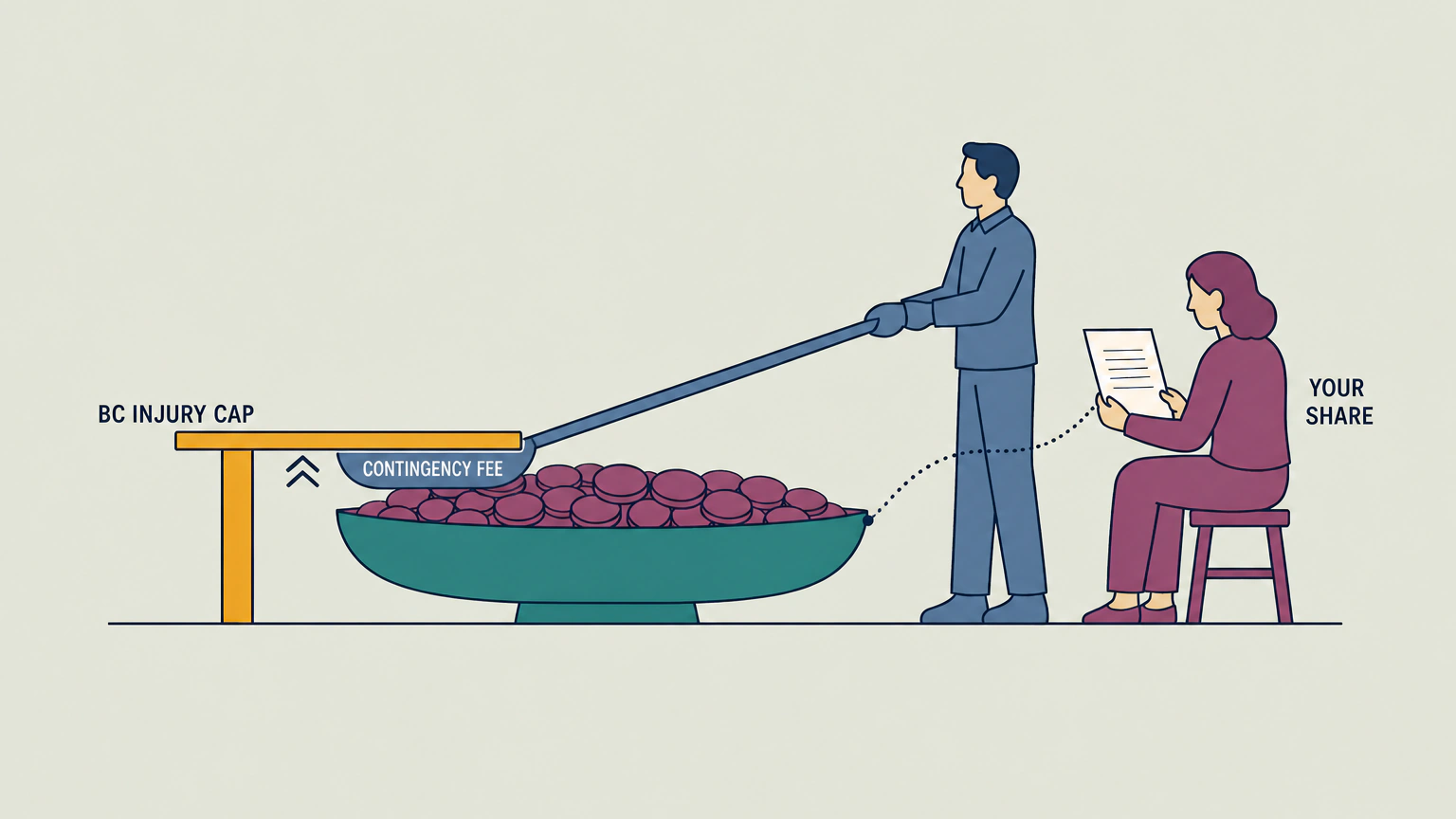
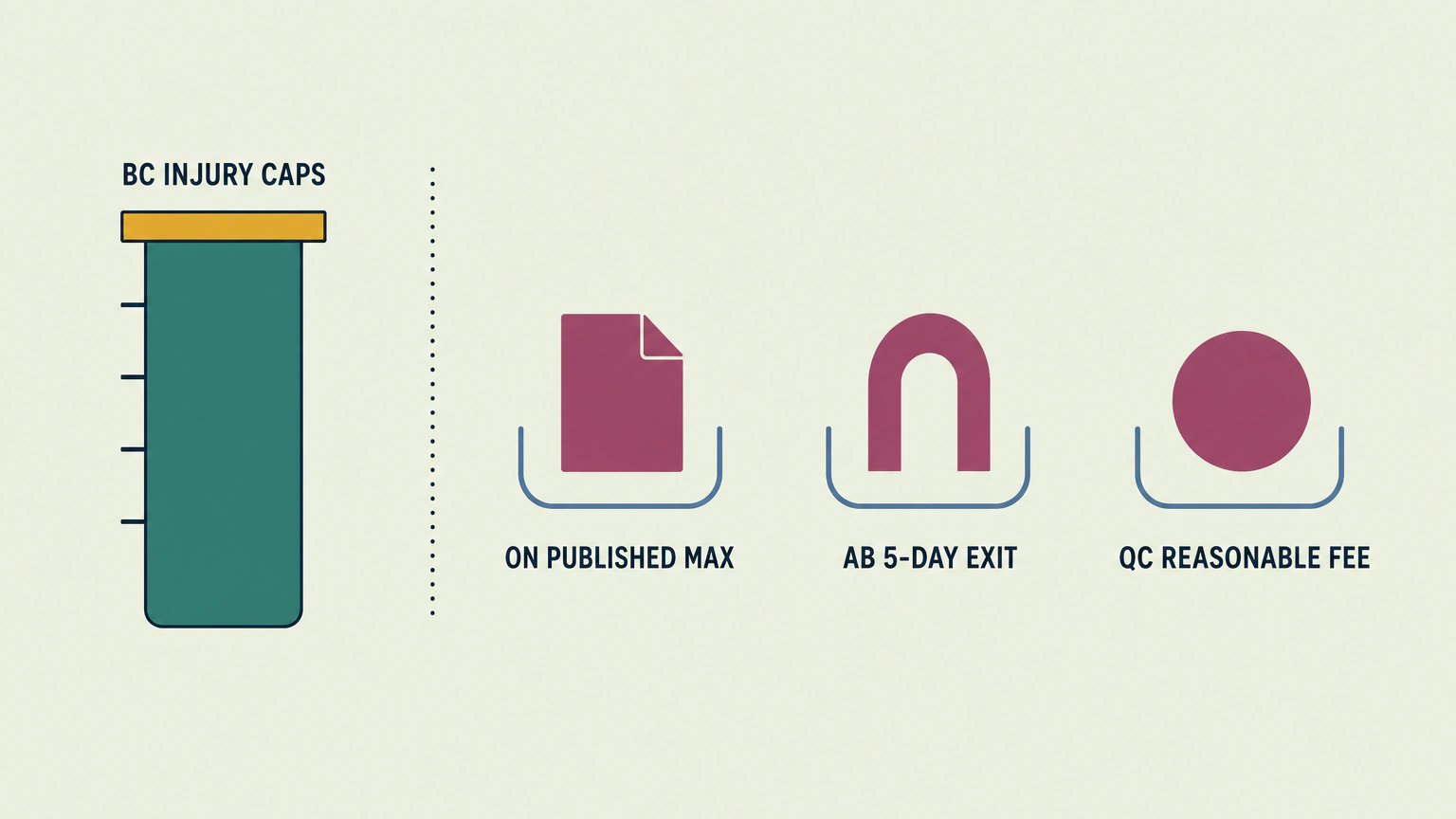
Among the four provinces checked here, only British Columbia puts a number on a personal injury contingency fee. Law Society of British Columbia Rule 8-2(1) sets the number. Without court approval, a lawyer acting for a plaintiff may charge at most 33 1/3 percent of the amount recovered in a personal injury or wrongful death claim arising out of the use or operation of a motor vehicle, and at most 40 percent in any other personal injury or wrongful death claim. Both ceilings run up to and including trial. If you want the maximum contingency fee in Ontario, the honest answer is that no percentage is prescribed there or in Alberta; for Quebec, no general percentage was identified in the current Code and Barreau guidance opened for this review. In those provinces the percentage is constrained differently: Ontario bars the fee from exceeding the amount recovered and requires firms that market contingency services to publish a maximum; Alberta requires the agreement to state its maximum fee or rate; and Quebec requires fees to be fair, reasonable and proportionate to the work.
Read the section for your province, then read what else leaves a settlement, because the order of deductions also affects your share. Our directory of personal injury lawyers across Canada lists firms by province.
Please note: This is general information about how contingency fee rules work in Canada, not legal advice. The rules differ by province and they change. If you have a signed agreement or a live claim, speak to a licensee in your own province.
What "no maximum" actually means in Ontario
Ontario built the machinery for a percentage cap and never switched it on. That's why two firms can quote very different numbers and both be acting lawfully.
The statute makes room for a cap, and the regulation leaves it empty
Section 28.1(5) of the Solicitors Act says that where a contingency fee agreement involves a percentage of the amount recovered, the amount paid to the lawyer "shall not be more than the maximum percentage, if any, prescribed by regulation". The regulation made under it, O. Reg. 563/20, prescribes no percentage. Section 28.1(12)(a) still gives Cabinet the power to set one, including a scale varying by recovery size or claim type. The Law Society of Ontario, the regulator that licenses and disciplines lawyers, reads it the same way in its own guidance: "No maximum percentage has been prescribed by regulation."
The one hard ceiling that does exist
Section 1 of O. Reg. 563/20 is the real limit. A lawyer acting for a claimant cannot recover more in fees than the client recovers under an award or settlement, including any costs but excluding disbursements and taxes. Costs are what the losing side is ordered to pay toward your legal bill. Disbursements are what your firm spends running the file.
That stops a fee larger than the settlement, but it does not make a high percentage unlawful, and disbursements and taxes may still come off your money, because they sit outside the comparison.
The firm's own published maximum is the number you can check first
Rule 3.6-2.2(1) of the Rules of Professional Conduct is the most useful thing here. A lawyer who markets legal services on the basis that clients may be charged a contingency fee must publish a general maximum contingency fee percentage, on their website or, with no website, by giving it to potential clients at first contact. You can read a firm's ceiling before you call.
Two limits on that. The rule doesn't apply to class proceedings, or where the client (or whoever pays the fees) is an organization employing more than 25 people, employing a lawyer full time, or holding assets or gross annual revenues over $10 million. And the Law Society's commentary lets a lawyer agree a rate above their published maximum, provided they disclose that it exceeds that maximum and afterwards publish the higher rate. Neither rule touches agreements entered into before 1 July 2021. Check the published maximum for your claim type when comparing medical malpractice lawyers with other injury firms, since a firm may publish more than one.
The Consumer Guide you must be given before you sign
Rule 3.6-2.1(2)(a) requires an Ontario lawyer entering a contingency fee agreement to give you the Law Society's consumer guide, "Contingency fees: What you need to know", and a reasonable opportunity to review and consider it before the agreement is entered into. Not at signing, and not afterwards.
The agreement itself normally has to be the Law Society's Standard Form Contingency Fee Agreement dated 18 November 2021, wherever services are provided wholly or partly in exchange for a percentage of what is recovered (O. Reg. 563/20, s. 7(1)). An earlier form dated 18 February 2020 is out of date. Another form is allowed in only two cases: a court approved the agreement or the fee, or the paying client is an organization that meets the same size test. Those agreements must still carry eight prescribed statements.
British Columbia sets numeric caps for injury claims
In British Columbia the question has a number for an answer, set by the regulator, and going past it has a consequence.
33 1/3 percent for motor vehicle injury claims, 40 percent for other injury claims
Rule 8-2(1) of the Law Society of British Columbia Rules sets the maximum remuneration a lawyer is entitled to under a contingent fee agreement for representing a plaintiff, up to and including all matters pertaining to the trial of an action:
- 33 1/3 percent of the amount recovered in a claim for personal injury or wrongful death arising out of the use or operation of a motor vehicle, the rule most car accident lawyers in the province work under.
- 40 percent of the amount recovered in any other claim for personal injury or wrongful death.
The scope is narrow. The caps stop at the end of trial, and Rule 8-2(3) allows a separate agreement for an appeal. They cover personal injury and wrongful death only, so a commercial claim has no percentage ceiling. Rule 8-2(2) also permits an agreement under which the lawyer instead elects an amount equal to the costs awarded to you.
What happens if an agreement goes over the cap
Section 66(4) of the Legal Profession Act makes a contingent fee agreement that exceeds the limits in the rules void, unless the court approved it. Approval cannot come afterwards. Section 66(6) allows the application only before the agreement is entered into, and only after you have been served with at least five days' written notice. The court may approve only if you both agree on the amount and it finds the fee reasonable. A void agreement doesn't leave the lawyer unpaid: section 66(5) lets them charge what they could have charged with no contingent fee agreement, but only if the triggering event occurs.
The paragraph that must appear in your B.C. agreement
Rule 8-4 requires a prominently placed statement in plain words. For a motor vehicle injury or wrongful death claim, this is the wording the rules require:
Under the Rules of the Law Society of British Columbia, without court approval, a lawyer may charge a maximum of 33 1/3% of the total amount recovered in a claim for personal injury or wrongful death arising out of the use of a motor vehicle.
The percentage limit applies to all matters related to the trial of a lawsuit, but does not include any appeal. A lawyer and a client may make a separate agreement for legal fees for an appeal.
Fees charged by different lawyers vary.
Other injury and wrongful death claims get the same statement with 40% in place of 33 1/3%. The practical test: if that paragraph isn't in the document in front of you, the agreement doesn't comply. Our listings of law firms across British Columbia cover every practice area in the province.
Contingency fee rules by province: what is verified here
Four provinces, set against the current consolidation of each rule.
| Province | Percentage cap set by law | What must be in the agreement | Where the rule lives |
|---|---|---|---|
| Ontario | None prescribed | Standard form dated 18 November 2021; fee cannot exceed what you receive; firm must publish its own maximum | Solicitors Act s. 28.1; O. Reg. 563/20; Rules of Professional Conduct 3.6-2.1, 3.6-2.2 |
| British Columbia | 33 1/3% motor vehicle injury or wrongful death; 40% other injury or wrongful death, to end of trial | Written; a prominently placed statement of the applicable maximum; no fee plus a share of costs | Legal Profession Act ss. 66 to 68; Law Society of B.C. Rules 8-2, 8-3, 8-4 |
| Alberta | None prescribed | Written, signed, witnessed with an affidavit of execution; must state the maximum fee or rate; five days to cancel after you are served your copy | Alberta Rules of Court, Alta Reg 124/2010, rr. 10.7, 10.8 |
| Quebec | No general percentage identified in the current Code and Barreau guidance opened here | Fees fair, reasonable and proportionate to the services rendered, with the result obtained one of nine listed factors | Code of Professional Conduct of Lawyers, RLRQ c. B-1, r. 3.1, ss. 101, 102 |
Those four are the only provinces we opened directly, and we won't characterize rules we haven't read. Elsewhere in Canada, two steps get you the answer: open your own law society's published rules and find the fees part, then ask the firm, in writing, for the maximum percentage they charge.
The percentage is not the only thing that leaves your settlement
The percentage alone does not show what the final cheque will be. It may be only one of three deductions.
Disbursements come off first
Disbursements are what your firm pays out while the file runs: court filing fees, medical records, expert reports, process servers. In Ontario, where the agreement makes you responsible for them and the firm advanced them, that reimbursement is a first charge on the amount recovered (O. Reg. 563/20, s. 4), subject only to section 13 of the Legal Aid Services Act, 2020. First charge means off the top, before any split. Alberta covers the other flank: rule 10.7(2)(e)(i) says no fee, as a percentage or otherwise, may be payable on disbursements or other charges recovered.
In the Ontario situation described above, the order is:
- Disbursements advanced by the firm, reimbursed off the top.
- The fee percentage, measured on the base your agreement defines, which is not always the same base.
- Tax on the fee, which sits on top of the fee rather than inside it.
Whether that base is gross or net of disbursements is the most important line in the document.
Who keeps the costs the other side pays
Three provinces, three answers, which is why reading about the wrong province costs money.
Ontario no longer prohibits counting costs in the fee base. Section 28.1(8) of the Solicitors Act, which forbade it, was repealed in 2018, and the Law Society confirms costs may be included in the amount the fee is calculated on. Costs also count toward the ceiling in section 1 of the regulation.
British Columbia goes the other way. Section 67(2) of the Legal Profession Act forbids an agreement giving the lawyer both a fee based on a proportion of the amount recovered and any portion of an amount awarded or paid as costs.
Alberta allows a share of costs with a ratio limit: under rule 10.7(2)(f)(iv), the percentage of the costs award the lawyer may receive cannot exceed the percentage of the judgment or settlement they are entitled to.
Tax sits outside Ontario's fee ceiling
Ontario's ceiling is measured excluding taxes, and where the fee is a percentage of the recovery, section 2 of the regulation keeps court-recoverable disbursements out of that calculation.
Rates published by the Canada Revenue Agency: Ontario 13 percent HST, Alberta 5 percent GST, British Columbia 5 percent GST, and Quebec 5 percent GST plus 9.975 percent QST. B.C. also charges 7 percent provincial sales tax on legal services, which its Bulletin PST 106 applies to fees, charges and specified disbursements. These are the rates, not a calculation of your bill. Your agreement and your bill have to show the tax.
Matters that cannot be taken on contingency at all
Ontario bans these agreements outright in two areas. Section 28.1(3) of the Solicitors Act says a lawyer must not enter one where they are retained in a proceeding under the Criminal Code or any other criminal or quasi-criminal proceeding, or in a family law matter.
British Columbia voids the agreement instead. Section 67(3) of the Legal Profession Act makes a contingent fee agreement void for services relating to child guardianship or custody, or to parenting time, contact or access, and section 67(4) makes one for a matrimonial dispute void unless the court approves it. Both areas involve outcomes a percentage shouldn't attach to, since a child's living arrangements are not a recovery. Ask instead about an hourly rate, a flat fee for a defined stage, or legal aid.
Contingency arrangements do appear outside injury work, employment claims being one example, where readers arrive with the same question about what a severance payment is worth before deductions. If you were hurt at work, ask workplace injury lawyers which route your claim takes and how that route gets paid for.
Before you sign: what to check and what to ask
A ten-minute document check, not a challenge to the lawyer.
- Ask for the firm's published maximum contingency percentage, and in Ontario check their website before you call.
- Confirm in writing which percentage applies to your matter, since a firm may publish more than one maximum.
- Ask whether the percentage is calculated before or after disbursements come out, and get that answer in the agreement rather than in an email.
- Ask who keeps any costs the other side is ordered to pay, and what happens if those costs exceed the fee.
- Ask what you owe for disbursements if the claim does not succeed.
- In Ontario, ask for the Law Society's Consumer Guide and read it before you sign anything.
- In British Columbia, check the agreement carries the required statement of the maximum, and note the date you got your copy.
- In Alberta, note the date you were served your copy, because your right to cancel without owing fees runs five days from it.
Red flag: A clause requiring the lawyer's consent before you settle or discontinue. Prohibited in Ontario (O. Reg. 563/20, s. 8(a)) and B.C. (Rule 8-3(c)(ii)), and void in Alberta (rule 10.6(1)(b)). Ask for it to be struck.
Red flag: A clause saying you may not change lawyers. Prohibited under the same provisions, and Alberta's rule 10.6(2) confirms you may change lawyers despite any agreement to the contrary.
Red flag: A percentage quoted out loud that appears nowhere in the signed document. In Ontario, B.C. and Alberta, the contingency agreement must be in writing, so ask for that number to be written in.
If the fee already looks wrong
Ontario, Alberta and B.C. each provide a review route rather than requiring an argument with the firm. In Ontario, for a contingency fee not approved by a court, the bill has to state your right to apply to the Superior Court of Justice for an assessment under section 28.1 of the Solicitors Act and the latest date for asking; the statute allows 30 days from delivery of the bill or one year after payment. In Alberta a review officer can review the agreement and the account, and every account under a contingency fee agreement must say so. In B.C. you may apply to a registrar to have the agreement examined within three months of making it or of the retainer ending.
Those deadlines are short and they differ. Your provincial law society or court can explain the review route and time limit that applies to you.
Frequently asked questions
Is there a legal maximum contingency fee in Ontario?
No. Section 28.1(5) of the Solicitors Act caps the fee at "the maximum percentage, if any, prescribed by regulation", and O. Reg. 563/20 prescribes none. The Law Society of Ontario agrees: "No maximum percentage has been prescribed by regulation." The fee still can't exceed what you recover.
Why can a lawyer in British Columbia only charge 33 1/3 percent on a car accident claim?
Because Law Society of British Columbia Rule 8-2(1)(a) sets that maximum, without court approval, for a lawyer representing a plaintiff in a personal injury or wrongful death claim arising out of the use or operation of a motor vehicle, up to and including trial. Other personal injury and wrongful death claims sit at 40 percent.
Do I pay anything at all if my claim does not succeed?
The fee is contingent on success, so no percentage is charged on nothing. Disbursements are separate, and whether you owe them if the claim fails depends on your agreement. Ontario agreements must also explain that a losing party can be ordered to pay the other side's costs.
What are disbursements, and do they come out of my share or the lawyer's?
Disbursements are money your firm spends running the file: court filing fees, medical records, expert reports. Whether you owe them and how they are deducted depends on the agreement. In Ontario, where you are responsible for them and the firm advanced them, that reimbursement is a first charge on the recovery (O. Reg. 563/20, s. 4).
Does my lawyer also keep the costs the other side is ordered to pay?
It depends on your province and your agreement. Ontario permits costs in the amount the fee is calculated on, since section 28.1(8) was repealed. British Columbia forbids an agreement giving a lawyer both a proportion of the recovery and a share of costs. Alberta caps the costs percentage at the judgment percentage.
Do I pay tax on top of the contingency percentage?
Yes. Tax is charged on the fee and sits outside Ontario's ceiling, which is measured excluding taxes. Canada Revenue Agency rates are 13 percent HST in Ontario, 5 percent GST in Alberta and British Columbia, and 5 percent GST plus 9.975 percent QST in Quebec. B.C. adds 7 percent provincial sales tax on legal services.
Can a lawyer take a family law or a criminal case on contingency?
Not in Ontario: section 28.1(3) of the Solicitors Act prohibits them where the lawyer is retained in a criminal or quasi-criminal proceeding or a family law matter. In British Columbia an agreement for child guardianship, custody, parenting time, contact or access is void, and one for a matrimonial dispute is void unless a court approves it.