

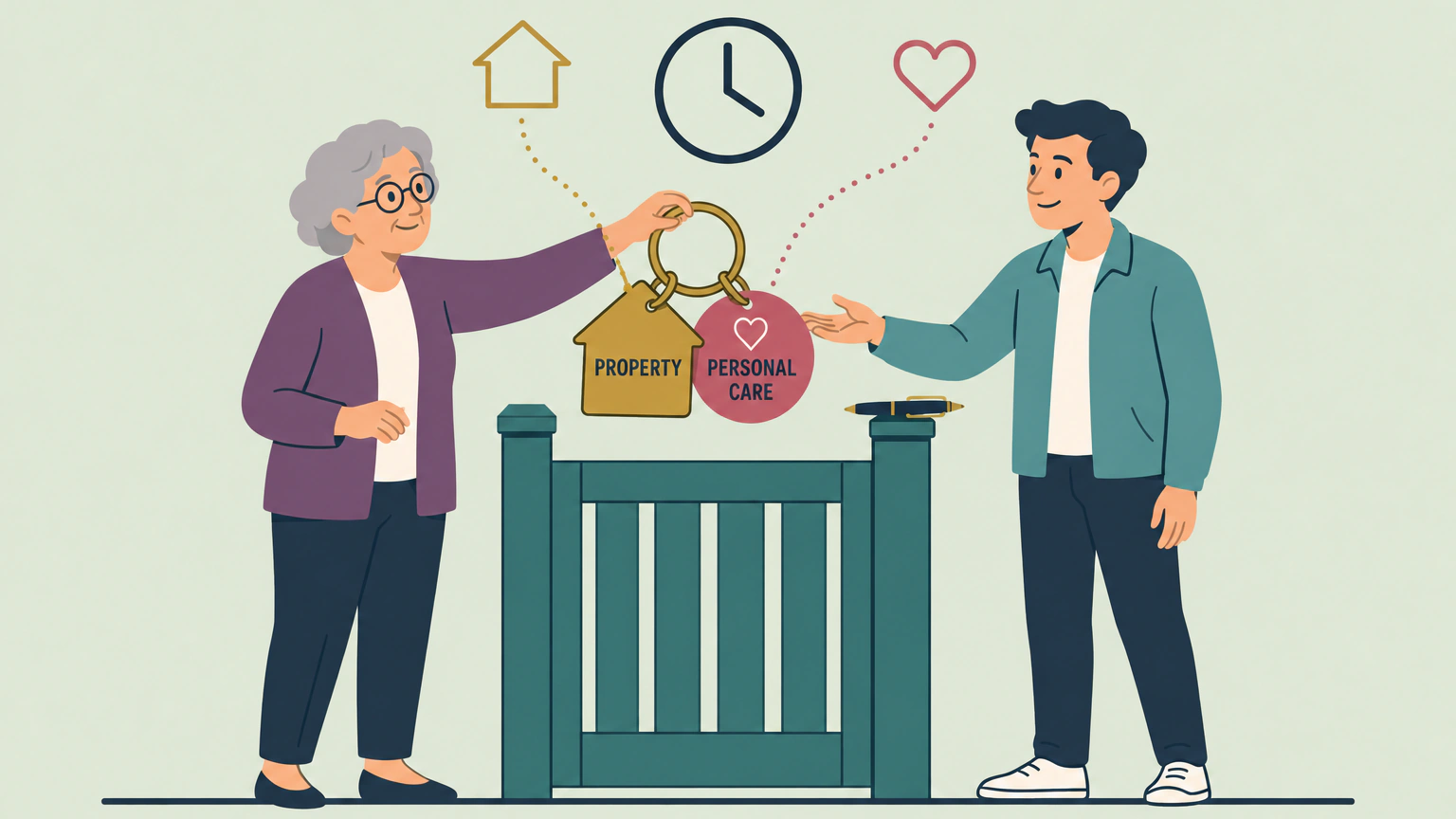
In Ontario you make two separate documents, a continuing power of attorney for property and a power of attorney for personal care, and you can make both yourself for free with the government's kit. Each one needs two eligible witnesses signing with you. Your property attorney can act from the day it's signed, unless you write in a later start.
The second half is for whoever ends up holding the document: what you can be paid, and what you owe in records.
On this page
- The two documents Ontario uses, and what each one covers
- How to make yours for free
- When your attorney can actually start using it
- Why your bank's own form can cancel the one you already have
- If you're the attorney: what you're allowed to pay yourself
- If you're the attorney: the rules you're signing up for
- What happens if there's no power of attorney when it's needed
- Do you need a lawyer, and what does it cost?
- Questions people ask about powers of attorney in Ontario
The two documents Ontario uses, and what each one covers
Ontario's Substitute Decisions Act splits money and personal care into two documents, and in both of them the word attorney means the person you choose, not a lawyer.
Your money and property: the continuing power of attorney
This is the money document. Your attorney can do anything with your property you could do, except make your will.
The word continuing is doing real work. A power of attorney for property is continuing only if it says so, or if it shows you meant the authority to be used while you're incapable. Ontario also allows a non-continuing version, which the Office of the Public Guardian and Trustee describes as covering your financial affairs "but can't be used if you become mentally incapable." That one suits a long trip abroad, not dementia. Together with the personal care document, those are the three kinds Ontario recognizes.
Is it too late for Mom? Maybe not. Being unable to manage money and being unable to sign the document are two different tests, and a diagnosis doesn't settle the second. She can still give a continuing power of attorney if she understands seven things. What she owns and roughly its value. What she owes anyone who depends on her. What the attorney can do, and that the attorney has to account for it. That she can cancel it while she's capable, that her property can lose value, and that the attorney could misuse the authority.
Your health and daily care: the power of attorney for personal care
This one covers your health care, food, housing, clothing, hygiene and safety. The bar for signing it sits lower than the money bar: you need to understand whether the person you're naming genuinely cares about your welfare, and that you may need them to decide for you.
One extra rule governs who can act. Someone paid to provide your health care or residential, social, training or support services can't be your attorney for personal care unless they're also your spouse, partner or relative. So the support worker you've come to trust is out, unless she's family.
It can also carry your wishes. Ontario's own example is life support: some people tell their attorney they don't want it if there's no hope of recovery. Here are the two side by side.
| Continuing power of attorney for property | Power of attorney for personal care | |
|---|---|---|
| What it covers | Your money, bank accounts, investments, real estate and bills. Your attorney can do anything with your property that you could do, except make a will. | Decisions about your health care, housing, food, clothing, hygiene and safety. |
| When it can be used | From the day it's signed and witnessed, unless the document names a later date or event. | Only for a decision you can't make yourself. |
| Age to make one | 18 or older | 16 or older |
| Who can be your attorney | Anyone 18 or older. Many trust companies will act, for a fee. | Anyone 16 or older, except someone paid to provide your health care or residential, social, training or support services who isn't your spouse, partner or relative. |
| Witnesses | Two eligible witnesses, in person or by live video under Ontario's remote-witnessing rules | Two, with the same rules and exclusions |
| Pay for your attorney | A fee scale set by regulation applies unless your document says otherwise | The Act sets no fee scale |
| The law | Substitute Decisions Act, 1992, ss. 5, 7, 8, 10, 40 | Substitute Decisions Act, 1992, ss. 44, 46, 47, 48, 49 |
How to make yours for free
The forms cost nothing, and the part people get wrong is who stands beside them when they sign.
Get the forms, and decide who you're naming
The Ministry of the Attorney General's kit is free, on screen or printed, and the Public Guardian and Trustee no longer mails out paper forms. CLEO's free Guided Pathway is gentler: it asks questions and fills in the forms from your answers. A kit bought elsewhere has to be built on Ontario law, because every province and territory has its own. You don't need a lawyer, though the kit says consulting one is a good idea anyway.
Your attorney for property has to be 18, and for personal care, 16. Many trust companies will act, for a fee. Talk to whoever you're naming first, and name a substitute in case your first choice can't act. Two attorneys have to agree on everything unless you write "jointly and severally" into the form.
One quiet trap: keep identification numbers and bank account details out, because Ontario's land registration system won't accept a power of attorney carrying them. You don't need to file or register either document to make it binding. A continuing power of attorney may still need to be registered if your attorney uses it for a land transaction.
Who isn't allowed to witness your signature
Two witnesses. Both present with you, either in person or through live video under Ontario's remote-witnessing rules. Each one signing. The same excluded list covers both documents.
The exclusions are where good documents die, and the definitions are what catch people. A spouse is someone you're married to, or someone you live with outside marriage if you've cohabited a year, have a child together, or have signed a cohabitation agreement. The Act's partner is wider still: two people who've lived together at least a year in a close personal relationship of primary importance in both their lives. A long-time housemate can land inside that.
We'd sidestep the question. Pick two adults who aren't family and don't live with you. Video signing is allowed under conditions, and you don't need a notary.
Before anyone signs as your witness, check that neither person is:
- the person you're naming as attorney, or that person's spouse or partner
- your spouse, including a common-law spouse
- your partner, which the Act defines as someone you've lived with for at least a year in a close relationship of primary importance to you both
- your child, or someone you've clearly treated as your own child
- under 18
- someone whose property is under guardianship, or who has a guardian of the person
Then make sure both witnesses are with you when you sign, and that each signs in front of you and the other witness.
When your attorney can actually start using it
This is the question behind "how do I invoke it", and each document answers it differently.
Property: from the day it's signed, unless you say otherwise
The government form settles it in one line: "Unless otherwise stated in this document, this continuing power of attorney will come into effect on the date it is signed and witnessed." It doesn't wait for incapacity. You can change that by naming a later date or an event instead.
Here's the catch. Tie it to your own incapacity without saying how that gets decided, and your attorney waits on one of two formal things. Written notice from a capacity assessor, or word that a certificate of incapacity has been issued under the Mental Health Act. The Public Guardian and Trustee advises naming a method yourself instead, and its example is a letter from your doctor. Don't name a particular doctor, the kit warns, unless you know they'd write it.
Nobody arrives to announce the moment. You can leave an immediately effective document with a trusted professional, with instructions on when to release it. The kit names that route's risk: years can pass, and the holder can move away or die.
Personal care: only once you can't decide for yourself
This one never works while you can still make the decision yourself.
For treatment decisions, the Health Care Consent Act decides when your attorney steps in. For everything else, your attorney needs reasonable grounds to believe you can't make that particular decision. If your document requires your incapacity to be confirmed first and doesn't say how, confirmation arrives as written notice from an assessor.
That's the law. The lived version is blurrier. Early short-term memory loss is a grey zone, and it's where a well-meaning son starts paying the bills a year early and his mother feels pushed out of her own life. A good attorney keeps asking, and keeps the person in the decision for as long as there's a decision left.
Why your bank's own form can cancel the one you already have
You signed a continuing power of attorney last spring. Then the bank slides its own power of attorney form across the desk, and signing it may cancel the document you made.
A new continuing power of attorney ends the earlier one, unless you say in the new one that you intend to have more than one. The government's own form opens by doing exactly that. Line 1 reads: "revoke any previous continuing power of attorney for property made by me."
The Public Guardian and Trustee is blunt about the bank version. That form "will likely only cover your bank accounts and investments with that institution and not any of your other assets." Signing it "could also cause the Power of Attorney you have already signed to be revoked, leaving you with no one able to handle your other affairs." Your house, your accounts elsewhere, your pension. Nobody.
The better move runs the other way. Take the document you already have into the bank and ask them to keep a copy on file, which both the kit and the Public Guardian and Trustee suggest. That way the bank can raise any problem while you can still fix it. Leaving the original with someone you trust is another answer.
If a bank refuses a properly signed continuing power of attorney, the Public Guardian and Trustee points to the bank's head office, the bank ombudsman, or a lawyer.
Before you sign a power of attorney form at your bank - Ask whether it covers only your accounts at that bank. - Read the opening lines for wording that cancels earlier powers of attorney. - If you want to keep the one you already have, the new document has to say you intend to have more than one. - Show the bank the continuing power of attorney you already have, and ask it to keep a copy on file.
If you're the attorney: what you're allowed to pay yourself
Nobody tells you this part. You took on your father's finances as a favour, and a few hundred hours in you've started to wonder whether you can be paid for any of it.
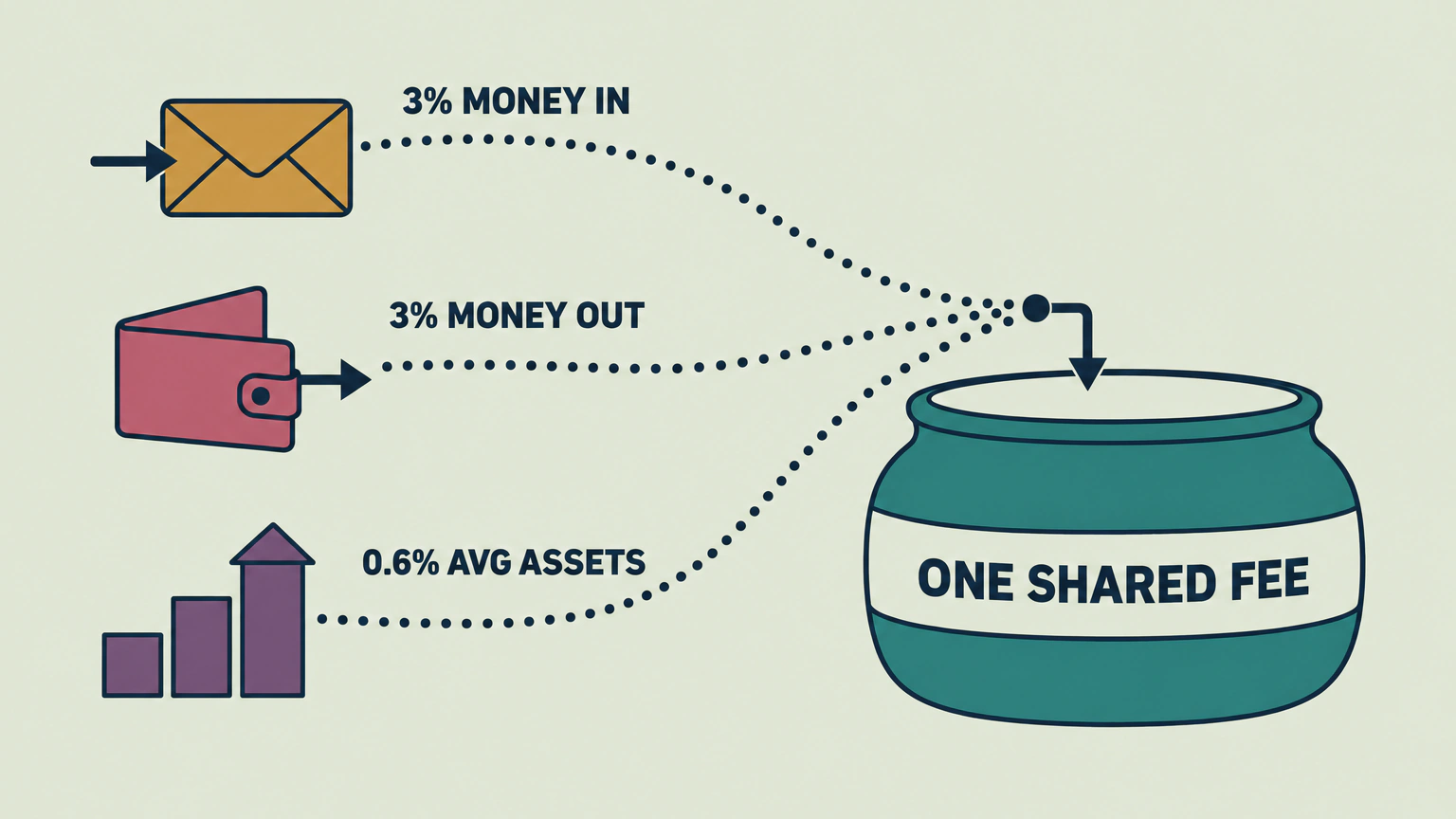
You can, and there's a set scale. Unless the document says otherwise, an attorney for property may take 3% of the money received for the person and 3% of the money paid out for them. On top of that comes three-fifths of 1% (0.6%) of the average value of their assets each year, as a care and management fee. Say $30,000 came in and $26,000 went out, and the assets averaged $180,000. That's $900 plus $780 plus $1,080, so $2,760 for the year.
What the fee scale allows
Everything that came in on their behalf during the year, capital and income together.
Everything you paid on their behalf during the year, such as bills, care costs and taxes.
Use the list of assets and values you keep for your accounts. How to average them is a fair question for a lawyer.
Your figure for the year
Up to $2,760.00 for the year
3% of $30,000 received: $900.00
3% of $26,000 paid out: $780.00
0.6% (three-fifths of 1%) of $180,000 in average assets: $1,080.00
Substitute Decisions Act, 1992, s. 40; O. Reg. 26/95, s. 1.
Now the limits, and they matter more than the arithmetic. You can take it monthly, quarterly or yearly. If there are two of you, the kit is clear: "If there is more than one attorney, they will have to share the permitted amount." One amount, split, not one each. If the document sets its own pay, or says the attorney isn't paid, the document wins. When the Public Guardian and Trustee isn't the attorney, taking more than the scale allows needs its written consent. If there is one, the person's guardian of the person or attorney for personal care must also consent in writing. If the Public Guardian and Trustee is the attorney, the court must approve the increase instead. A court passing your accounts can adjust what you took. And the Act sets no fee scale at all for attorneys for personal care.
Write down every amount, its date, and how you worked it out. That isn't tidiness. It's the regulation.
If you're the attorney: the rules you're signing up for
Most of these duties switch on once the person can't manage their money, or you have reasonable grounds to think so.
Your duties once the person can't manage their money
You're a fiduciary: you act honestly, carefully and in good faith, for the other person's benefit rather than your own or the family's. Four duties sit beside that, and they're the ones people skip. Explain your powers and duties to the person. Encourage them to take part in decisions about their property. Help them keep regular contact with the family and friends who support them, and consult those people from time to time, along with whoever provides their care.
Spending has an order: the person's own support, education and care first, their dependants second and only if the property still covers the first, other legal obligations third on the same condition. Gifts and loans to family and friends are allowed only if there's enough left for the person's own needs, and only if you have reason to believe, from what they said while capable, that they'd have made them.
Two hard limits. You can't make their will, and you can't sell something you know they've left as a specific gift in their will unless that's necessary to do your job. A gift of money sits outside the rule.
If you're paid, the standard rises: not the care an ordinary prudent person takes with their own affairs, but the care of someone in the business of managing other people's property. That higher standard is a reason to bring in financial advisors rather than picking investments alone. And you're liable for any loss flowing from a breach.
The records you have to keep, and who can see them
The day a sibling asks for "a full accounting", you'll either have it or you won't. The regulation says what it means.
Your accounts open with the person's assets and liabilities on the day you first act. After that they're running lists. Assets bought and sold, with dates, reasons and counterparties. Money received, with amounts, dates, sources and the account it went into. Money paid out, with amounts, dates, purposes and payees. Investments made or redeemed, with amounts, dates, rates and types. Debts taken on and paid off. Then come two entries that are easy to miss. Every amount of compensation, with its date and how you calculated it, and the assets and values you used for the care and management fee. Keep a copy of the power of attorney with the accounts.
An attorney for personal care keeps a different record: the decisions made, the reason for each, who was consulted, and the person's wishes, past and present.
Now the part that surprises people. The list of who can demand a copy of your accounts is short: the person themselves, and their attorney for personal care or guardian of the person. A sibling isn't on it. What a sibling can do is apply to court to have your accounts passed, and unless they're a dependant they need the court's permission to apply.
The second route has more teeth. Where somebody alleges that a person who can't manage their property is losing a significant part of it, or failing to provide the necessities of life, the Public Guardian and Trustee must investigate. Not may. Must. One co-attorney can't simply remove another for misusing a parent's money, and nor can a worried daughter. The route that does exist is a complaint to the Public Guardian and Trustee, backed by bank statements.
What happens if there's no power of attorney when it's needed
Money is the harder gap. Ontario is explicit that without an attorney for property your family, including your spouse, can't automatically step in.
Two routes lead out, and neither is quick. One starts with a capacity assessment. If an assessor finds the person incapable of managing property, the Public Guardian and Trustee becomes their statutory guardian. A spouse, partner or relative can then apply to take over with a written management plan, and the Public Guardian and Trustee can ask for security first. The other route is a court application to be appointed guardian.
Personal care runs differently. For treatment decisions the Health Care Consent Act ranks who speaks for you. A guardian of the person comes first, then your attorney for personal care, then a representative appointed by the Consent and Capacity Board. After those come a spouse or partner, a child or parent, a parent who has only a right of access, a sibling, and any other relative. Where nobody on that list qualifies, or two of equal rank disagree, the Public Guardian and Trustee decides instead.
Picture the actual people in that list. The one at the top may not be the one you'd choose, and that's the strongest argument there is for signing both documents while you can.
Do you need a lawyer, and what does it cost?
No lawyer is required, and a properly witnessed kit form is a real power of attorney. Ontario still names four situations where it suggests you talk to one. You've already given power of attorney over your bank accounts through your bank, or you're thinking about it. You run or own a business. Your family situation is difficult. You own property in another province or country.
If cost is the obstacle, the Law Society Referral Service will name a lawyer or licensed paralegal who provides a free consultation of up to 30 minutes. Our own cost profiles for estate planning lawyers run from $320 to $1,062 across 860 profiles. That covers estate-planning work in general, not a power of attorney on its own. Our category pages are priced by location, not as one figure for the whole country. If the account that arrives doesn't match the conversation you had, here's how to challenge a lawyer's bill.
We're not your lawyer. If your family is complicated, you own a business or you hold property outside Ontario, an hour with an estates lawyer is money well spent.
So: download the kit, or run CLEO's Guided Pathway. Pick two witnesses who aren't family and don't live with you, and sign both documents in front of both of them. Then tell your attorney where the original is kept, because a document nobody can find is a document nobody can use. If you'd rather have it drafted, our Ontario listings are where to start.
Questions people ask about powers of attorney in Ontario
Does a power of attorney need to be notarized in Ontario?
No. Ontario asks for two witnesses, not a notary. A bank can still ask to see the original, or a notarized copy, before it deals with your attorney. That's the institution's own assurance, not something the document requires.
Can I sign a power of attorney electronically in Ontario?
Not with an electronic signature. Ontario's Electronic Commerce Act doesn't apply to powers of attorney for financial affairs or personal care, and the government form must be printed and signed to be valid. Video signing is allowed under conditions: one witness has to be a lawyer or paralegal licensed by the Law Society of Ontario, the signatures happen at the same time, and everyone signs complete, identical copies.
Can I name two people as my attorney?
Yes. They'll have to make every decision together unless your document says they can act separately, which the kit does with the words "jointly and severally". If one of them dies, resigns or can no longer act, the other carries on alone unless your document says otherwise.
Can my attorney take money for themselves?
Only what the law or your document allows: compensation under the fee scale or your own pay terms, and gifts or loans only when there's enough left for your care and reason to believe you'd have made them yourself. Anything past that breaks their duty, and where someone who can't manage their property is losing a significant part of it, the Public Guardian and Trustee must investigate.
Can a power of attorney change my will?
No. Your attorney for property can do anything with your property you could do, except make your will. They also can't sell something they know you've left as a specific gift in your will unless that's necessary to carry out their duties, though a gift of money sits outside the rule. None of it helps if there's no will at all. Here's what happens to a partner when there's no will.
How do I cancel a power of attorney in Ontario?
Write a revocation and sign it the same way you signed the original, in front of two eligible witnesses. Then tell your attorney, your bank and anyone else holding a copy. If you own real estate, the Public Guardian and Trustee suggests having a lawyer register notice of the revocation on title. A power of attorney also ends when you die, which is where probate and estate administration lawyers take over.
What if my spouse or my child signed as a witness?
Then the document isn't effective as signed. A court can still declare it effective, on an application, if that's in your interests, and for a property document anyone who dealt with your attorney in good faith without knowing of the problem is protected. If you're still capable, signing a fresh one with eligible witnesses is far simpler, and the new document cancels the old.