

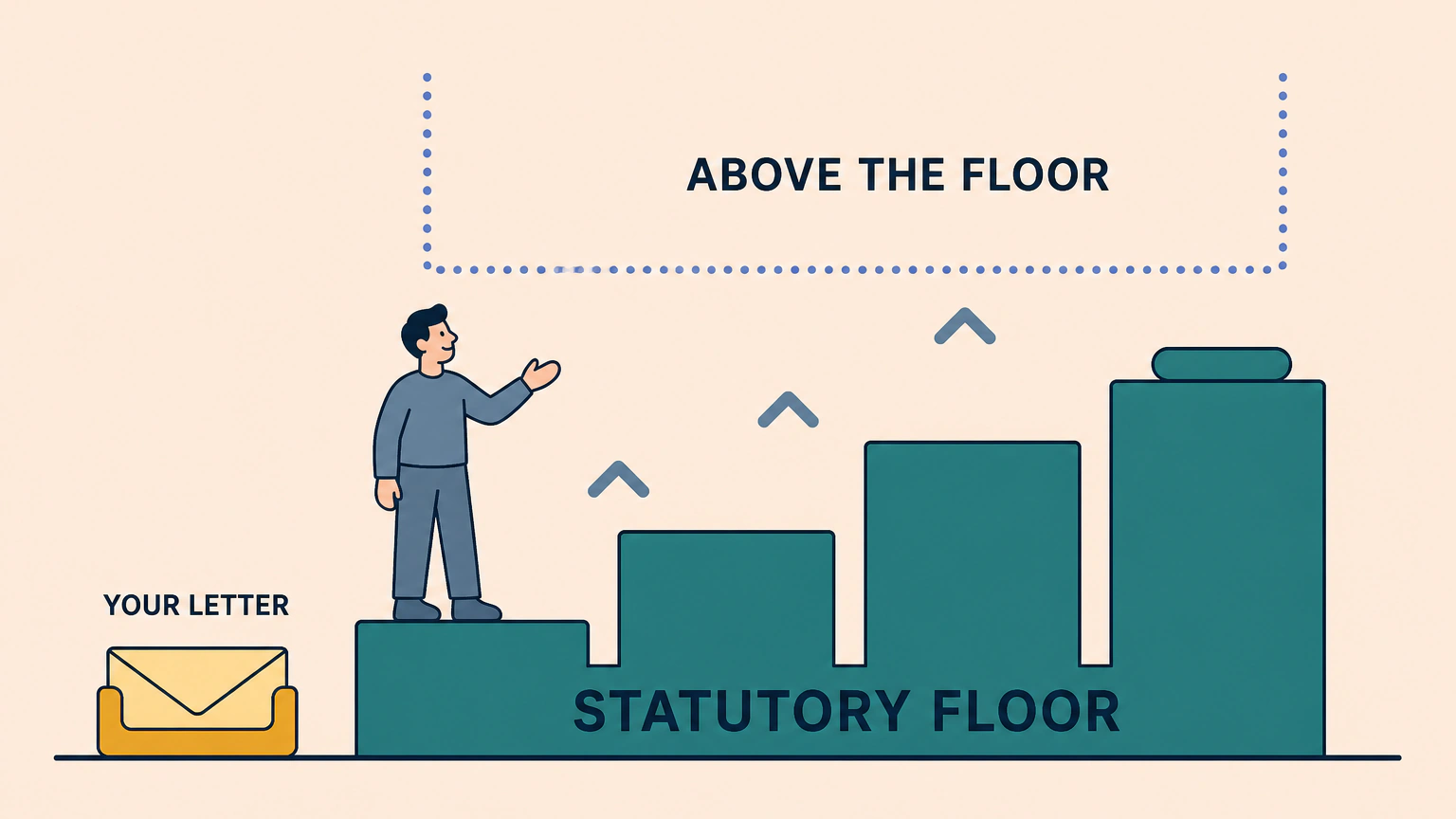
If you're asking how much severance you're entitled to in Canada, the answer starts somewhere you probably don't expect: not with how long you worked, but with which employment standards law covers your employer. The same twelve years of service buys eight weeks in Alberta, British Columbia and Quebec. If your employer is federally regulated, add twenty-four days' wages to those eight weeks. In Ontario the same service can be worth as much as twenty weeks. Whatever the number, it's a floor and not your entitlement. Your employer can't go below it, can't buy its way under with a release, and may owe more under common-law reasonable notice outside Quebec.
Two things below get you to your own figure: a five-jurisdiction table and a checker.
On this page
- The first question is not how long you worked. It is which law covers you.
- The three things Canadians call severance
- The statutory floor, five jurisdictions compared
- The same career, five different answers
- Why one week per year is the wrong rule for termination pay
- The letter on your table, and what you cannot sign away
- If you are federally regulated, you may be able to ask for your job back
- What it costs to have someone read the offer before you sign
- Before you reply, work through this
- Frequently asked questions
The first question is not how long you worked. It is which law covers you.
Nearly every page on this subject opens with a scale of weeks. That's the second question. The first is which of Canada's fourteen employment standards regimes you're standing in: ten provinces, three territories, and the federal Canada Labour Code. Each sets its own floor, and the gaps are wide enough to change your answer by months of pay.
Sort yourself before you read a figure. If the dismissal followed an injury or a compensation claim, that's a separate lane with its own clock, handled by workplace injury and workers' compensation lawyers.
Federally regulated work, and how to tell in ten seconds
Run down this list: banks, airlines and airports, railways, telecommunications and broadcasting, interprovincial trucking and bus lines, ports and shipping, federal Crown corporations. If your employer is one of those, the Canada Labour Code is your statute and no provincial employment standards act applies to you. Ontario's own Act says so: it doesn't apply where the employment relationship falls within the legislative jurisdiction of Parliament.
Short list, big consequences. A different notice scale, a separate severance payment counted in days rather than weeks, and a route to asking for the job back under its own rules.
If you are not federally regulated, your province decides
Where you worked is usually the starting point, but cross-border work can trigger a different province's rules. Ontario's Act is explicit: its standards apply where the employee's work is to be performed in Ontario, or partly outside Ontario as a continuation of Ontario work. A head office in Toronto doesn't pull a Calgary job under Ontario rules.
The three things Canadians call severance
"Severance package" is everyday speech, not a legal term. It covers up to three separate entitlements, and each one comes from somewhere different. The label typed at the top of your offer decides none of them.
Statutory notice, or pay instead of notice, which most employees get
This is the floor, and all five of these jurisdictions have one. Your employer can make you work out the notice period, pay you for it instead, or split the difference. Alberta's Code lists exactly those three options.
One detail an offer letter may leave out: in Ontario, paying you instead of working you doesn't end the employer's other obligation. Section 61(1)(b) still requires it to make the benefit plan contributions needed to keep your benefits running through the notice period you would otherwise have received. If your drug plan went dark the day you were walked out, that's worth a question.
Statutory severance pay, which exists in only two of these five jurisdictions
Ontario and federally regulated work create a genuinely separate payment that sits on top of notice: s. 64 of the Employment Standards Act, 2000, and s. 235 of the Canada Labour Code. Ontario's statute is blunt about it. Section 65(7) says severance pay is in addition to any other amount you're entitled to under the Act or your contract.
British Columbia, Alberta and Quebec create no separate statutory severance payment. When an offer in Vancouver, Calgary or Montreal calls a payment "severance", the label alone doesn't tell you whether it is statutory notice, common-law or civil-law notice, or a settlement of both.
Common-law reasonable notice, the part with no formula
Outside Quebec's civil-law framework, non-union employees may also be entitled to common-law reasonable notice, which courts assess from the Bardal factors: length of service, age, the character of the employment, and the availability of similar work. There's no table to look it up in, no cap on the result, and no arithmetic you can do at your kitchen table.
Whether it applies to you usually turns on one thing in your employment contract: a termination clause that validly limits you to the statutory minimum. That clause decides whether the floor is also your ceiling, and reading it is the job worth paying someone for. Anyone who hands you a range without reading your contract is guessing.
The statutory floor, five jurisdictions compared
The scales don't line up with each other on any axis. Every figure is the general individual termination floor for a dismissal without cause. Employees excluded by statute or regulation, and group or mass terminations, follow different rules.
| Which law covers you | Instrument and section | Nothing is owed until | Notice, or pay instead of notice | Separate statutory severance pay? | Source current to |
|---|---|---|---|---|---|
| Federally regulated employers | Canada Labour Code, R.S.C. 1985, c. L-2, ss. 230(1.1), 235(1) | 3 consecutive months | 2 weeks at 3 months; 3 weeks at 3 years; then 1 more week per completed year, to 8 weeks at 8 years | Yes. After 12 consecutive months, the greater of 2 days' wages per completed year and 5 days' wages | Act current to 21 June 2026, last amended 12 December 2025 |
| Ontario | Employment Standards Act, 2000, S.O. 2000, c. 41, ss. 54, 57, 61, 64, 65 | 3 months of continuous employment | 1 week under 1 year; 2 weeks from 1 to under 3 years; then 1 more week per band, to 8 weeks at 8 years or more | Yes. 5 years or more, plus either a $2.5 million payroll or being one of 50 or more employees severed within six months because of a permanent discontinuance at an establishment. 1 week per completed year plus part years, capped at 26 weeks | e-Laws currency date 19 August 2026, consolidated from 1 January 2026 |
| British Columbia | Employment Standards Act, R.S.B.C. 1996, c. 113, ss. 4, 63 | 3 consecutive months | 1 week after 3 months; 2 weeks after 12 months; 3 weeks after 3 years, plus 1 more week per additional year, to 8 weeks | No. Section 63 calls it compensation for length of service, and equivalent written notice discharges it | This Act is current to 18 August 2026 |
| Alberta | Employment Standards Code, R.S.A. 2000, c. E-9, ss. 55, 56, 57 | more than 90 days | 1 week over 90 days to under 2 years; 2 weeks 2 to under 4; 4 weeks 4 to under 6; 5 weeks 6 to under 8; 6 weeks 8 to under 10; 8 weeks at 10 or more | No | King's Printer consolidation current as of 26 November 2025 |
| Quebec | Act respecting labour standards, CQLR c. N-1.1, ss. 82, 82.1, 83 | 3 months of uninterrupted service | 1 week under 1 year; 2 weeks 1 to 5 years; 4 weeks 5 to 10 years; 8 weeks at 10 years or more | No. Section 83 gives a compensatory indemnity where no notice is given | À jour au 7 avril 2026 |
Five jurisdictions rather than fourteen, because we read those five in the statutes themselves: the four largest provinces plus federally regulated work. Saskatchewan, Manitoba, Nova Scotia, New Brunswick, Prince Edward Island, Newfoundland and Labrador and the three territories each run their own scale. Search your province's name plus "employment standards" plus "termination notice", land on the provincial government's own page, and check the consolidation date printed on it.
Statutory Floor Checker
Choose the law that covers your employer and enter your completed months of service. This block returns the statutory minimum for that combination, and the section that sets it.
Count from your first day to your last, in whole months.
Alberta states its threshold in days, more than 90, not in months. If you are within a few days of that line, check the exact dates.
This checker covers dismissal by the employer without cause, on an individual termination, in five jurisdictions. It does not cover mass or group termination, temporary layoff, dismissal for just cause, resignation, retirement, unionised employees whose collective agreement governs, employees excluded by regulation, or the nine provinces and territories not in Table A.
Your statutory minimum
What the section covers
How the threshold is read
The figure the section sets
What the severance section covers
How that threshold is read
The figure that section sets
This is the minimum, not your entitlement. Outside Quebec, a non-union employee whose contract does not validly limit them may be entitled to common-law reasonable notice, which has no fixed formula or absolute ceiling. This checker does not estimate it.
The floor is a staircase, and the second track sits above it
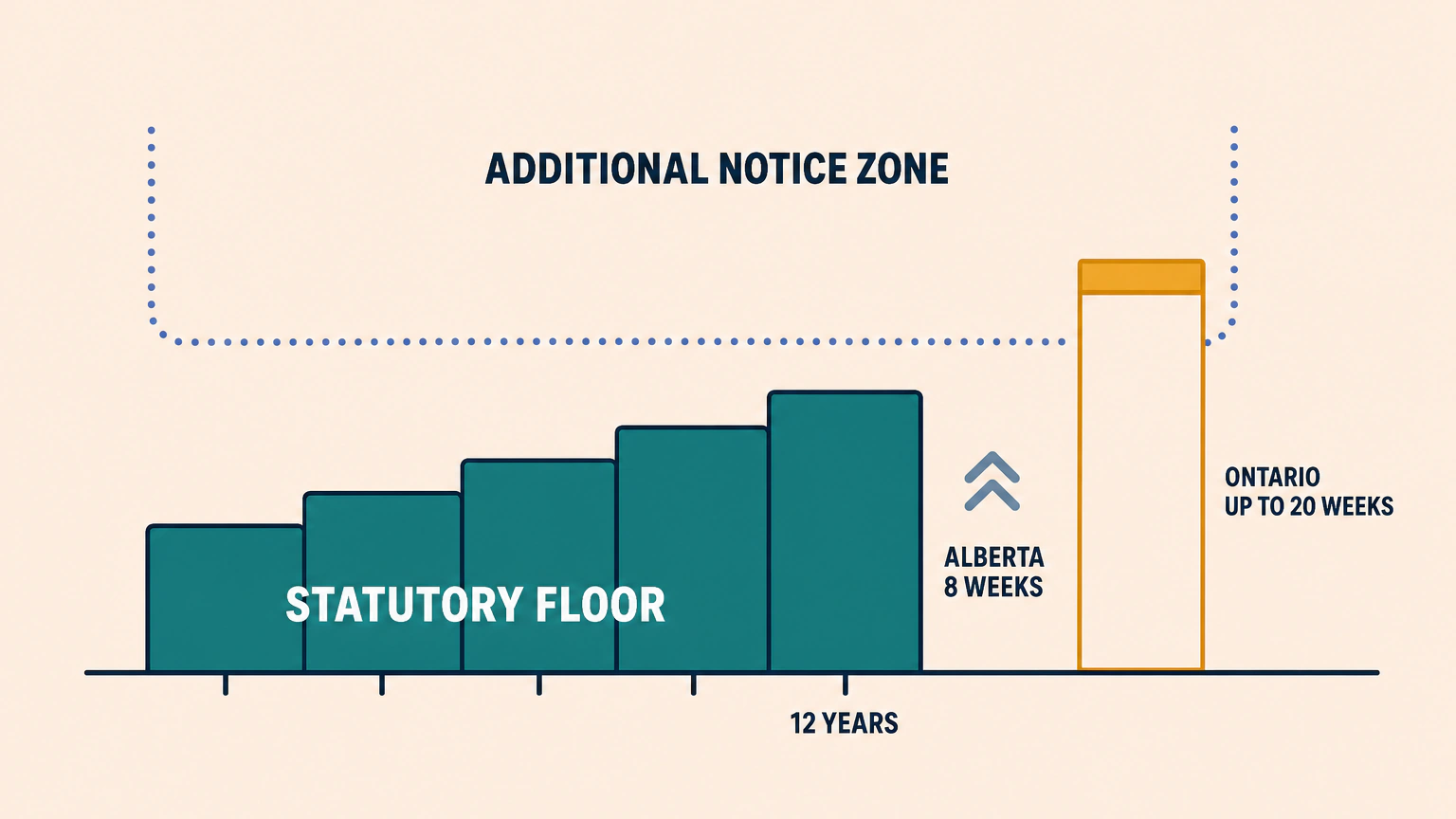
The statutory minimum rises in steps with length of service, and the steps differ in every jurisdiction. Above all of them sits a second entitlement with no fixed formula and no absolute ceiling.
- Statutory floorIt rises in steps, not in a straight lineEach jurisdiction sets its own steps, and they do not line up with one another. One week per year of service is not the notice rule in any of them.
- 12 years in Alberta8 weeksAlberta reaches the top of its scale at 10 years and stays there. British Columbia and Quebec also give 8 weeks at 12 years of service.
- 12 years in OntarioUp to 20 weeks8 weeks of notice, plus up to 12 weeks of severance pay where the conditions in s. 64 of the Employment Standards Act, 2000 are met. Where they are not met, it is the 8 weeks of notice alone.
- Additional notice zoneOpen at the topOutside Quebec, a non-union employee whose contract does not validly limit them may be entitled to common-law reasonable notice, which has no fixed formula or absolute ceiling. Quebec runs on its own rule, in article 2091 of the Civil Code of Québec. This checker does not estimate either one.
Ontario, and the extra entitlement most people never hear about
Ontario's notice scale steps once a year: one week under a year of service, two weeks from one to under three, then another week per band up to eight weeks at eight years. Nothing is owed until three months of continuous employment.
The part people miss is s. 64. If no prescribed exclusion applies, you're owed severance pay as well when you have five years or more and your employer either has a payroll of $2.5 million or more, or you were one of fifty or more employees severed within six months because of a permanent closure of all or part of the business at an establishment. Section 65(1) calculates it as one week of regular wages per completed year, plus a twelfth of a week for each completed month of a part year, to a ceiling of 26 weeks under s. 65(5). Twelve years is twelve weeks of severance pay on top of eight weeks of notice.
The payroll test is checkable. Section 64(2): total the wages of all the employer's employees in the four weeks ending with the last completed pay period before your severance, multiply by thirteen, and see whether you clear $2.5 million. The last or second-last fiscal year's total works too.
British Columbia, where the same thing has a different name
British Columbia doesn't use the word severance in its Act. Section 63 creates a liability for "compensation for length of service": one week's wages after three consecutive months, two weeks after twelve months, then three weeks after three years plus one further week per additional year, stopping at eight.
The employer discharges the whole liability by giving equivalent written notice instead of paying, so working notice isn't a lesser offer. And the eight-week ceiling arrives at eight years and never moves again: a British Columbian with thirty years is owed the same statutory minimum as one with eight.
Alberta, the province with no three week band
Alberta's scale has a hole in it. Section 56 goes one week, two weeks, then straight to four. There is no three-week step, and no seven-week step either. Nothing is owed where the employment ran ninety days or less, under s. 55(2)(b), and Alberta counts that entry line in days while every other jurisdiction here counts in months.
At eighteen months, Alberta's notice period is one week where Ontario, British Columbia, Quebec and the federal Code all set two weeks of notice; federal law also adds five days' wages. If you're near the ninety-day line, work out the exact date.
Quebec, where the bands are widest and the number is lowest in the middle
Quebec's s. 82 has only four bands: one week under a year, two weeks from one year to five, four weeks from five to ten, and eight weeks at ten or more. Wide bands mean long flat stretches. By four years, Quebec still pays two weeks while the other four rows show four weeks of notice.
Section 82.1 takes the notice requirement away in four situations: less than three months of uninterrupted service, a fixed-term contract that simply expires, an employee who committed a serious fault, and a contract that ends through superior force. Where notice isn't given at all, s. 83 requires a compensatory indemnity equal to the regular wage for the notice period you should have had.
Federally regulated employees, notice in weeks and severance in days
The federal notice scale under s. 230(1.1) starts at two weeks once you complete three consecutive months, holds there until three years, then climbs a week a year to eight weeks at eight years.
Section 235(1) is the part that isn't familiar. Once you've completed twelve consecutive months of continuous employment, and unless the dismissal was for just cause, your employer owes the greater of two days' wages for each completed year and five days' wages. Twelve years gives twenty-four days. Four years gives eight.
Watch the unit: federal statutory severance is counted in days' wages, not weeks, and it stacks on top of the notice weeks rather than replacing them. Any page that quietly converts it into weeks and folds it into one figure is describing a different number than the statute gives you.
The same career, five different answers
Same person, same job, same dismissal without cause, five different places to have been standing.
| Completed service | Ontario | British Columbia | Alberta | Quebec | Federally regulated |
|---|---|---|---|---|---|
| 18 months | 2 weeks | 2 weeks | 1 week | 2 weeks | 2 weeks, plus 5 days' wages |
| 4 years | 4 weeks | 4 weeks | 4 weeks | 2 weeks | 4 weeks, plus 8 days' wages |
| 12 years | 8 weeks, plus up to 12 weeks severance pay if the s. 64 conditions are met | 8 weeks (the scale reaches its cap at 8 years) | 8 weeks | 8 weeks | 8 weeks, plus 24 days' wages |
At eighteen months, Alberta's one-week notice period is half the notice period elsewhere, while federal law also adds five days' wages. At four years, Quebec's two weeks is half the notice period elsewhere, while federal law adds eight days' wages. At twelve years the four provinces converge on eight weeks and Ontario can reach twenty if the s. 64 conditions are met. Federal employees sit at eight weeks too, plus those twenty-four days of severance pay.
Nothing in that spread reflects what the work was worth. It reflects which legislature wrote the schedule.
Why one week per year is the wrong rule for termination pay
You'll meet the phrase "one week per year of service" on most pages covering this topic, and it is a real statutory formula. It's just attached to the wrong entitlement. One week per completed year is how Ontario calculates severance pay under s. 65(1). Termination pay under s. 57 is a banded table, and bands don't behave like formulas.
Run eighteen months through both. One week per completed year says one week. Section 57(b) says two, because eighteen months sits in the "one year or more and fewer than three years" band. The shortcut underpays exactly the people who can least afford it.
There's a more damaging version in circulation. Some pages say common law notice runs at one week per year to a maximum of twenty-six weeks. That takes Ontario's severance formula and its 26-week statutory cap and staples both onto common law, which has neither. If a page tells you your entitlement is capped at half a year, it's describing a statute you may not even be under.
The letter on your table, and what you cannot sign away
What a release cannot reach. Ontario's Employment Standards Act, 2000, s. 5(1): "no employer or agent of an employer and no employee or agent of an employee shall contract out of or waive an employment standard and any such contracting out or waiver is void." British Columbia's Employment Standards Act, s. 4: "The requirements of this Act and the regulations are minimum requirements and an agreement to waive any of those requirements ... has no effect." In plain terms: the floor is yours whether you sign or not. What you're being asked to give up is everything above it.
A release cannot reach the statutory minimum
The statutory minimum isn't part of the deal. It's owed because the statute says it's owed, and both sections strike out any agreement that tries to trade it away. When an employer presents the floor as the offer and asks for a signed release in exchange, it's asking you to sell something you already own.
Work out the floor first: whatever the offer exceeds it by is the actual proposal, and it's often smaller than the total makes it look.
The deadline in the letter is the employer's deadline, not the law's
An offer may expire in a week or even forty-eight hours. That date is set by the employer. It's a negotiating position, not a limitation period.
Real deadlines exist, set by statute and by the route you take. A federal unjust-dismissal complaint runs ninety days from dismissal; Quebec's complaint under s. 124 runs 45 days from dismissal. Employment standards claims, human rights applications and civil actions each have their own periods, and they are not the same length. If the reason for the dismissal touches a protected ground, discrimination lawyers can tell you which of those started first, and that one is often the shortest.
If you are federally regulated, you may be able to ask for your job back
Part III of the Canada Labour Code lets some federally regulated employees chase the job itself. Quebec has its own route: after two years of uninterrupted service, an employee who believes the dismissal lacked good and sufficient cause can complain to the CNESST, and the Tribunal may order reinstatement.
Under s. 240(1), a person who has been dismissed and considers the dismissal unjust may complain in writing if they've completed twelve consecutive months of continuous employment and aren't part of a group covered by a collective agreement. Section 242(3.1) excludes layoffs caused by a lack of work or the discontinuance of a function. You have ninety days from dismissal to send the written complaint to the Head under the Code; s. 240(3) allows an extension only in narrow circumstances.
The remedy is what makes it different. Section 240(1.01) says that an employer who complies with the notice and severance divisions does not affect your rights under that Division, and does not prevent the Board from finding the dismissal unjust or "from making any order under subsection 242(4), including a reinstatement order." Taking the severance cheque does not, by itself, buy out the right.
What it costs to have someone read the offer before you sign
Here's the number people are usually too embarrassed to ask about. Across 871 cost profiles on our own employment law listings, the average engagement came to $562, with a listed fair price range of $410 to $716. That's what people who hired through this directory reported paying, not a survey of Canadian firms.
Set it against what's being decided: twelve years in Ontario with the s. 64 conditions met, and the gap between an offer at the notice floor and the full statutory entitlement is twelve weeks of pay. An hour of advice on whether your termination clause is enforceable decides whether the fight is about eight weeks or about something with no ceiling.
Affordability is the real barrier, and Statistics Canada has measured it: among Canadians who took action on a serious legal problem but didn't contact a lawyer, over a third said they couldn't afford legal help. Only a third contacted a legal professional at all. Ask an employment lawyer in your province whether a fixed-fee review is available before you assume the door is closed. And if the invoice doesn't match the quote, here's what to do if the bill is not what you expected.
Before you reply, work through this
- Write down which employment standards law covers your employer: federal if it's a bank, airline, railway, telecom, broadcaster, interprovincial carrier, port, shipping company or federal Crown corporation. Otherwise, start with the province where you did the work and check the cross-border rules if the work or employer spans provinces.
- Write down your completed service in years and months, counting from your first day, not your last promotion.
- Look that combination up in the five-jurisdiction table, or run it through the checker, and write the floor down in the units the law uses.
- Compare the offer to that floor. If it sits at or near the floor, you know what "generous" was doing in the covering letter.
- Find your employment contract and look for a termination clause. Whether it validly limits you to the statutory minimum can change the size of what else is owed.
- If you're federally regulated with twelve months of service, count ninety days from dismissal. If you're in Quebec with two years of uninterrupted service, count forty-five. Put the applicable date in your calendar.
- Don't treat the offer letter's expiry date as a legal deadline until you know which clocks are actually running.
- Get the offer read before you sign. If the fight is over unpaid termination pay rather than the size of a package, check your province's small claims ceiling first, because a claim under it may not need a lawyer at all.
Frequently asked questions
Does my employer have to give me severance pay in Canada?
Two different questions hide in that one. Notice, or pay instead of notice: yes, almost always, once you pass your jurisdiction's service threshold and the dismissal isn't for cause. A separate severance payment on top: only in Ontario and in federally regulated work among the five jurisdictions here, and only where the statute's conditions are met.
Do I get anything if I have worked less than three months?
Under the statutory scales, usually not. Ontario, British Columbia and Quebec each start at three months, the Canada Labour Code at three consecutive months, and Alberta requires more than ninety days. Outside Quebec, common-law reasonable notice does not use those statutory thresholds. Quebec's Civil Code has its own reasonable-notice rule for indeterminate-term contracts. A floor of zero doesn't necessarily make your entitlement zero.
Do I get severance if I am laid off rather than fired?
Often yes, because a layoff that crosses the statutory limit can count as a termination. In British Columbia, the usual limit is 13 weeks in 20, but a right of recall can change it. Ontario starts at 13 weeks in 20; listed circumstances can extend it to more than 13 but less than 35 weeks in 52, and a written agreement can allow a non-union layoff of 35 or more but less than 52 weeks in 78. Alberta uses 90 days in 120, subject to pay, benefit and collective-recall exceptions. Quebec covers a layoff of six months or more. Federal law deems a layoff a termination unless a regulation says otherwise.
What happens if I do not sign the severance agreement?
You still get the statutory minimum. Ontario's s. 5(1) makes any contracting out or waiver of an employment standard void, and British Columbia's s. 4 says an agreement to waive its requirements has no effect. Refusing to sign does not cost you the floor. It means the amount offered above the floor is not settled, and you may need to negotiate or pursue what else is owed.
Do federally regulated employees get severance pay on top of notice?
Yes. Canada Labour Code s. 235(1) requires the greater of two days' wages per completed year of employment and five days' wages, once you've completed twelve consecutive months, unless the dismissal was for just cause. Note the unit: days, not weeks, and it's owed in addition to the notice weeks under s. 230(1.1) rather than instead of them.
Is severance pay taxable in Canada?
Yes. A retiring allowance is included in your income under the Income Tax Act, and pay in lieu of notice is taxed as employment income. Part of a retiring allowance can sometimes go into an RRSP without using contribution room, but only for years of service before 1996, under s. 60(j.1). Worth an hour with a CPA first. The Employment Insurance Regulations normally allocate separation money from the week you left. But for claims or allocations that start between March 30, 2025 and October 10, 2026, a temporary federal measure says those earnings are not deducted from your benefits.
Does the eight week maximum mean eight weeks is all I can get?
No. Eight weeks is where the statutory notice scale stops, and that scale is one of three layers. Ontario and the federal Code add a separate severance entitlement above it. Outside Quebec, common-law reasonable notice may sit above the statutory floor and has no fixed formula or absolute ceiling; Quebec's Civil Code supplies its own reasonable-notice rule. A statutory maximum caps the statutory entitlement and nothing else.