

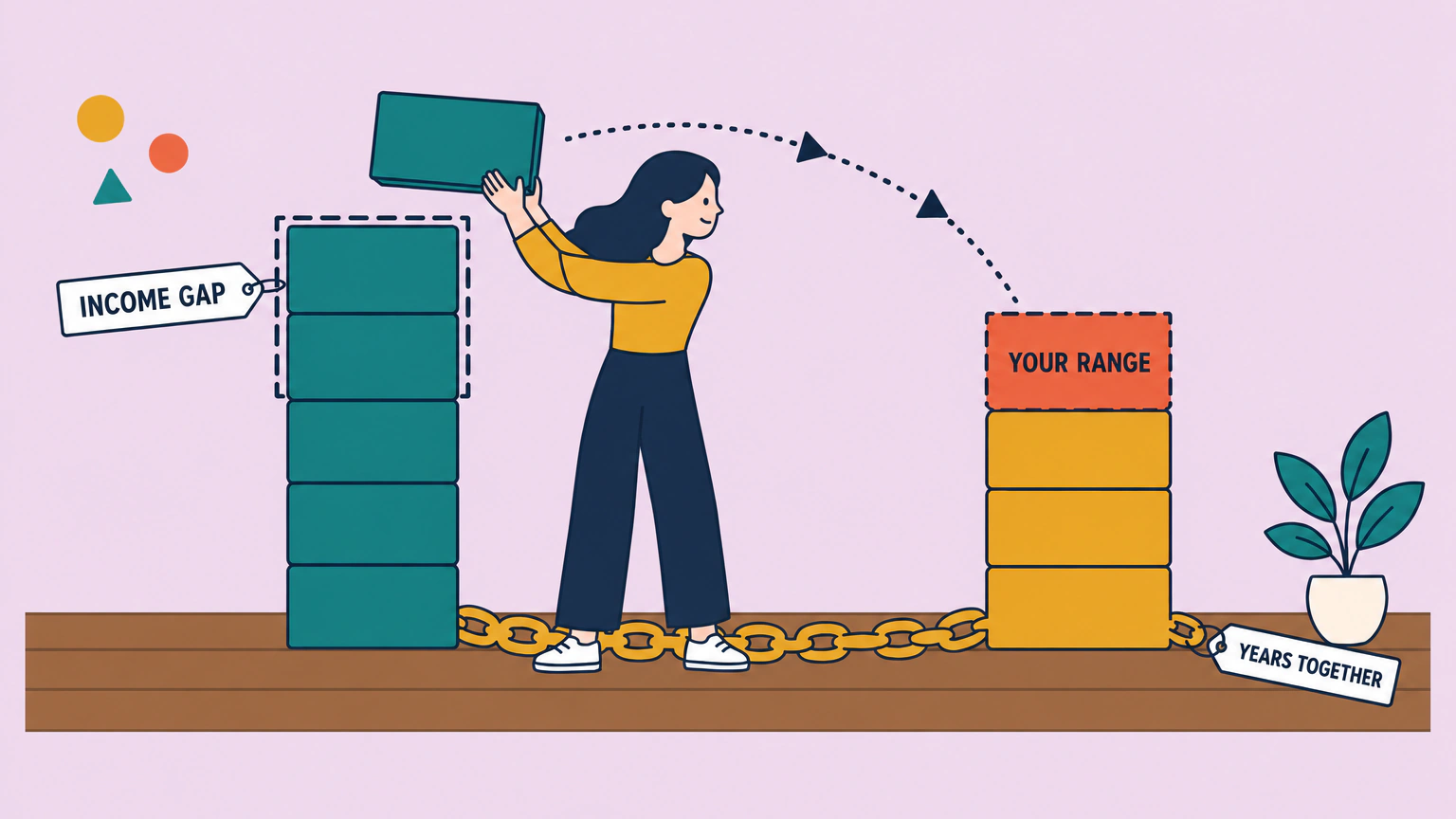
Once support is owed, Canadian judges and lawyers start with the Spousal Support Advisory Guidelines: with no dependent children, that's 1.5% to 2% of the gap between your gross incomes for every year you lived together, paid for half a year to a year per year together. For a lower-earning parent with primary care, the basic with-child formula targets 40% to 46% of the spouses' combined individual net disposable income. That takes software to find.
Two things trip people up first. The formula only matters once support is owed. And "indefinite" support doesn't mean forever.
On this page
- First, is support owed at all?
- Two formulas, and how to tell which one is yours
- Without child support: the math, step by step
- With child support: why this one takes software
- How long support lasts
- Where in the range you'll land
- When the formula stops deciding
- What support really costs after tax
- Changing or ending support later
- Quebec: support follows marriage or civil union
- Before you agree to a number
- Frequently asked questions
First, is support owed at all?
The guidelines don't decide whether you owe support or are owed it. They start after that question is settled. Justice Canada puts it plainly: "It may be a waste of your time and energy to calculate a spousal support amount if there is no legal requirement to pay it."
Courts recognize three reasons to order support. Compensatory support makes up for what the relationship cost one of you, such as a career put on hold, a move for the other's job, or primary care of the children. Non-compensatory support answers need, and the drop from the standard of living you shared. Contractual support comes from an agreement you signed.
The guidelines' authors are blunt that an income gap alone doesn't create a right to support. In practice, though, a large gap often supports a claim based on need.
The Divorce Act tells a judge to weigh how long you lived together, what each of you did in the relationship, and any agreement. Its four goals are to recognize the economic gains or losses the marriage or breakup left you with, share the cost of caring for the children, ease the hardship of the breakup, and help each of you stand on your own in a reasonable time. Misconduct doesn't count. Ontario's Family Law Act sets out much the same purposes.
If your case rests on need, don't wait. A long delay can make a support claim harder to establish.
Never married? Your province decides who can ask
Married spouses can ask for support anywhere in Canada. In Ontario, asking the court to decide support as part of a divorce changes which forms you file, and our guide on how to file for divorce in Ontario covers them. Couples who never married rely on a provincial law, and the tests differ in how long you must have lived together and in what a shared child changes. Here's how it works in four provinces.
| Your situation | Who can ask | The law |
|---|---|---|
| Married, anywhere in Canada | Either spouse, on separation or divorce | Divorce Act, s. 15.2, on divorce. Otherwise your province's family law |
| Ontario, not married | Partners who lived together continuously for at least three years, or in a relationship of some permanence as parents of a child together | Family Law Act, s. 29 |
| British Columbia, not married | Partners in a marriage-like relationship for at least two years in a row, or for less if you have a child together | Family Law Act, s. 3 |
| Alberta, not married | Adult interdependent partners: at least three years in a row in a relationship of interdependence, some permanence with a child, or a signed partner agreement | Adult Interdependent Relationships Act, s. 3, and Family Law Act, s. 57 |
| Quebec, not married or in a civil union | No statutory right to spousal support. Partners in a parental union can ask for a compensatory allowance instead | Civil Code of Québec, arts. 585 and 521.43 |
We checked these four provinces against their statutes. In any other province or territory, start with its own family law Act.
In Ontario and Alberta, three years together is the usual bar. British Columbia's is two. Quebec is the outlier: partners who never married or entered a civil union have no statutory right to spousal support. Ontario's rule has wrinkles of its own, and our guide to who counts as common law in Ontario walks through them.
Two formulas, and how to tell which one is yours
The Spousal Support Advisory Guidelines were written by two family-law professors, Carol Rogerson of the University of Toronto and Rollie Thompson of Dalhousie, with funding from Justice Canada. The final version came out in July 2008, and their Revised User's Guide followed in April 2016.
They aren't law. Judges often base their decisions on them anyway, and family lawyers use them to negotiate. They were built for the Divorce Act, and courts often use them under provincial law too.
Which formula is yours turns on one question: is child support being paid? If not, including a long marriage where the kids are grown, you use the without-child formula. If it is, you use the with-child formula. That one is really a family of formulas, with versions for shared care, split care and a parent who pays spousal support while the children live with them. When child support ends, a case can cross over to the without-child formula on review.
Without child support: the math, step by step
This is the formula you can work out yourself, with a pencil and two tax returns.
The gap between your incomes, times your years together
Step one. Subtract the lower gross income from the higher one. Gross means before tax. Income starts from the child support definition that applies to you. Quebec uses its own definition instead of the Federal Child Support Guidelines.
Step two. Count your years together. Start when you began living together, and stop at separation. Quebec courts differ on whether years before marriage count. If you split up and then got back together, the periods usually add up.
Step three. Multiply the gap by 1.5% for each year for the low end, and by 2% for each year for the high end. Divide by 12 for a monthly figure.
Take the guidelines' own example. Arthur and Ellen separate after a 20-year marriage. He earns $90,000 and she earns $30,000, so the gap is $60,000. Twenty years gives 30% to 40% of that gap, or $18,000 to $24,000 a year. That's $1,500 to $2,000 a month, with no set end date, because they were together 20 years.
That range assumes the usual tax treatment: deductible for the person paying and taxable for the person receiving. We'll come back to what tax does to it.
What a $50,000 gap works out to
Take a couple earning $90,000 and $40,000. The gap is $50,000, and the only thing that changes from row to row is how long they lived together. Before the net-income cap, doubling the gap doubles the formula figures.
| Years together | Share of the gap | Per year | Per month | How long it lasts |
|---|---|---|---|---|
| 3 | 4.5% to 6% | $2,250 to $3,000 | $188 to $250 | 1.5 to 3 years |
| 5 | 7.5% to 10% | $3,750 to $5,000 | $313 to $417 | 2.5 to 5 years* |
| 10 | 15% to 20% | $7,500 to $10,000 | $625 to $833 | 5 to 10 years* |
| 15 | 22.5% to 30% | $11,250 to $15,000 | $938 to $1,250 | 7.5 to 15 years* |
| 20 | 30% to 40% | $15,000 to $20,000 | $1,250 to $1,667 | No set end date |
| 25 or more | 37.5% to 50%** | $18,750 to $25,000** | $1,563 to $2,083** | No set end date |
* No set end date if the recipient's age at separation plus your years together comes to 65 or more.
** The top of this range is capped where your net incomes would be equal. By hand, the guidelines' authors suggest 48% of the gap, about $2,000 a month here.
Monthly figures are the yearly figure divided by 12, rounded to the nearest dollar.
Most explanations leave out two things those numbers show. First, the amount stops growing at 25 years. From then on it stays at 37.5% to 50% of the gap, however long the marriage ran. Second, the top of that range is capped at the point where you'd both end up with equal net incomes, so the real top end can be lower than half the gap. The authors say you can estimate the cap by hand at 48% of the gap. For this couple, that's about $2,000 a month rather than $2,083.
Pro tip: check the math on any example you're shown. Run any example you're handed through the formula yourself. Multiply the income gap by 1.5%, then by your years together, and divide by 12 for the low end. Do it again with 2% for the high end. A 15-year marriage with an $80,000 gap gives $1,500 to $2,000 a month. We found one published guide printing $1,200 to $1,600 for that same case, a fifth too low.
With child support: why this one takes software
Child support comes first. The Divorce Act tells the court to give it priority, and spousal support is worked out from what's left.
The basic with-child formula applies when the lower earner has primary care and receives both kinds of support. It uses each spouse's individual net disposable income. Child support, taxes and permitted deductions come off first, with a notional child support amount for the recipient. Both spouses' child support contributions include special expenses, and benefits and credits count as income. Spousal support leaves the recipient with 40% to 46% of that combined pool.
Every dollar of spousal support changes both tax bills and the benefits, and that changes the pool. So the answer takes repeated trial runs, and Justice Canada says you'll likely need software built for it. Online calculators "may help with simple calculations, but not with the harder calculations," it adds. That's why a spousal support calculator for Ontario, or any other province, is on firmer ground without child support than with it. CLEO points Ontario readers to MySupportCalculator.
Duration works differently here. Initial orders have no set end date. These duration ranges apply to relationships shorter than 20 years:
- Low end: the longer of half the relationship, or until the youngest child starts full-time school.
- High end: the longer of the whole relationship, or until the youngest child finishes high school.
In the guidelines' own example, Bob and Carol were married 8 years and have children aged 4 and 6. Their range runs from 4 to 14 years.
For divorcing parents both habitually resident in Quebec, the formula uses Quebec's child support rules. Otherwise, the federal rules apply.
How long support lasts
How long spousal support lasts is half the formula, and the guidelines' authors say it's the half people ignore.
Half a year to a year for every year together
Without child support, the formula gives half a year to a full year of spousal support for each year you lived together. On the $50,000 example, a 10-year relationship gives 5 to 10 years. Any interim support you've already paid or received counts toward that total. Short marriages produce small, short awards, and where there's money, they can be paid as one lump sum.
Where you land in that time range often follows why support is owed. Strongly compensatory cases tend toward the long end. Cases built on the drop in living standard tend toward the short end.
The authors put the warning bluntly: "To ignore duration is to misapply the without child support formula." Amount and duration come as a package.
Twenty years, or the rule of 65
Support has no set end date in two cases. The first is a relationship of 20 years or more. The second is the rule of 65 for spousal support: your years together plus the recipient's age at separation add up to 65 or more, as long as you lived together at least five years. It's the age at separation that counts, not the age at trial.
Three quick checks:
- 12 years together and 54 at separation makes 66, so there's no set end date.
- 12 years together and 50 at separation makes 62, so support runs 6 to 12 years.
- 4 years together and 63 at separation makes 67, but the rule doesn't apply under five years together. That's 2 to 4 years.
Now the reassurance, and the warning. "Indefinite" only means no end date can be set at the start. "Indefinite support does not necessarily mean permanent support," the authors write, and the order stays open to review and change. A recipient on indefinite support is still expected to make reasonable efforts to support themselves. If you don't try, a court can treat you as earning what you could earn, which lawyers call imputing income, and cut support on review.
Where in the range you'll land
The honest answer to "how much spousal support will I get" is a range, and the middle of it isn't the default. The guidelines' authors found that 60% of reported with-child cases were ordered at the mid-point, mostly with little explanation, and they say that habit should be avoided.
What moves you up or down, according to the guidelines:
- how strong any compensatory claim is
- the recipient's needs
- the ages, number and needs of the children
- the payor's own needs and ability to pay
- the payor's reason to keep working
- how property and debts were divided
- the recipient's reason to become self-sufficient
The authors add that with-child cases should more often land in the upper half of the range, because the formula already allows for an average ability to pay.
Before you negotiate, write down which of these push your case up, which push it down, and why. A number with reasons behind it holds up. A number without them tends to get split down the middle.
When the formula stops deciding
At the bottom, below $20,000 of gross income for the person paying, support generally isn't payable. Between $20,000 and $30,000, courts may go below the range because the payor can't afford it. At the top, above $350,000, the formulas aren't applied mechanically and judgment takes over. That isn't a cap. Support can keep rising, case by case.
The guidelines also list exceptions, cases where the formula's answer doesn't fit. They include:
- money pressures in the interim period, right after separation
- debt payments
- support already owed to an earlier spouse or children
- illness and disability
- a short marriage with no children where one spouse gave up a great deal
- property division, including reapportionment in British Columbia and a pension already divided as property
- basic needs or hardship
- a payor whose income isn't taxed
- a child's special needs
Property shows up twice, as a factor in where you land and as an exception. If you're still working out what happens to the house, settle it alongside support.
Then there's restructuring. You, or a court, can trade amount against duration, as long as the total stays inside the range the formula produces when you multiply amount by years. That means higher payments for fewer years, lower payments for longer, or one lump sum.
A signed final agreement changes the starting point. The agreement governs unless a court can override it or set it aside. On a divorce, the court asks how the agreement was negotiated and whether it still meets the Divorce Act's goals, a two-part check lawyers call the Miglin test. The formula's ranges can help the court assess that agreement.
What support really costs after tax
The guidelines produce a before-tax figure, and it's the one people react to. Tax decides what each of you feels.
Qualifying periodic spousal support under a written agreement or court order is deductible for the person paying and taxable for the person receiving. The payor claims it on line 22000, with the total of all support paid on line 21999. The recipient reports it on line 12800. The CRA's conditions are strict:
- The two of you were living apart because the relationship broke down. Normally, the recipient must be free to choose how to use the payments.
- The order or agreement clearly states the spousal amount. Under current rules, anything it doesn't identify as support for the recipient alone counts as child support, which is neither deductible nor taxable. Pre-May 1997 orders can follow older rules.
- Payments to the same recipient count toward child support due for the current and earlier years first. Only the balance can count as deductible spousal support.
- Payments made before the agreement, earlier that year or the year before, count only if the agreement says they were made under it.
A lump sum generally isn't deductible or taxable, because it isn't periodic. That's why the guidelines' authors say a lump sum worked out from the ranges has to be cut down for tax.
If your order or agreement includes spousal support, register it with the CRA on Form T1158. One that covers child support only isn't registered. All of this is tax-return work, and a tax preparer can check it before you file.
Changing or ending support later
To change an order, you have to show that the "condition, means, needs or other circumstances" of either of you have shifted since the last order. That's the Divorce Act's test, and it works in both directions.
Retirement is a common trigger. If your order says nothing about it, retiring is usually a material change, and lawyers often write it in as a review point so nobody has to argue about it later. Courts look hard at an early retirement. If a pension was already split as property, the court tries not to count it twice, a rule from the Supreme Court's decision in Boston v. Boston.
A new partner doesn't end support automatically, whether the recipient remarries or moves in with someone. Support is often reduced and sometimes ended. Much depends on whether it was compensatory or needs-based, how long the first relationship lasted, the recipient's age, and the new household's standard of living.
Self-sufficiency counts too. A recipient is expected to make reasonable efforts, and a time-limited order can end on schedule. When a variation is argued, the total range (monthly amount times months) can be compared with what's already been paid.
A variation is an application, not an announcement. Stopping payments on your own isn't one.
Quebec: support follows marriage or civil union
Under Quebec's Civil Code, statutory spousal support is owed between married and civil union spouses. Partners who were neither have no right to it. That includes couples in the parental union, a status a 2024 reform created for unmarried partners who become parents of the same child.
A parental-union spouse can ask instead for a compensatory allowance. It makes up for the loss you took by contributing, in property or work, to the other partner's gains. It's paid all at once or in instalments, and it isn't support.
Married couples divorcing in Quebec can still use the guidelines. The with-child formula uses Quebec's child support rules when both parents are habitually resident there. The guidelines' own Quebec chapter records that their use dropped sharply there after a 2006 Court of Appeal decision faulted a judge for leaning on them instead of studying the household budget.
Before you agree to a number
Whichever side of the table you're on, settle these points in writing before any figure is agreed or ordered.
- Name the reason support is owed: a career one of you put on hold, a drop in the standard of living you shared, or a contract you both signed.
- Confirm which years count toward your relationship length, ending at separation.
- Use the same applicable child support income definition for both of you.
- Ask for the low, middle and high amounts and the range for how long, not a single number.
- Agree where in the range you'll land, and write down why.
- Decide whether retirement, a new partner or the end of child support will trigger a review, and say so in the agreement.
- Set out the spousal support amount separately from any child support, and register the agreement with the CRA on Form T1158.
We're not your lawyer, and a support claim is worth one conversation with a family lawyer before you sign anything.
Bring this list, your two most recent tax returns and three dates (when you moved in, married and separated) to a family lawyer in your province. If support is being settled as part of a divorce, divorce and separation lawyers can negotiate the two together.
Frequently asked questions
Does spousal support end if my ex remarries or moves in with someone?
Not automatically. A new partner can be a material change, and support is often reduced and sometimes ended. Much depends on why it was ordered. In the cases the guidelines' authors collect, support that makes up for a career set aside has tended to hold up better than support based on need. Either way, the payor must apply to vary a court order or renegotiate an agreement.
Does spousal support stop when I retire?
Not by itself. If your order or agreement says nothing about retirement, retiring is usually a material change that lets you ask for a variation, and lawyers often write it in as a review point. Courts look closely at an early retirement and may leave support where it was. If your pension was already divided as property, they try not to count it twice.
Is spousal support based on gross or net income?
It depends on the formula. With no dependent children, the guidelines use the gap between your gross incomes, before tax. With children, they use each spouse's individual net disposable income after child support, taxes and benefits, which is why that version needs software. Both start from the applicable child support income definition.
Do I have to pay spousal support if my spouse cheated?
Usually, yes. The Divorce Act tells judges not to consider misconduct in the marriage. Ontario's Family Law Act allows one narrow opening: conduct "so unconscionable as to constitute an obvious and gross repudiation of the relationship" can affect the amount, though not whether support is owed at all.
Is spousal support taxable in Canada?
Yes, when it meets the tax rules for periodic support under a written agreement or court order. It's deductible for the person paying and taxable for the person receiving. The agreement must state the spousal amount. Payments to the same recipient go toward child support due first, with only the balance counting toward deductible spousal support. Lump sums generally aren't deductible or taxable. If your order includes spousal support, register it with the CRA on Form T1158.
Can I get spousal support if we were never married?
In Ontario, British Columbia and Alberta, yes, once you meet that province's test. That's three years together in Ontario and Alberta and two in British Columbia. A child together can qualify you sooner, with some permanence in Ontario and Alberta, or a marriage-like relationship in BC. Alberta also allows a qualifying partner agreement. Quebec partners who never married or entered a civil union have no statutory right to spousal support.