

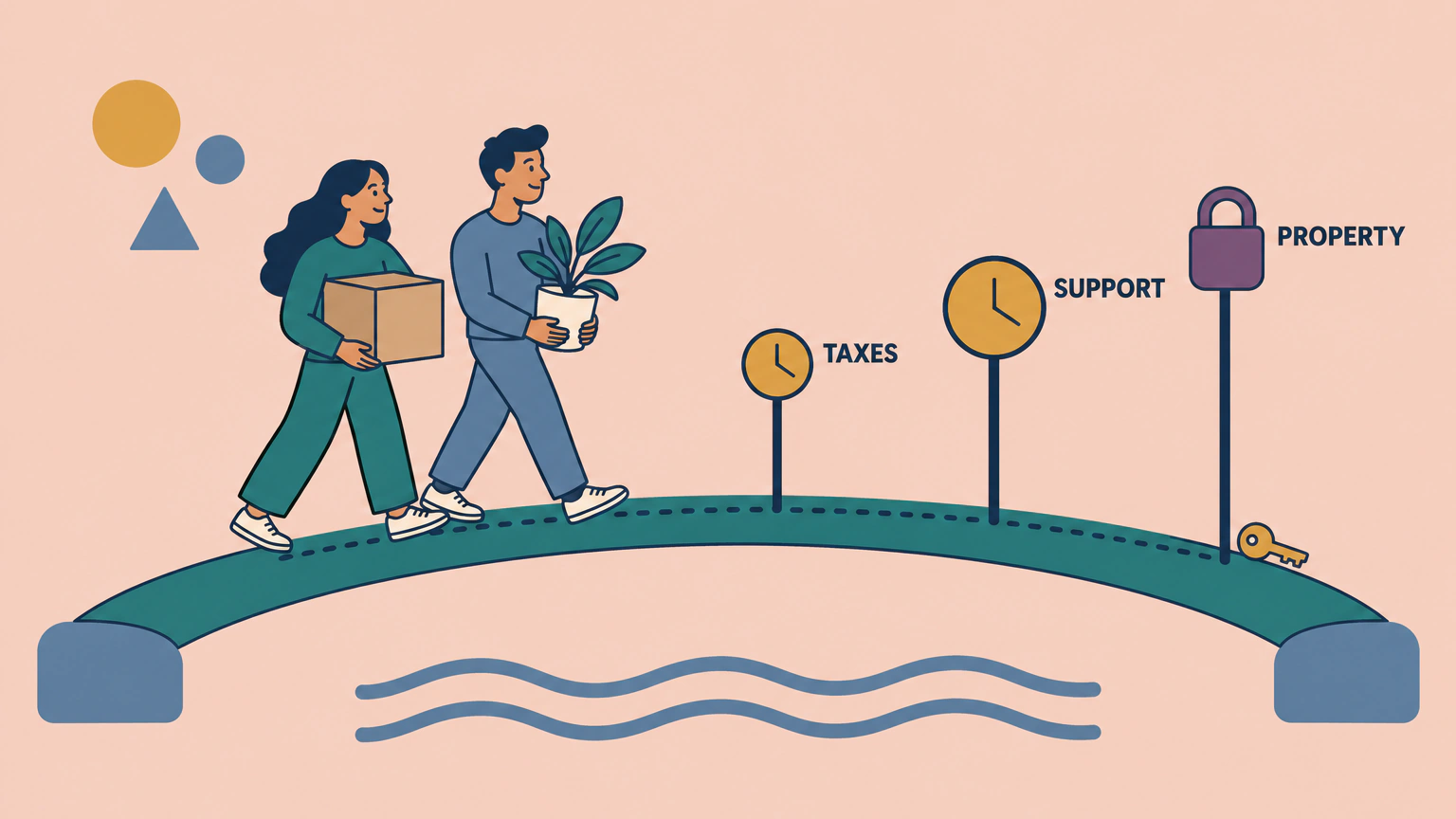
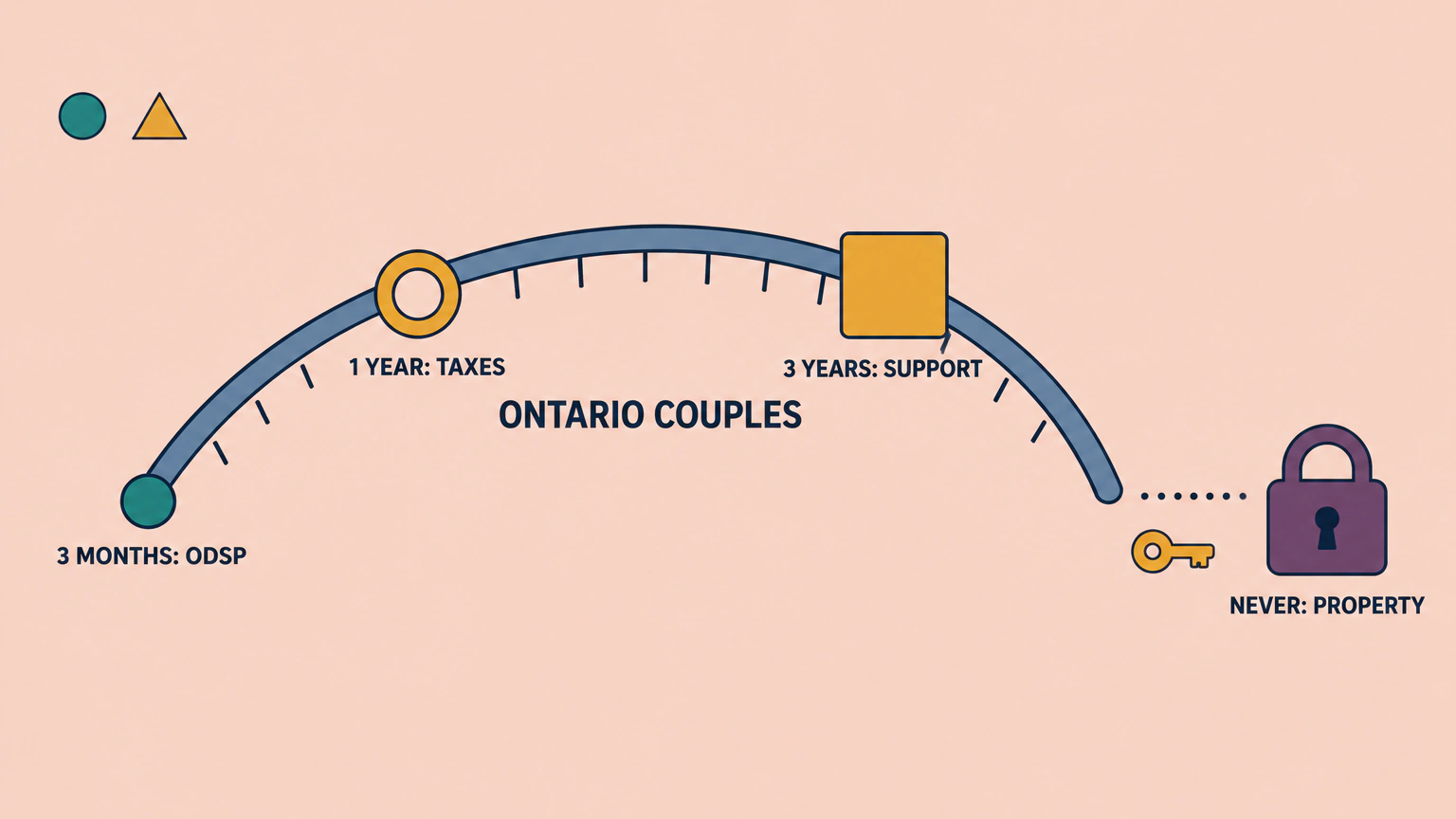
It matters, but Ontario has no single day on which you become common law. Each law keeps its own clock. Ontario Works and ODSP can count you as a couple after three months in the same home, and the CRA after twelve months. Spousal support takes three years of living together. And the rules that split property and pass on an estate without a will never count you at all, however long you stay.
So don't start with whether you're common law. Start with who's asking, and what changes once they count you.
On this page
- There's no single day you become common law in Ontario
- Who's asking, and when they start counting you
- Where do you stand today?
- Three months: when Ontario Works and ODSP treat you as a couple
- One year: taxes, pensions, immigration and the hospital
- Three years: spousal support, workplace pensions and claims on an estate
- Never: the house, the savings and an estate with no will
- What you can put in writing before the clocks decide for you
- Common questions about common law in Ontario
There's no single day you become common law in Ontario
There's no form to file and no certificate to frame. Each Act that cares about couples writes its own definition for its own purposes. The Ontario statutes call you a "spouse", and the federal ones call you a "common-law partner".
The Family Law Act builds its rules on one word. To "cohabit", it says, means "to live together in a conjugal relationship, whether within or outside marriage." That means a relationship that works like a marriage, not two roommates splitting the rent. Nothing in the Act's support rules asks you to register or sign anything. Your status is a set of facts about how you live.
You're in good company. Statistics Canada's 2021 Census counted 16% of Ontario couples as common law, roughly one couple in six, against 23% across Canada.
Who's asking, and when they start counting you
The outside world counts you early: the tax system, the benefits office and the hospital all treat you as a couple within a year, and sometimes much sooner. What the two of you can claim from each other starts late, and the biggest claims never start at all.
| What's at stake | When you start to count | If you have a child together | Where it says so |
|---|---|---|---|
| Ontario Works and ODSP | After 3 months in the same home, if you live like a couple socially and financially | The wait may not apply | O. Reg. 134/98, s. 1(1); O. Reg. 222/98, s. 1(1) |
| Income tax and CRA benefits | After 12 months living together as a couple | Right away | Income Tax Act, s. 248(1) |
| CPP survivor's pension and Old Age Security | After 1 continuous year | No shortcut | Canada Pension Plan, ss. 2(1), 42(1); Old Age Security Act, s. 2 |
| Immigration | After 1 year living together | No shortcut | Immigration and Refugee Protection Regulations, s. 1(1) |
| Medical decisions when one of you can't decide | After 1 year, or the day you sign a cohabitation agreement | Right away | Health Care Consent Act, 1996, s. 20(7) |
| Spousal support after a breakup | After 3 years living together continuously | No set wait, but a judge must find "a relationship of some permanence" | Family Law Act, s. 29 |
| Survivor benefits from an Ontario workplace pension | After 3 years living together continuously | Same test as spousal support | Pension Benefits Act, s. 1(1) |
| Support from your partner's estate | After 3 years living together continuously | Same test as spousal support | Succession Law Reform Act, s. 57 |
| An automatic share of property or the family home | Never | Never | Family Law Act, ss. 1(1), 5(1), 19(1) |
| Inheriting when there's no will | Never | Never | Succession Law Reform Act, s. 1(1) |
| Bereavement leave, human rights protection, a restraining order | From the day you live together as a couple | From the same day | Employment Standards Act, 2000, s. 45; Human Rights Code, s. 10(1); Family Law Act, s. 46(2) |
Every rule also needs the two of you to be living together as a couple, which the statutes call a conjugal relationship. Time is only the part you can count on a calendar.
Where do you stand today?
Give three answers: how long you've lived together, whether you have a child together, and whether you've both signed a cohabitation agreement. The cards then sort all eleven rules for you. Some already count you, some have no fixed wait because another fact decides the answer, some are still waiting, and two never start. They test the calendar only. Every rule still needs the two of you to be living as a couple.
Where do you stand today?
Ontario starts counting an unmarried couple at different points: three months for Ontario Works and ODSP, one year for taxes, CPP, immigration and medical decisions, three years for spousal support, workplace pension survivor benefits and claims on an estate, and never for an automatic share of property or for inheriting without a will.
6 of these 11 rules already count the two of you as a couple. 3 are still waiting on the calendar. 2 never start, however long you live together.
This is the time test only. Every rule also needs the two of you to be living together as a couple.
Already counts you
Ontario Works and ODSP
The rule
You count as spouses once you've lived in the same home for at least three months.
It also needs
The social and family side of your life together, and the money side, both have to look like a couple's. The regulation says sexual factors aren't to be investigated or considered.
What it changes
The office assesses the two of you as a couple instead of as two single people.
Before three months, the office may still count you if you jointly declare that you're spouses, a court order or domestic contract requires support, or one person has a current duty under the Family Law Act to support the other person or one of that other person's dependants. A child together isn't enough on its own.
Source
O. Reg. 134/98, s. 1(1); O. Reg. 222/98, s. 1(1)
Income tax and CRA benefits
Starts at 12 months together
The rule
You count as common-law partners once you've lived together as a couple for 12 months in a row, or right away if you're the parents of the same child.
It also needs
A conjugal relationship. A split of under 90 days doesn't break the 12 months.
What it changes
You have to tell the CRA by the end of the month after your status changed. Your benefits and credits are then worked out on both incomes.
One route we don't test here: the CRA also counts a partner who has custody and control of your child, if the child depends wholly on them for support.
Source
Income Tax Act, s. 248(1)
CPP survivor's pension and Old Age Security
Starts at one continuous year
The rule
You count as common-law partners after one continuous year of living together. A child together doesn't shorten it.
It also needs
A conjugal relationship at the time that matters. For a survivor's pension, that's the day your partner dies.
What it changes
The common-law partner at the date of death is the survivor for the CPP survivor's pension, ahead of a married spouse your partner had left.
Source
Canada Pension Plan, ss. 2(1), 42(1); Old Age Security Act, s. 2
Immigration
Starts at one year together
The rule
You count as common-law partners after at least one year of living together. A child together doesn't shorten it.
It also needs
A conjugal relationship.
What it changes
For most purposes under Canada's immigration law, you count as each other's family member.
Source
Immigration and Refugee Protection Regulations, s. 1(1), 1(3)
Medical decisions when one of you can't decide
Starts at one year together, or the day you both sign a cohabitation agreement
The rule
You count as spouses if you've lived together for at least one year, or you're together the parents of a child, or you've both signed a cohabitation agreement.
It also needs
A conjugal relationship, and that you aren't living apart after a breakup.
What it changes
A spouse is fourth on the list of people who can consent to treatment for someone who can't: after a guardian, an attorney for personal care and a representative the Consent and Capacity Board appoints, and ahead of children and parents.
Source
Health Care Consent Act, 1996, s. 20(1), (7), (8)
Bereavement leave, human rights protection and a restraining order
The rule
You count from the day you live together as a couple. None of these three sets a waiting period.
It also needs
A conjugal relationship. For a restraining order, it's enough that you live together or once did, for any period of time.
What it changes
Unpaid bereavement leave reaches your partner and their close family, the Human Rights Code protects you against discrimination because of marital status, and you can ask a family court for a restraining order.
Source
Employment Standards Act, 2000, ss. 45, 50.0.2; Human Rights Code, s. 10(1); Family Law Act, s. 46(2)
No fixed wait, but another fact decides it
Not yet
Spousal support if you separate
Starts at three years together
The rule
You count as spouses after living together continuously for at least three years.
It also needs
A conjugal relationship. Qualifying only opens the door: support depends on need and on what the other person can pay.
What it changes
Either of you can ask a court for support from the other.
With a child together there's no set wait, but a judge has to find that yours is 'a relationship of some permanence'. The Act puts no number on that.
Source
Family Law Act, ss. 29, 30
Survivor benefits from an Ontario workplace pension
Starts at three years together
The rule
You count as spouses after living together continuously for at least three years.
It also needs
A conjugal relationship on the date that matters, and a pension plan that Ontario's Pension Benefits Act covers.
What it changes
The spouse on the date of death is entitled to the pre-retirement death benefit, and a pension that starts while the member has a spouse has to be a joint and survivor pension.
With a child together there's no set wait, but the relationship has to be one 'of some permanence'.
Source
Pension Benefits Act, ss. 1(1), 44(1), 48(1)
Support from your partner's estate
Starts at three years together
The rule
You count as a spouse after living together continuously for at least three years.
It also needs
Your partner must have been supporting you, or legally obliged to, right before they died.
What it changes
You can ask a court for support out of the estate. The application is due within six months of the grant of probate or administration.
With a child together there's no set wait, but the relationship has to be one 'of some permanence'.
Source
Succession Law Reform Act, ss. 57, 58(1), 61(1)
Never, however long you stay
An automatic share of property or the family home
The rule
Living together never brings Ontario's property-sharing rules or an automatic right to the home. Those belong to married spouses, however long you stay.
What you have instead
A court claim for unjust enrichment, where you prove what you contributed and how it built up the other person's wealth.
What it changes
Each of you leaves with what's in your own name unless a court orders otherwise.
Source
Family Law Act, ss. 1(1), 5(1), 19(1); Kerr v. Baranow, 2011 SCC 10
Inheriting when there's no will
The rule
Living together never makes you a spouse for inheritance without a will. For that, 'spouse' means married.
What you have instead
A will, or the estate support claim on the card called 'Support from your partner's estate'.
What it changes
Without a will, the Act shares out your partner's estate and leaves you out.
Source
Succession Law Reform Act, s. 1(1)
Three months: when Ontario Works and ODSP treat you as a couple
This is the shortest clock in Ontario law, and it lands on the people with the least room for surprises. Ontario Works and the Ontario Disability Support Program use the same words in their regulations. Someone becomes your spouse once they've lived in the same home as you "for a period of at least three months", if two other things are true.
The social and family side of your relationship has to be "consistent with cohabitation". So does the money side: the support one of you gives the other, or how tangled your finances are. The regulations add that "sexual factors shall not be investigated or considered."
Three other routes skip the wait. You can declare yourselves spouses. A court order or a written family agreement can require one of you to support the other. Or one of you can owe support under the Family Law Act. That route can count a partner sooner when they have a current duty to support you or one of your dependants, including a child.
Once you count, the office assesses you as one couple, not two single people.
One year: taxes, pensions, immigration and the hospital
Four different laws settle on one year. They don't agree on what a child changes, though, and that gap is where a lot of the confusion about common law in Ontario starts.
The CRA counts twelve months, or none if you share a child
For income tax, your partner becomes your common-law partner once you've lived together in a conjugal relationship "throughout the 12-month period that ends at that time", in the Income Tax Act's words. If you're both parents of the same child, there's no wait at all. A split of less than 90 days after a breakdown doesn't reset the twelve months.
The CRA's guidance is direct: "You must tell the CRA about your new marital status by the end of the following month after your status changed." From then on, your benefits and credits are worked out on adjusted family net income, which includes both incomes. The CRA recalculates, and any adjustment starts the month after your status changed. If you were paid too much, you'll get a notice of the balance owing.
What the new status does to a whole tax return is its own subject. If your status changed partway through the year, a tax preparer can walk you through it.
CPP, Old Age Security and immigration all want a full year
The Canada Pension Plan and the Old Age Security Act use the same test. A common-law partner is someone you've lived with in a conjugal relationship "for a continuous period of at least one year". When one of you dies, the date that counts is the day of death.
That matters most for the CPP survivor's pension. It goes to whoever was the common-law partner at death. A married spouse qualifies only if there's no such partner, so a partner of a year or more comes ahead of a husband or wife the deceased had left.
Canada's immigration rules count "at least one year" of living together too. None of the three shortens the wait for a child. If a sponsorship application is your next step, start with who can represent you on an immigration application.
Medical decisions: a year, a child or a signed agreement
Picture a hospital corridor. Your partner can't make a treatment decision, and the doctor needs someone who can. Ontario's Health Care Consent Act ranks who that can be. A spouse comes fourth, after a guardian, an attorney for personal care and a representative the Consent and Capacity Board appoints, but ahead of children and parents.
For that list, you're spouses if you live in a conjugal relationship outside marriage and you've lived together for at least one year. Being parents of a child together, or both signing a cohabitation agreement under the Family Law Act, counts at once. Living apart after a breakdown ends it.
So a couple eight months in, with no child and no agreement, has no place on that list as spouses. If you each name the other in a power of attorney for personal care, your partner outranks the spouse rule, with no clock to wait on.
Three years: spousal support, workplace pensions and claims on an estate
Three years is the number most people have heard. It's also the one that governs what the two of you can claim from each other, and it's the rule most often misquoted.
What section 29 says, and the one year rule it doesn't contain
Section 29 of the Family Law Act is the door to spousal support for couples who never married. It says "spouse" includes two people who aren't married to each other and have cohabited "continuously for a period of not less than three years". It adds a second route: "in a relationship of some permanence, if they are the parents of a child".
The first route is a calendar test. The second has no number in it at all. A judge decides whether your relationship had "some permanence", and a child together is what opens that route.
Getting through the door doesn't set an amount. Section 30 says every spouse must support the other "in accordance with need, to the extent that he or she is capable of doing so." Whether support is paid, and how much, turns on one person's need and the other's ability to pay.
Watch for the one year rule. Some pages that rank for this question say Ontario's Family Law Act makes you common law after one year if you have a child. It doesn't. Section 29 has two routes: three years of living together continuously, or "a relationship of some permanence" if you're the parents of a child. The second route has no number in it, so a judge decides. The one-year rules belong to the CRA, CPP, immigration and medical consent.
You can count as living together without sharing one address
Lisa Climans and Michael Latner were together for almost 14 years. They never married and never moved in together, and each kept a home in Toronto. But every July and August they lived together at his Muskoka cottage. They spent winter weekends in Florida, and he supported her financially. When it ended, she asked for spousal support, and he argued they had never cohabited.
The trial judge found they were spouses under section 29, and in 2020 the Court of Appeal for Ontario left that finding alone. "Lack of a shared residence is not determinative of the issue of cohabitation," the court wrote.
The trial judge also drew a limit, which the appeal court repeated with approval: "there needs to be some element of living together under the same roof." Courts weigh a list of factors the decision recites: shared shelter, sexual and personal behaviour, services, social activities, economic support, children, and how others saw the couple.
A weekend relationship isn't what the court approved.
Pensions and estates borrow the same test
Ontario's Pension Benefits Act copies the support test almost word for word. Unmarried partners count if they're "living together in a conjugal relationship" continuously for at least three years, or in a relationship of some permanence with a child together. Once you count, a pension that starts while the member has a spouse "shall be a joint and survivor pension", which keeps paying the survivor for life. If the member dies before the pension starts, the spouse on the date of death gets the pre-retirement death benefit. This covers plans that Ontario's Act governs.
The Succession Law Reform Act borrows section 29 for one purpose: support from an estate. If your partner was supporting you, or had to, right before they died, you can ask a court for support out of the estate. The deadline is six months after the grant of probate or administration, and after that a court can allow a claim only against what's still undistributed.
Never: the house, the savings and an estate with no will
Two things never arrive on the calendar. Living together, for any number of years, doesn't give you a share of your partner's property or an automatic right to stay in their home. Nor does it make you their heir if they die without a will. If you've assumed that enough years bring half of everything, here's why they don't.
Why no number of years splits the property
The worry usually sounds like this: if my partner moves in, do they get half my house? Under the statute, no.
For the Family Law Act's property rules, "spouse" means two people who are married to each other, with no living-together route. So the equalization payment in section 5, which splits the growth in a married couple's wealth, isn't open to you. Neither is the rule that "Both spouses have an equal right to possession of a matrimonial home." Each of you leaves with what's in your own name.
One nuance: a judge deciding a support claim can order property transferred, or make an order about the home, as part of that support. So "never" describes the property-sharing rules, not every order a support judge can make.
Outside the statute, the remedy is a lawsuit for unjust enrichment. In Kerr v. Baranow, the Supreme Court of Canada set the test: the other person was enriched, you lost out correspondingly, and there's no legal reason for it. Where a couple ran a "joint family venture", the award is a share of the wealth "proportionate to the claimant's contributions." Courts look at mutual effort, economic integration, actual intent and whether the family came first. It's a claim you have to prove with records, and that can feel deeply unfair after years spent on a home in someone else's name.
If you're married, the rules on who gets the house when a married couple splits are very different.
If your partner dies without a will
Outside its support Part, the Succession Law Reform Act gives "spouse" the Family Law Act's general meaning, which is married. So if your partner dies without a will, Ontario's inheritance rules share out the estate and leave you out, however long you lived together.
Two things remain. One is the estate support claim, with its six-month deadline. The other is the CPP survivor's pension after a year together. A will changes everything else, and estate planning lawyers can draw one up for each of you. The fuller picture, including how other provinces handle it, is in our guide to what happens when a common law partner dies without a will.
What you can put in writing before the clocks decide for you
A cohabitation agreement lets you choose your own rules instead of waiting for a statute to choose them. Under section 53 of the Family Law Act, two people who live together, or plan to, and aren't married can agree on their rights while together, if they split up, or when one of them dies. That covers who owns what, how property gets divided and whether either of you pays support. It can't settle decision-making responsibility or parenting time for your children.
The formalities are strict. The agreement can't be enforced unless it's in writing, signed by both of you and witnessed. If you later marry each other, it becomes a marriage contract. A court can set it aside if one of you didn't disclose significant assets or debts, or didn't understand what you signed. It can also override a support waiver that leaves someone in what the Act calls "unconscionable circumstances", a result too unfair to stand. In practice, an agreement is only as strong as the financial disclosure behind it.
Our own cost profiles for family law work of every kind, 950 of them, run from $3,153 to $21,011. That's our quote data, priced to a location, not a market average or the price of one agreement. Family lawyers can tell you what yours would cost, and separation lawyers handle the other end if you're already apart.
We're not your lawyer, and a home or a support claim deserves one. Start with these six steps:
- Tell the CRA by the end of the month after you reach twelve months together, or after your child arrives.
- Each make a will. Without one, Ontario's inheritance rules leave a common law partner nothing.
- Each sign a power of attorney for personal care. It ranks ahead of the spouse rule on the hospital's list.
- Check who is named as beneficiary on every workplace pension, RRSP, TFSA and life insurance policy.
- If the home is in one name, keep dated records of what the other person pays toward it. A property claim rests on proving contributions.
- If you want different rules, put them in a cohabitation agreement: in writing, signed by both of you, and witnessed.
Common questions about common law in Ontario
How long do you have to live together to be common law in Ontario?
It depends on who's asking. Ontario Works and ODSP can count you after three months in the same home. The CRA counts you after twelve months, and CPP, immigration and medical decisions after one year. Spousal support takes three years, or a child and a relationship of some permanence. Property sharing and inheritance without a will never count you, however long you stay.
Is six months common law in Ontario?
No. None of the eleven rules that count Ontario couples uses six months. The shortest fixed wait is three months, for Ontario Works and ODSP. Some routes have no fixed wait at all. The next fixed wait is the CRA's twelve months. If you've heard six months from a workplace plan, check that plan's booklet.
Is common law the same as marriage in Ontario?
No. After three years together, or with a child and a relationship of some permanence, you can ask for spousal support just as a married spouse can. But you never get the property-sharing rules or the automatic right to stay in a home you don't own. And without a will, you inherit nothing from your partner. Those two gaps are the ones worth planning around.
Can a common law partner take half my house in Ontario?
Not by living there. Ontario's property-sharing rules apply only to married spouses. A partner can sue for unjust enrichment, but they have to prove what they contributed and how it built up your wealth. If a court finds the two of you ran a joint family venture, the share is proportionate to those contributions, under the test in Kerr v. Baranow. It's never an automatic half.
Do you have to tell the CRA you're common law?
Yes. The CRA says you "must tell the CRA about your new marital status by the end of the following month after your status changed." Your status changes when you reach twelve months together, or from the start if you're both parents of a child. Your benefits and credits are then recalculated on both incomes, starting the month after the change.
How do you prove you're common law in Ontario?
There's no certificate, and section 29 doesn't ask you to register. Each body that asks looks at the facts. Courts weigh shared shelter, personal behaviour, services, social life, economic support, children and how others saw you, the list recited in Climans v. Latner. Keep the lease or deed, joint bills and dated records. If things end badly, you may have to show you were a couple at all.
Is common law the same in the rest of Canada?
No. British Columbia is the one other province we checked. Its Family Law Act counts you as spouses after two years in a marriage-like relationship, and that brings property division with it, which Ontario never does. For any other province, check that province's family law statute. For inheritance, our guide to what happens when a common law partner dies without a will compares five provinces.