

On this page
- The short answer, and what each province requires
- Where a handwritten will stands, province by province
- If you use witnesses instead, this is what the signing has to look like
- When a court can rescue a will that was done wrong
- Six ways a homemade will fails
- When to stop and get help
- Questions people ask about handwritten wills
The short answer, and what each province requires
Maybe you're holding a page of your mother's handwriting that turned up in a drawer, and nobody in the family can say whether it counts. Maybe you're the one at the kitchen table with a pen. Either way, you want the same thing first.
In five of the seven provinces we checked, a will you write out by hand and sign is valid with no witnesses at all. The catch is how the statutes describe it. Ontario, Alberta, Saskatchewan and Manitoba use the word wholly: the will has to be wholly in your handwriting. Newfoundland and Labrador instead requires it to be in your handwriting and signed.
British Columbia and Prince Edward Island are the two without a general holograph route. Both normally want two witnesses, but each keeps a narrow unwitnessed-will exception. British Columbia's is for certain forces members on active service. The Island's is for serving forces members and mariners at sea or on a voyage.
One piece of vocabulary, because it's what you'll meet at probate. A will entirely in your own hand is a holograph will. Canadian legislation spells it "holograph", half the internet spells it "holographic", and they mean the same document. The question is whether yours earns the word.
What wholly in your own handwriting rules out
Work the word and the whole rule falls out of it. A holograph will is the writing, all of the writing, and nothing but the writing. Type one clause, paste in a paragraph from a template, or let a helpful nephew print your grandchildren's names so the spelling is right, and the exemption is gone. What's left is an ordinary will, and an ordinary will needs the full witnessed signing it was never given.
The statutes are oddly relaxed about where your signature goes and strict about what sits below it. Ontario treats a will as signed at its end even when the signature lands after, under, beside or opposite the end of the text. But anything written underneath that signature, or slipped in afterward, gets no effect. Manitoba asks for the signature at the end in so many words. So sign once, at the bottom, and resist the urge to add a line about the piano later.
Why a will kit you fill in by hand is not a handwritten will
This is the failure we'd bet on, and it's why people arrive at this question. A kit from the stationery shop or a download is a printed will. Writing your answers into its blanks doesn't make the printed clauses part of a holograph will. The safe route is to treat the kit as an ordinary will and follow its witness requirements.
That isn't an argument against kits. A kit is a form, and a form is only as good as the signing that follows it. A kit isn't something to pick up, write names on and rely on without checking the instructions. Two conditions do most of the work. Make sure the package was written for your province rather than for the country in general. Then follow its signing instructions to the letter, because that's the part a court will look at.
Where a handwritten will stands, province by province
We opened the statute in seven provinces. Five have a general route for a will written in your own handwriting, with no witnesses. Two have no general holograph route. And six of the seven give a judge some power to rescue a will that went wrong, which is a second and completely separate protection.
| Province and Act | Handwritten will, no witnesses | Can a court rescue a will that was not signed properly | Where it says so |
|---|---|---|---|
| Ontario, Succession Law Reform Act | Yes, if it is wholly in your own handwriting and you sign it | Yes, if the person died on or after 1 January 2022. Not for an electronic will | ss. 4, 6, 21.1 |
| British Columbia, Wills, Estates and Succession Act | No general holograph route. Certain forces members on active service may make a signed written will without witnesses | Yes, and the record the court gives effect to may be an electronic one | ss. 37, 38, 40, 58 |
| Alberta, Wills and Succession Act | Yes, if it is wholly in your own handwriting and you sign it | Yes, on clear and convincing evidence | ss. 15, 16, 37 |
| Saskatchewan, The Wills Act, 1996 | Yes, if it is wholly in your handwriting and you sign it | Yes | ss. 7, 8, 37 |
| Manitoba, The Wills Act | Yes, if it is wholly in your own handwriting and you sign it at the end | Yes | ss. 4, 6, 23 |
| Newfoundland and Labrador, Wills Act | Yes, if it is in your handwriting and you sign it | No. The Act gives the court no power to cure a will that was made wrong | s. 2 |
| Prince Edward Island, Probate Act | No general holograph route. A serving forces member or a mariner at sea or on a voyage may use a signed writing without witnesses | Yes, but only if the deceased signed the document | ss. 60, 62, 70 |
Rules for the seven provinces we opened the statute for. Everywhere else, start with your own province's wills Act and read its signing section first.
If you live in British Columbia or Prince Edward Island
British Columbia has no general holograph exemption, so the handwritten page that works in Calgary normally fails in Kelowna. Sign at the end in front of two witnesses who attend at the same time, and have them sign in front of you. Those witnesses must be 19 or older, a stricter bar than the province sets for making a will at all. A narrow exception lets certain forces members on active service make a signed written will without witnesses. British Columbia is also the one province here that lets a will be electronic outright, with its own rules for electronic presence and signatures.
Prince Edward Island normally wants both witnesses present with you and with each other. Its narrow exception is for a signed writing by a forces member covered by section 62 or a mariner at sea or on a voyage. For everyone else on the Island, the witnessed signing is the only road in.
If you use witnesses instead, this is what the signing has to look like
Strip away the provincial wording and the witnessed route has a common shape in all seven. You sign the will at its end, or you acknowledge a signature you already made. Two witnesses attend at the same time, either in the room or through a remote route the province allows. Then each signs as that province requires. Miss any leg of that and you're relying on a court to forgive it, which is a different article of faith entirely.
The divergences are small, and they're where people trip. For an ordinary in-person signing, your witnesses don't need to read the will or know what's in it. They witness you sign or acknowledge your signature, and nobody has to be a notary. Manitoba's remote route goes further: each witness must be satisfied that you understand the will and are signing freely.
Who can witness, and the gift that vanishes if you pick the wrong person
Here's the rule almost everyone half knows, stated properly. Using a beneficiary as a witness does not usually void your will. It can void that person's gift and, depending on the province, a spouse's or partner's gift. The exceptions differ. Ontario, Alberta, Saskatchewan and Manitoba can preserve the gift when the will is validly witnessed without that person or no attestation was needed. Their courts may also restore it under the tests in those Acts. British Columbia has a different court power tied to the will-maker's intention. Prince Edward Island does not provide either of those fixes in its witness-gift section.
Newfoundland and Labrador runs the logic the other way around. There, a gift to a witness who certifies the will survives if the will can be proved without that witness's evidence, and fails if it can't.
The practical rule is simple: don't make the family ask a court to give the gift back.
Red flag: The person who witnesses your will should get nothing under it. Neither should their spouse or, in Alberta and Manitoba, the partner named in that province's Act. It isn't usually the will that fails. It's the gift. Two neighbours, a colleague, or a friend who inherits nothing will do. If a beneficiary has already signed, don't assume extra signatures will fix it. The exceptions differ by province.
Signing over video, and the person who still has to be a lawyer
Remote witnessing outlived the emergency that produced it, and it's permanent across most of this set. Five of those provinces require a lawyer somewhere in the video call. British Columbia's electronic-presence rule does not.
Ontario requires at least one witness to be a licensee of the Law Society. Alberta treats people as present when an active member of the bar is providing legal advice and services while the will is made, signed and witnessed. Saskatchewan needs one witness to be a lawyer who verifies identity and confirms the contents. Manitoba runs remote witnessing through a person authorized by regulation. Newfoundland and Labrador goes furthest: the witness attending by video has to be a lawyer, and a non-lawyer witness can't attend remotely at all.
The mechanics are what people get wrong, and the provinces don't all use counterparts. Ontario and Alberta permit complete, identical copies that together form the will. Manitoba instead requires the signed original to reach the witnesses, who compare it and then sign that original. Follow the route your province sets out rather than retyping a page or signing another copy.
When a court can rescue a will that was done wrong
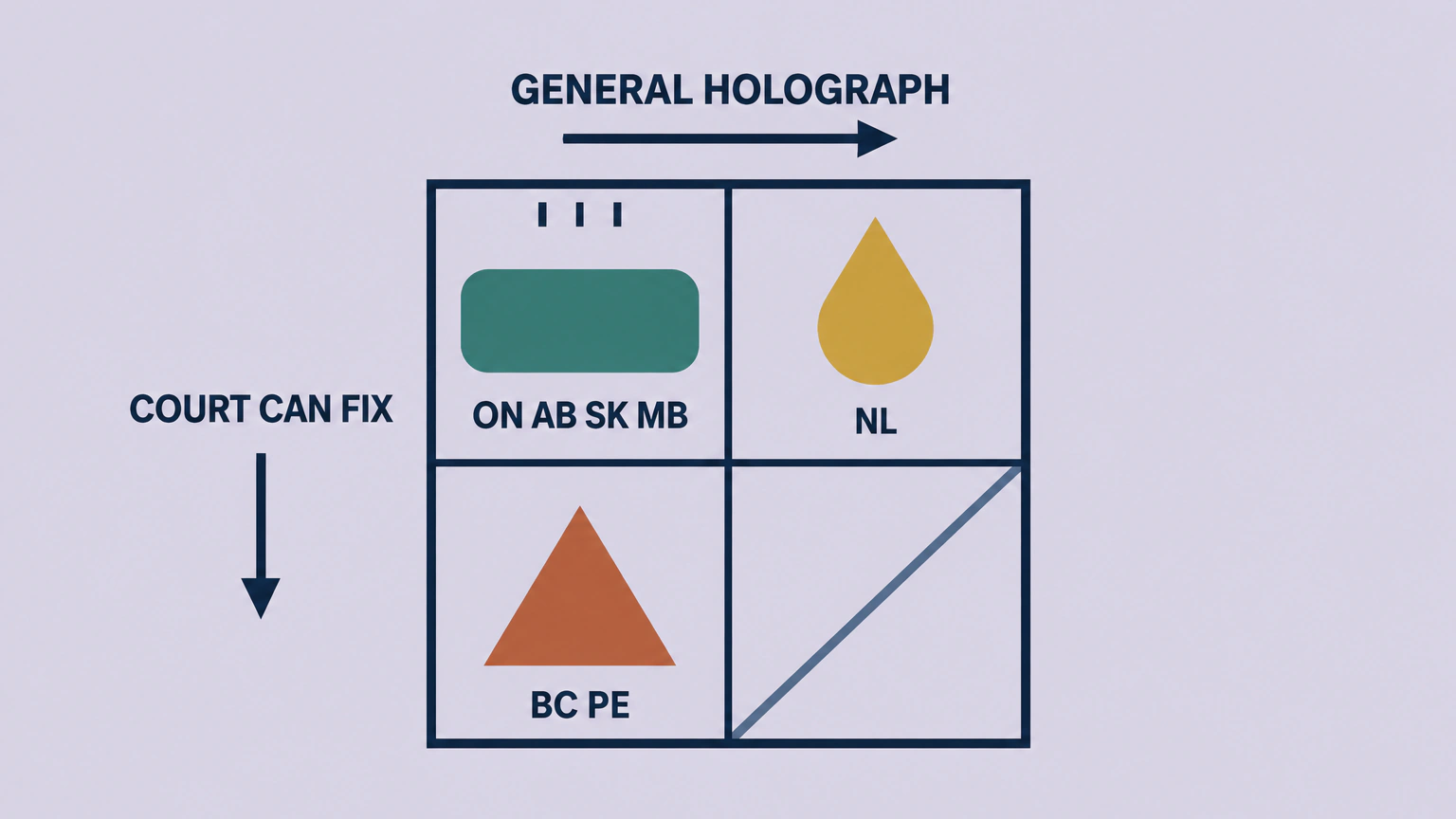
Now the half of the question nobody answers. Whether your province accepts a handwritten will and whether its court can rescue a will you got wrong are two different questions with two different answers, and they don't travel together.
The intuition gets it backwards. British Columbia has no general holograph route, then hands its judges one of the broadest rescue powers in the seven, wide enough to reach a record stored electronically. Newfoundland and Labrador accepts your handwritten page and gives its court nothing. The province that looks permissive offers the thinner safety net. Ontario is younger at this than people assume: its judges only got the power for deaths on or after 1 January 2022, so an older death gets no second chance there.
What the judge is actually being asked to decide
Underneath the statutory language, the question is short: does this document record what the dead person actually wanted done with their estate? A judge isn't repairing a form. They're deciding whether the paper carries a real testamentary intention, then ordering that it be treated as valid and fully effective as if it had been made properly.
The standards aren't identical. Alberta words it as clear and convincing evidence, and Saskatchewan's power runs on substantial compliance. Ontario and Manitoba are looser, asking the court to be satisfied that the document sets out testamentary intentions. British Columbia's version reaches furthest, covering a record that exists only in electronic form. Ontario expressly refuses that, which makes the two provinces mirror images on one question.
What none of them can do is read your mind about detail. A perfectly witnessed will with a beneficiary's name misspelled can become the executor's problem at probate, and by then the person who wrote the will is gone. These curing sections address execution defects. They don't guarantee that unclear language will be read the way you meant.
Newfoundland and Labrador has no rescue, and Prince Edward Island has a condition
Newfoundland and Labrador's Wills Act contains no curing power at all. We read the whole Act looking for one, and there's nothing: no substantial compliance, no dispensation, no application to validate. A will that misses the formalities there fails. An earlier valid will may govern. Without one, the estate goes down the intestacy road instead. That's a hard edge for a province otherwise generous about handwriting.
Prince Edward Island has a rescue, and it carries a condition the others don't impose. The court can treat a non-compliant document as valid, provided the deceased signed it. Read that twice if you've just found an unsigned draft among a parent's papers. On the Island, an unsigned draft sits outside the power that exists to save it.
Why you should never plan on the rescue
The curing power is not a backup plan. It requires a court application after you're dead. An executor or another interested person may have to assemble evidence about what you intended, and the proceeding creates legal costs that proper signing could have avoided.
So it's an expensive way to address a signing mistake that was free to avoid. Treat it as the thing that might save your family, not the thing you're counting on. If you end up needing it, that's the point where a probate lawyer stops being optional.
Six ways a homemade will fails
Every one is avoidable in the ten minutes before you sign.
- You typed part of it. In Ontario, Alberta, Saskatchewan and Manitoba the exemption only covers a document wholly in your own handwriting.
- You filled in a printed form by hand. The printed clauses don't become handwritten. Treat the kit as an ordinary will and follow its witness rules.
- You added words below or after your signature. Later text can be excluded even when the signature itself is valid.
- One of your witnesses inherits. The will may stand, but that witness's gift, and sometimes their partner's, is at risk. The exceptions and court remedies differ by province.
- Your two witnesses did not attend together. They generally must be present at the same time, whether physically or through a remote route the province allows.
- You left it where nobody will look. A handwritten will has no witnesses to say it exists, so your executor has to know where it is.
When to stop and get help
A handwritten will can meet the signing rules in five of these provinces, but that doesn't mean it covers every planning problem. If you use one, write it out by hand, sign it at the bottom, and tell your executor which drawer.
There's a difference between a will that's valid and one that's sufficient. A document can be flawless on its formatting and still be the wrong instrument for the person who signed it. That's the line where you stop. A blended family, where the default rules and your intentions point different ways. A business or a farm somebody has to keep running. Property in more than one province, or outside Canada. A beneficiary who needs a trust, whether for a disability, an addiction, or an age you'd rather they reached first. Anyone whose capacity a relative might later question. In each of those, the formalities aren't the risk. The plan is.
Quebec is its own legal world, and that's why it isn't among the seven. Succession there runs on the Civil Code of Québec rather than a Wills Act, and the Code allows exactly three forms of will: the notarial will, the holograph will, and the will made in the presence of witnesses. A Quebec holograph will has to be written entirely by the testator and signed, without technical means, and it's subject to no other formal requirement. What the Code adds is the step afterward. A holograph or witnessed will has to be probated by the court before anyone can act on it, while a notarial will doesn't. None of that maps onto the seven provinces we opened, so a Quebec reader should start with a notary.
We're not your lawyer, and a document that decides where everything you own ends up is worth an hour of somebody's time. If your situation is on that list, spend it with estate planning lawyers in your province, not on a better pen. You may also sign a power of attorney at the same sitting, which carries its own witness rules. And once validity is settled, the next question is usually what the estate itself owes.
Questions people ask about handwritten wills
Does a handwritten will need to be witnessed?
In Ontario, Alberta, Saskatchewan, Manitoba and Newfoundland and Labrador, no. A will in your own handwriting and signed by you can stand on its own, with nobody watching. British Columbia and Prince Edward Island have no general holograph route and normally require two witnesses. Both have narrow exceptions for certain forces members, and Prince Edward Island also covers mariners at sea or on a voyage.
Is a will kit I filled in by hand a handwritten will?
Not as a whole. Its printed clauses are not in your handwriting. The safe route is to treat the kit as an ordinary witnessed will and follow the signing instructions for your province.
Does a will have to be notarized in Canada?
Not in any of the provinces we checked. A notary stamp proves who signed something, not that the document works, and it can't repair a will that missed a formality. What counts is the form itself: either your own handwriting throughout with your signature, or the full witnessed signing. Quebec is separate, and there a notarial will is one of three routes rather than a stamp added afterward.
Can my daughter witness my will if I am leaving her something?
She can, but her gift may fail even if the rest of the will stands. A spouse's gift, and in Alberta or Manitoba a partner's gift, may also be at risk. Some provinces recognize extra qualified witnesses or no required attestation. Several have a court remedy. Prince Edward Island's witness-gift section provides neither fix. Pick someone who inherits nothing.
How old do you have to be to make a will in Canada?
It changes at the border. British Columbia sets the bar at 16 and Newfoundland and Labrador at 17, while Ontario, Alberta, Saskatchewan, Manitoba and Prince Edward Island all use 18. The exceptions are not the same. Marriage, partnership, military service and being at sea matter in some provinces, with different rules in each. If you're below the stated age, check the provision for your province before relying on a will.
What happens to my estate if my will is thrown out?
An earlier valid will may govern if it was never properly revoked. Otherwise, your province's intestacy rules take over. Those rules choose your heirs by relationship and fix their shares, whatever the failed document said. That lands hardest on unmarried partners, and what happens when there is no valid will walks through it province by province.
Can a court fix a will that was never signed?
In most of these provinces, possibly. Six of the seven let a judge give effect to a document that missed the formalities, and an unsigned draft is exactly what that power exists for. Two catches decide it. Prince Edward Island's version works only if the deceased actually signed, and Newfoundland and Labrador has no curing power at all, so an unsigned page there is just a page.