

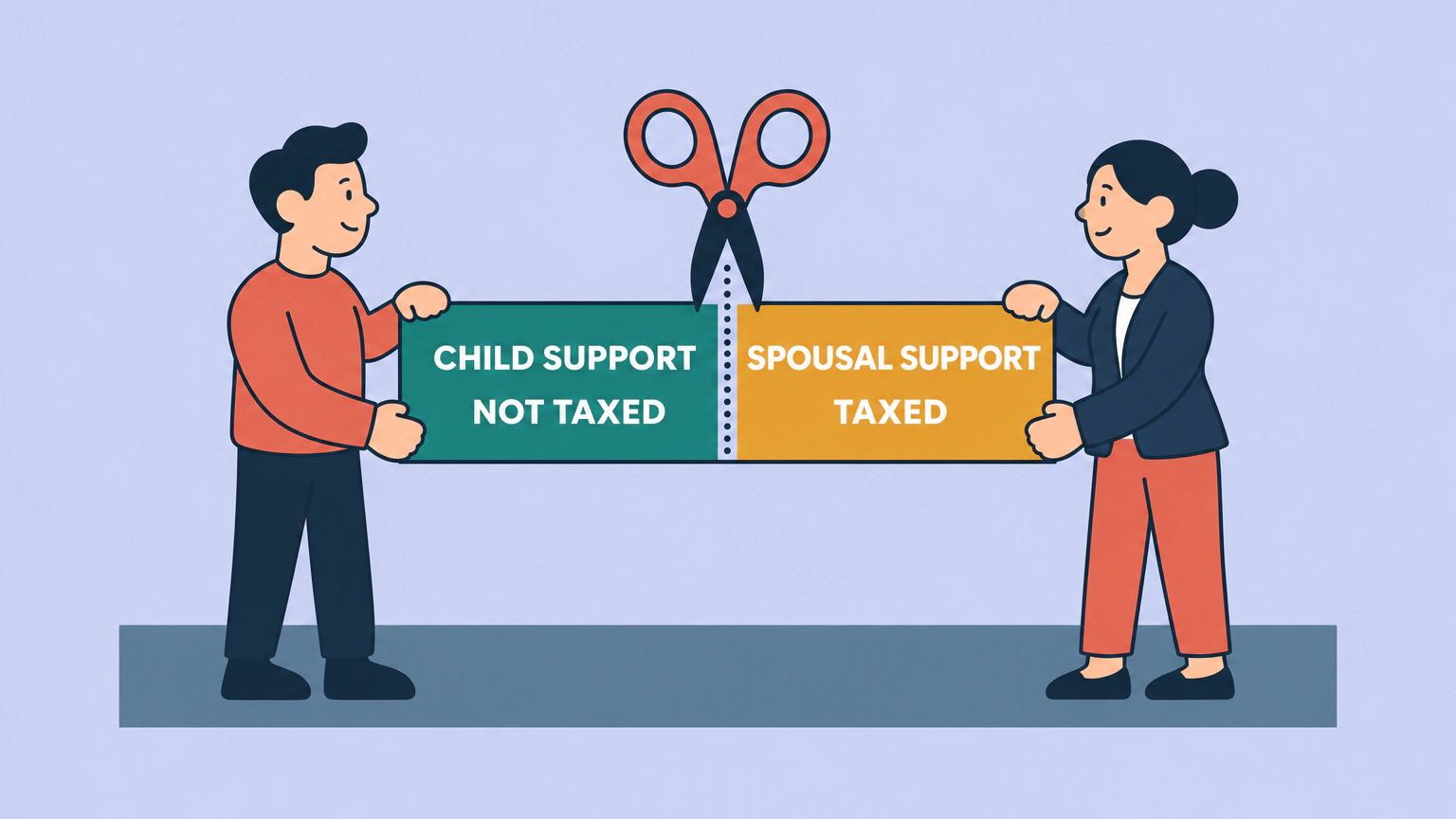
No. If your order or agreement was made after April 1997, the parent who receives child support doesn't pay tax on it, and the parent who pays can't deduct it. Spousal support runs the other way, and it's the wording of your agreement, not what you meant when you sent the money, that decides which is which.
So child support is the easy part. The money is in how the paper is written.
On this page
- The short answer, for both sides of the payment
- What actually goes on your tax return
- How each kind of payment is treated at tax time
- Why one combined number can cost you the deduction
- Why child support counts as paid first
- The deadline for support you've already paid
- Paying the mortgage or the tuition directly
- Who can claim the kids after you separate
- Legal fees: why only one side can deduct them
- What to get into the agreement before you sign
- Frequently asked questions
The short answer, for both sides of the payment
If you receive child support, it isn't income. If you pay it, you can't deduct it. That holds for any court order or written agreement made after April 1997, in every province and territory. It applies the same way to parents who were married and parents who lived common law.
It's one federal rule, set in the Income Tax Act, so searching "in Ontario" or "in BC" gets you the same answer. Quebec runs its own income tax too, so Quebec residents may also have to file a provincial return with Revenu Québec.
We know how this lands if you're the one paying. You're handing over money you've already paid tax on, and you get nothing back for doing the right thing. That feels unfair, and it's still the rule.
Orders from before May 1997 that have never changed can still follow the old rules, set out with every other kind of payment a little further on.
Reading an American page? Search for alimony and many results are from the United States, where agreements signed after 2018 give the payer no deduction. Canada never made that change. Spousal support is still deductible here, so if a page talks about the IRS, it isn't about you.
What actually goes on your tax return
If child support is the only money moving between you, it adds nothing to the recipient's income and gives the payer nothing to deduct. The CRA still asks each of you to enter the total on an information line (12799 if you received it, 21999 if you paid it) and to leave the taxable and deductible lines empty.
Once spousal support is in the mix, the lines do real work. The payer enters the total paid on line 21999 and the deductible part on line 22000. The recipient enters the total received on line 12799 and the taxable part on line 12800. The recipient reports spousal support even if the payer never claims the deduction.
You don't send proof with your return, but the CRA can ask for it later. Keep bank statements, cheque images, an employer's statement showing the transfer from your pay, a statement from your provincial maintenance enforcement program, or a receipt your ex signed for the year's total.
An order or agreement that includes spousal support gets registered with the CRA on Form T1158, along with a copy of the document. One that covers child support only doesn't.
How each kind of payment is treated at tax time
The name on the e-transfer doesn't decide any of this. What decides it is what was paid, and what the paper says about it.
| What was paid | Person paying | Person receiving | What decides it |
|---|---|---|---|
| Child support under an order or agreement made after April 1997 | No deduction | Not taxed | The federal rule for every order since May 1, 1997 |
| Child support under an older order that has never changed | Deductible | Taxed | It keeps the old rule until the amount is varied, the order's own cut-off date passes, or you both file Form T1157 |
| Regular spousal support under a written agreement or court order | Deductible | Taxed | It must be periodic and stated as spousal support |
| One combined amount with no spousal figure | No deduction | Not taxed | The whole amount counts as child support |
| Spousal support with nothing in writing | No deduction | Not taxed | Without an order or written agreement it isn't a support amount |
| A one-off lump sum that settles support for good | No deduction | Not taxed | It isn't paid on a periodic basis |
| A lump sum that catches up missed spousal support | Deductible when paid | Taxed when received | Arrears keep the character of the payments they replace |
| Rent, mortgage or tuition paid to someone else | Only if the order or agreement covers it | Only if the order or agreement covers it | Naming subsections 56.1(2) and 60.1(2) is the sure route |
The combined amount is the one that catches people out, because the mistake gets made at the kitchen table months before anyone files a return.
Why one combined number can cost you the deduction
The Income Tax Act calls any support amount child support unless the agreement identifies it as solely for the spouse. So an agreement that says "$1,500 a month in support" is all child support. That's true even if everyone at the table knew $700 of it was meant for the spouse.
Here's what the difference is worth. Written as $800 of child support and $700 of spousal support, the payer deducts $8,400 a year and the recipient reports $8,400. Written as one $1,500 figure, the deduction is $0.
Take hypothetical tax rates of 30% for the payer and 20% for the recipient. With one combined figure, the payer gives up $2,520 a year in tax savings. The recipient keeps $1,680 a year that would have gone in tax. Between them, the two households end up $840 a year worse off.
Some recipients see the combined figure as a win, since nothing gets taxed. We wouldn't call it one. Two households that already stretch one income now have less between them.
The fix costs nothing: put two figures in the document, one for the children and one for the spouse. These amounts are illustrations, not what a court would set. For your own number, start with how spousal support is calculated.
Why child support counts as paid first
If your agreement covers both kinds of support, every dollar you pay in a year goes first to that year's child support. Next it goes to any child support you still owe from earlier years. Only what's left over counts as spousal support. The label on your e-transfer doesn't change that, and neither does paying the spousal part first.
It isn't shared out pro rata, either. Pay $15,000 of an $18,000 year and you don't get five-sixths of the deduction. You get whatever is left once child support is covered.
$800 of child support and $700 of spousal support a month, paid late
| Year 1 | Year 2 | |
|---|---|---|
| Child support due | $9,600 | $9,600 |
| Spousal support due | $8,400 | $8,400 |
| Total actually paid | $15,000 | $21,000 |
| Goes to child support first | $9,600 | $9,600 |
| Left for spousal support, deductible and taxable | $5,400 | $11,400 |
The $3,000 of spousal support missed in Year 1 becomes deductible in Year 2, when it's paid.
Pay only $9,000 in Year 1 and you deduct nothing, because $9,000 minus $9,600 is below zero. The $600 of child support you still owe then comes off the top of whatever you pay the next year.
Extra money above what the order says, like help with a home repair or a gift for the kids, doesn't count toward any of it. The priority rule falls away only where child support and spousal support go to different people under different orders. Courts put child support first when they set support too, under the Divorce Act, but that's a separate rule from the tax one.
The deadline for support you've already paid
Many people start paying the week they separate and sign something months later. That gap is where real money gets lost.
How far back an agreement can reach
As a general rule, an agreement or court order made in a calendar year can cover support paid earlier that year and in the year before, and no further. It does that only if it says so. The words that matter come straight from the Income Tax Act: the agreement has to provide that the earlier amount "is to be considered to have been paid and received thereunder".
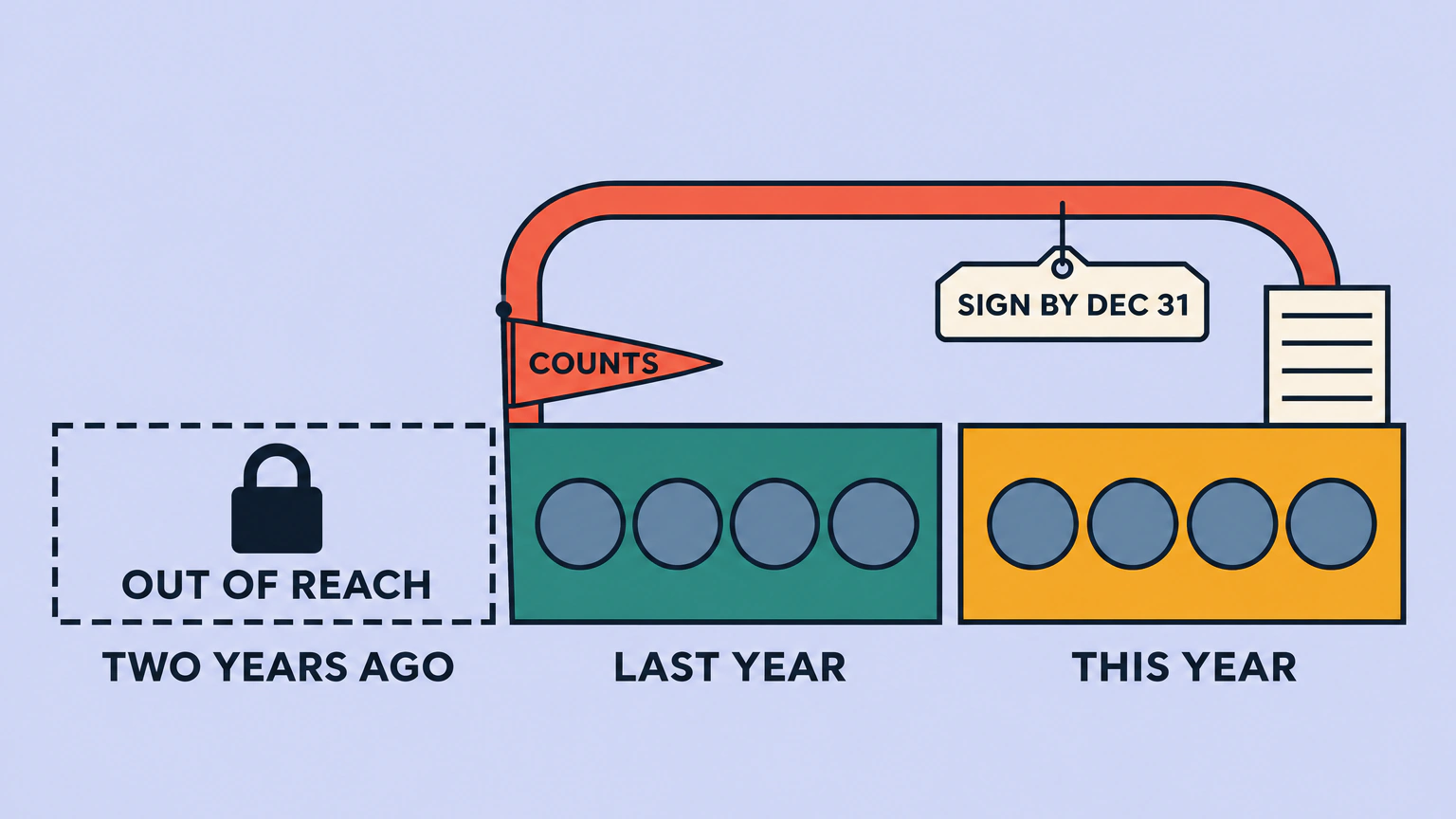
Without that sentence, the earlier payments stay voluntary. Voluntary payments are neither deductible nor taxable.
Say you separate in March 2025 and start paying $700 a month in spousal support in April. By the end of that year you've paid $6,300. An agreement signed on December 10, 2026 with the sentence in it can cover all $6,300, and you then ask the CRA to adjust your 2025 return. At a hypothetical 30% rate, that's $1,890 back.
Sign the same agreement on January 4, 2027 and it can't touch 2025 at all. The $6,300 is gone for good.
You must have been living apart when each payment was made. A court order follows the same rule. In practice, this is about a signed agreement, because a court date before year-end is unlikely.
You may read that you have two years, or that you can't reach back at all. Neither is right. The Act says the year of the agreement and the year before.
Why the person receiving support should read this too
The clause cuts both ways. Payments deemed paid under the agreement are deemed received under it, so the person receiving them now owes tax on them, in the earlier year. In the same example, $6,300 at a hypothetical 20% rate is $1,260 owed for a year you thought was closed. Nobody withheld a cent for it.
That's a fair thing to raise before you sign. You can ask for a higher support amount or a one-time adjustment to cover the tax, which is what lawyers mean by a gross-up. The date gives the recipient some leverage too. We'd use it to reach a fair deal, not to run out the clock. A payer who loses the deduction has less to pay you with.
From here on, a recipient with a job can ask their employer to withhold more tax by filling out Form TD1. A payer can ask the CRA to approve less tax withheld from their pay, using Form T1213.
Paying the mortgage or the tuition directly
A verbal okay isn't enough. A payment to a landlord, lender or school counts as support only if the order or agreement requires it, even when the recipient asked you to pay that way. The recipient normally also has to be free to redirect it.
The sure route is a sentence saying that subsections 56.1(2) and 60.1(2) of the Income Tax Act apply. That's the Act's own wording for treating these amounts as support. It's the one place where section numbers belong in your agreement.
The expense must be for your ex or the children, and it can't be for a home you live in yourself. Loan payments on the recipient's home have their own ceiling. In any year, they count only up to one-fifth of the original loan.
Any amount paid to a third party for the children, or not identified as solely for the spouse, is child support, so it brings no deduction. Your share of "section 7" costs under the child support guidelines, such as school fees or activities, brings no deduction either.
Who can claim the kids after you separate
The wording reaches past support itself, into the tax credits that follow the child.
If you pay child support
A parent required to pay support for a child generally can't claim the eligible dependant amount for that child. That's the credit a single parent can claim for one dependant they support at home. The parent the child lives with usually can, if the other conditions are met. The child has to be under 18, or older and dependent because of a disability, and that parent can't have a new spouse or partner living with them. Only one such claim is allowed per household, and only one for a given child.
In the year you separate, a payer of spousal support may be able to choose between the support deduction and the spousal amount, whichever saves more. Ask a tax preparer to run it both ways.
If you share parenting
This is the wording trap almost nobody warns you about. Shared-parenting support is often netted, so only the higher earner sends money. If the agreement shows only that net payment, that parent is simply a payer and can't claim the credit.
The Act lifts the block when both parents would otherwise be shut out. The Canadian Bar Association's tax toolkit for family lawyers is specific about what that takes. The order or agreement has to state that each parent owes the other support, and how much, even if only one payment changes hands. Saying the support was worked out under the guidelines isn't enough.
Then the two of you decide which of you claims. If you both claim, neither of you gets it. With two or more children, one parent can claim for one child and the other parent for another.
The Canada Child Benefit and your RRSP room
Child support isn't part of net income, so it doesn't reduce your Canada Child Benefit. Spousal support is different. Receiving it raises the recipient's net income and can lower income-tested benefits, and deducting it lowers the payer's.
In shared parenting, each parent gets half of what they'd get with the child full time, worked out on their own family income. Once you've been apart for more than 90 days, tell the CRA your marital status has changed. It asks to hear by the end of the month after the change.
RRSP room follows the same split. Spousal support you receive counts as earned income and adds to your room, and a deductible payment reduces the payer's. Child support does neither.
Legal fees: why only one side can deduct them
This one is unfair on its face, and we'll say so. The parent receiving support can deduct legal fees spent to establish support, collect late payments, ask for an increase or defend against a cut. That's true even though child support itself isn't taxed. The parent paying can't deduct fees spent negotiating, contesting or reducing support. Neither of you can deduct fees for the divorce or separation itself, or for parenting arrangements.
Winning isn't required, as long as the claim was genuine and had a reasonable chance of success, says the CRA's income tax folio on support payments. Ask your lawyer for a bill that separates the deductible work, and subtract any costs the court awarded you.
What to get into the agreement before you sign
Before you sign, make sure the agreement says:
- A separate dollar figure for child support and for spousal support.
- The date payments start and how often they're made.
- If support started before signing, that the amounts paid since that date are considered paid and received under this agreement.
- If you pay a landlord, lender or school directly, that subsections 56.1(2) and 60.1(2) of the Income Tax Act apply.
- If you share parenting and only one of you sends money, how much each of you owes the other.
- Which parent will claim the eligible dependant amount.
- That you'll both sign any tax forms the deduction needs.
Now the cost. Our family-law pages put a separation agreement on agreed terms at a planning fee of C$2,000 to C$3,200, and children's arrangements or complex assets can change the quote. Advice before signing runs C$800 to C$1,200 a person. Set those against the $2,520 a year one combined figure can cost a payer, or the $1,890 a missed December 31 can cost. Ours are planning figures, so get a real quote.
We're not your lawyer or your accountant. A clause this size is worth an hour with each before you sign.
If you've been paying since last year with nothing signed, call a family lawyer now. Ask a tax preparer to run both returns before you sign. If you're in Ontario and divorcing, the court side comes next: here's how to file for divorce in Ontario.
Frequently asked questions
Do I have to report child support on my taxes?
It doesn't go into your income. Under any order or agreement made after April 1997, you pay no tax on child support and it doesn't raise your net income. The CRA does ask you to enter the total support received on line 12799, an information line. Only the taxable part goes on line 12800.
Can I claim child support on my taxes if I'm the one paying?
No. Child support under an order or agreement made after April 1997 isn't deductible, and paying more than the order says doesn't change that. Under those orders, the only support you can deduct is spousal support set out in writing. Even then, you can deduct it only once the year's child support, and any you owed from earlier years, is paid.
Is spousal support taxable in Canada?
Yes, when it's paid regularly under a written agreement or court order and the amount is stated as spousal support. The person paying deducts it and the person receiving reports it as income, even if the payer never claims the deduction. Nothing is withheld from the payments, so plan for the bill.
Does child support affect the Canada Child Benefit?
No. The benefit is worked out from net income, and child support isn't part of net income. Spousal support is different. Receiving it raises your net income and can lower the benefit, and paying it lowers your net income.
If I pay child support, can I claim my child as a dependant?
Usually not. A parent who has to pay support for a child generally can't claim the eligible dependant amount for that child. One exception is shared parenting where the agreement spells out that each of you owes the other, and how much. Then you decide who claims. If you both claim, neither of you gets it.
Is a lump sum payment taxable?
A one-off payment that settles support for good generally isn't deductible or taxable. A lump sum that catches up missed spousal support is different: it's deductible when paid and taxable when received. If the part for earlier years is $3,000 or more, the recipient can ask the CRA to look at taxing that part in those years instead.
Can I claim support payments for past years?
Not child support under any order made after April 1997. For spousal support, an agreement or order can reach back only to January 1 of the year before it's made, and only if it says so. If it does, ask the CRA to adjust the earlier return. Anything paid before that window stays outside the deduction for good.
Are the rules different if we were common law?
No. Married and common-law couples who've separated follow the same tax rules, and spousal support still has to be in writing. One wrinkle: parents who never lived together as a couple need a court order, because a private agreement doesn't count for them. If you're not sure where you stand, here's who counts as common law in Ontario.