

On this page
- The short answer, and the dates that matter
- The clock that decides whether you can be sued
- Payments and signed admissions can restart time before expiry
- What an expired deadline does not do
- The second clock, the one on your credit file
- The debts these clocks do not touch
- What to do when a collector calls about an old debt
- Questions readers ask about old debts
The short answer, and the dates that matter
A letter turns up about an account you stopped paying years ago. Or the phone rings and a stranger reads your old balance back to you. Before you say a word, here's what decides how much power they have.
The normal deadline is two years after discovery in Ontario, British Columbia, Alberta, Saskatchewan, Manitoba and Nova Scotia. Manitoba has transition rules for older claims. Newfoundland and Labrador generally uses six years from the right arising. Expiry can support a limitation defence, but it doesn't stop a creditor from filing a claim. A qualifying acknowledgment or part payment made before expiry can restart the period. Newfoundland and Labrador requires every confirmation, including payment, to be written and signed.
The starting point depends on the province, debt and contract. It may be discovery, default after a demand, or the day the right arose. A qualifying acknowledgment or part payment restarts time only if the Act's conditions are met before expiry. A phone call or an agency's purchase of the account doesn't, by itself, reset these periods.
Three clocks run on an old debt. Most of the confusion here comes from mixing them up.
| What the rule covers | The usual rule | What can change the result |
|---|---|---|
| Basic period for a creditor to start a court claim | 2 years in six of the seven provinces we checked, 6 years in Newfoundland and Labrador | A qualifying acknowledgment or part payment made before expiry |
| Whether the debt can sit on your Ontario credit file | Normally 7 years from your last payment, or from default if you never paid | A payment changes the date. The entry may remain if the creditor confirms it is not statute barred and the confirmation appears in the file |
| Whether the underlying right remains after expiry | It generally remains in six jurisdictions checked | Newfoundland and Labrador extinguishes the right under section 17(1) |
That last question has one exception among the seven jurisdictions we checked, and it matters enormously in St. John's. Section 17(1) of Newfoundland and Labrador's Act says a cause of action "and the right or title on which it is based are extinguished upon the expiration of the limitation period". Everywhere else we looked, the deadline takes the courtroom away and leaves the debt standing.
The clock that decides whether you can be sued
Being contacted and being sued are different legal questions. A limitation period governs the claim or remedy described by the statute. Separate collection rules govern calls and letters.
What the two years actually run from
The clock does not start when a collection agency buys the account. In the six two-year jurisdictions here, the basic period turns on statutory discovery rules. Those rules ask when the claimant knew, or should have known, the loss, cause, defendant and that a proceeding was appropriate. Alberta states the test in similar terms.
For consumer debt, the trigger can depend on default terms and whether payment first required a demand. Ontario and Saskatchewan presume knowledge on the act or omission unless the contrary is proved. Manitoba instead requires the claimant to prove that the proceeding was started in time.
Newfoundland and Labrador is built differently. It counts from the day the right to sue arose rather than from discovery.
How long your province gives a creditor
| Province | How long a creditor has to sue | What the clock runs from | The Act, and how current it is |
|---|---|---|---|
| Ontario | 2 years | The day the claim is discovered | Limitations Act, 2002, ss. 4-5. e-Laws currency date 3 September 2026 |
| British Columbia | 2 years | The day the claim is discovered | Limitation Act, S.B.C. 2012, c. 13, s. 6. Current to 1 September 2026 |
| Alberta | 2 years, and never more than 10 | The day you knew or ought to have known | Limitations Act, R.S.A. 2000, c. L-12, s. 3(1). Consolidation current as of 15 December 2022 |
| Saskatchewan | 2 years | The day the claim is discovered | The Limitations Act, S.S. 2004, c. L-16.1, s. 5. Consolidation shows amendments to 2007 |
| Manitoba | 2 years under the current Act. Transition rules apply to older claims | Discovery, subject to sections 28-31 | The Limitations Act, C.C.S.M. c. L150, ss. 6, 28-31. Version current 4 September 2026 |
| Nova Scotia | 2 years, and never more than 15 | The day the claim is discovered | Limitation of Actions Act, S.N.S. 2014, c. 35, s. 8(1). Published consolidation to 2015, c. 22 |
| Newfoundland and Labrador | 6 years | The day the right to sue arose | Limitations Act, S.N.L. 1995, c. L-16.1, s. 6(1)(h) |
Some competing tables still give Manitoba six years. The current Act came into force on 30 September 2022 and uses a two-year basic period. Its transition rules matter for older claims. For a claim found before the new Act began, the deadline was the earlier of the old expiry date and 30 September 2024. Do not apply a new two-year calculation to every older Manitoba debt.
Every province's figure comes straight from its own Act, and the section number and currency date sit beside it so you can check us. If you'd rather know who we are first, that page is short.
Six jurisdictions are missing: Quebec, New Brunswick, Prince Edward Island, Yukon, the Northwest Territories and Nunavut. We list a province only after reading its own law, and we haven't read those six. Because other guides conflict, use the official law, not another summary. In Quebec, check the Civil Code rules on prescription. Elsewhere, find your province's or territory's Limitations Act.
Newfoundland and Labrador runs on a different clock
Newfoundland and Labrador gives a creditor six years to sue on a debt, counted from the day that right arose. On its own, that's just a longer deadline than the rest.
The real difference is what happens at the end. In Ontario or Manitoba, expiry usually creates a defence but leaves the underlying right intact. In Newfoundland and Labrador, section 17(1) extinguishes the cause of action and the right behind it.
That is the closest thing to a debt disappearing among the seven provinces we opened. It is also why the phrase “a debt never goes away” needs a provincial qualifier.
Payments and signed admissions can restart time before expiry
Here is where a decent instinct can create risk. A small payment made before the limitation period expires can restart time under these statutes. After expiry it doesn't. Newfoundland and Labrador also requires every confirmation, including payment, to be written and signed.
What counts as an admission, and what doesn't
An admission only counts if it's in writing. Ontario also requires your signature, or your agent's. The other five two-year provinces say the same in their own words, and the signed admission has to reach the creditor or their agent to count.
Then comes the carve-out that matters more than the rule. For a debt, part payment "has the same effect" as that signed acknowledgment, in Ontario's words. It needs no signature at all, and the other five two-year provinces treat it the same way.
So the phone call you're dreading is not the danger. The five dollars you were about to send is. Manitoba and Alberta close the obvious loophole too. A signed admission there can count even when it refuses to promise payment. "Fine, I owe it, but you'll never see a cent" may be enough.
Three moves that can restart an unexpired limitation period - Making a part payment before the period expires. - Signing and delivering an arrangement that acknowledges the debt before expiry. - Sending the creditor or agent a signed written admission before expiry, even without a promise to pay.
A later payment does not restart an expired period
The most reassuring rule in Canadian limitation law sits in a subsection most guides skip. An admission only works if it's made before the deadline expires.
Ontario says its rule applies only if the admission reaches the creditor "before the expiry of the limitation period applicable to the claim". Manitoba lists timing as one of three conditions. The other provinces here have their own versions.
A payment on a debt that's already out of time revives nothing. Say your two years ran out in 2024 and a collector talks you into fifty dollars next month. That fifty dollars buys them nothing in court. You're out the money, which stings. The deadline still stands, and that's the part that matters.
Saying it on the phone is not the same as signing it In all six of the two-year provinces the statute asks for the same thing before an admission counts. It has to be in writing and signed, and it has to reach the creditor before the deadline passes. British Columbia adds that an electronic signature counts. A phone call where you agree the account is yours does none of that. A payment is a different matter entirely, and it needs no signature anywhere except Newfoundland and Labrador.
What an expired deadline does not do
Two beliefs about expired deadlines cause trouble. First, in six jurisdictions here, expiry generally doesn't extinguish the underlying right. Second, expiry isn't permission to ignore court papers. A creditor may still file, and a defendant may need to raise the limitation issue.
Raise the defence in your reply
A limitation period can be a defence that must be raised. Alberta's Act expressly grants immunity when a defendant pleads the Act. Do not assume a court will calculate the deadline for you.
If you ignore a claim, the creditor may seek default judgment. Read the papers and applicable court rules for the response deadline. Plead the limitation issue and all supporting facts. The last payment and any qualifying acknowledgment are evidence, not the whole defence. If the amount is modest, your province's small claims ceiling decides which court you're in. If it is larger, a civil litigation lawyer answers filed claims for a living.
We're not your lawyer, and a filed claim needs prompt advice. Take the papers and payment records to a lawyer. In Ontario, a licensed paralegal may help if the matter falls within their permitted scope.
Alberta also limits some collection attempts
Alberta adds a separate collection rule. It sits in the Collection and Debt Repayment Practices Regulation rather than the Limitations Act.
The regulation says no collection agency or collector may “pursue a non-judgment debt where the last payment or written acknowledgement by the debtor is more than 6 years previous.” That is a restriction on the collection attempt itself.
The six-year conduct rule excludes judgment debts. A judgment has its own enforcement rules and may still face collection rules.
The second clock, the one on your credit file
If you've been researching this at two in the morning, you've met a six-year or seven-year figure and assumed it answers the lawsuit question. It doesn't. Credit reporting is a separate provincial rulebook with its own clock. The two can expire years apart.
Seven years in Ontario, and the line that keeps it there longer
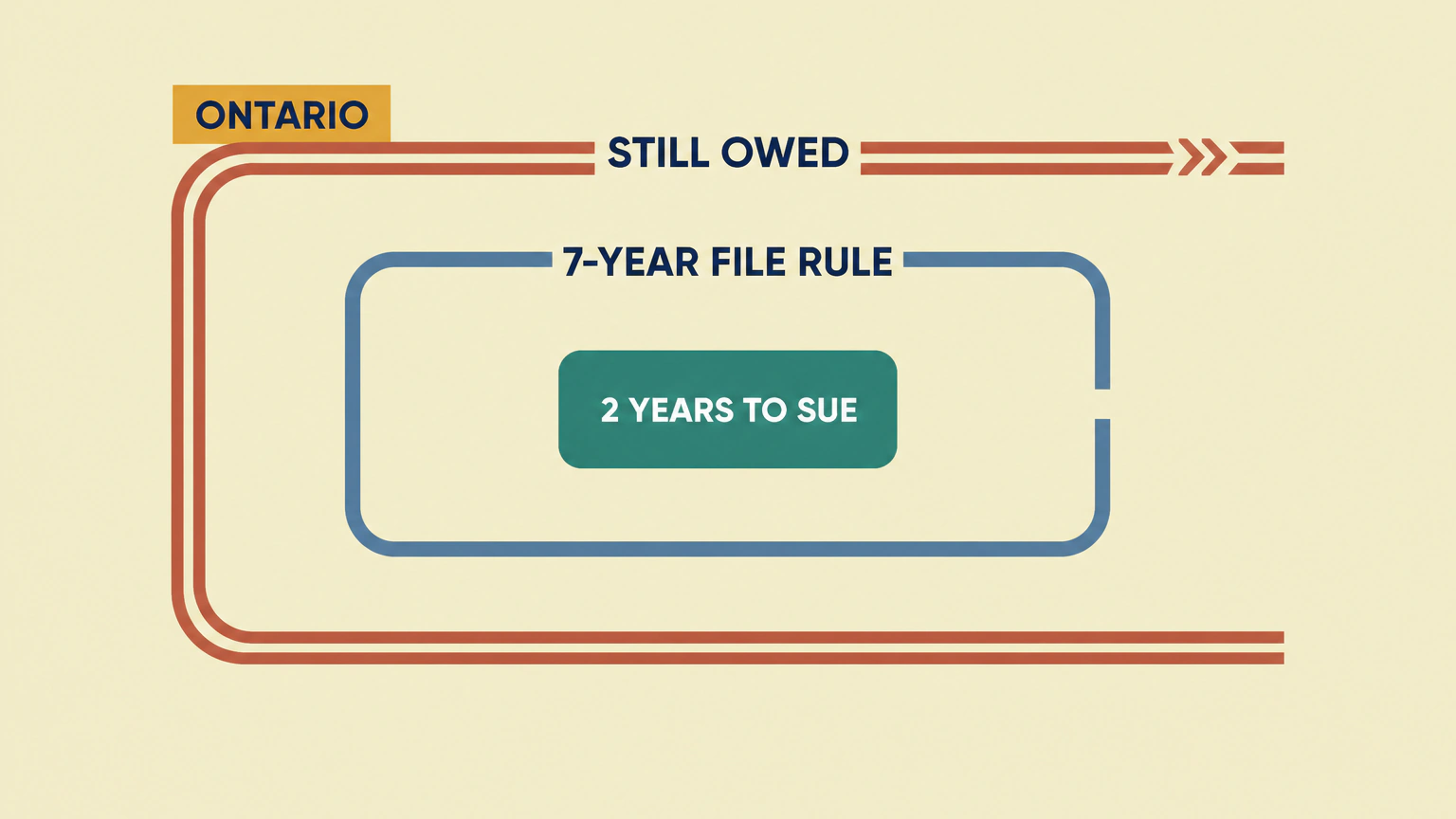
Ontario's Consumer Reporting Act tells credit bureaus what they may not put in a report. A collection comes off seven years after your last payment. Where you never paid, it's seven years from the default.
That seven-year rule ends with an exception. The entry can stay “unless the creditor or the creditor's agent confirms that the debt or collection is not barred by statute and the confirmation appears in the file.” If that confirmation is accurate and appears in the file, the entry may remain longer. You can dispute wrong credit-file details for free. An agency generally must wait through the notice period before reporting. It may report sooner after two failed attempts to find the person's address, despite due care.
Ontario's reporting clock runs from the last payment. A payment also restarts the lawsuit period if it is made before expiry and qualifies under section 13. A payment after expiry does not restart that lawsuit period. Pull your credit file when checking the reported activity date. If the problem is an Ontario one, our Ontario listings are the place to start.
The debts these clocks do not touch
Judgments are the big one. Once a creditor has been to court and won, you're not arguing about a deadline to sue any more. You're dealing with enforcement, and those rules vary far more between provinces.
| Province | How long a creditor has to act on a court judgment | Source |
|---|---|---|
| Ontario | No limitation period under the Limitations Act. Enforcement steps have 6-year leave and renewal rules | Limitations Act, 2002, s. 16(1)(b), Rules of Civil Procedure, r. 60.07, and Small Claims Court Rules, rr. 20.06-20.08 |
| Manitoba | No limitation period for a Manitoba court order made on or after 1 October 2012 | The Limitations Act, C.C.S.M. c. L150, s. 3(1)(d), (2) |
| British Columbia | 10 years for a B.C. judgment. An extraprovincial judgment can expire sooner | Limitation Act, S.B.C. 2012, c. 13, s. 7 |
| Alberta | 10 years after the claim arose | Limitations Act, R.S.A. 2000, c. L-12, s. 11 |
| Saskatchewan | 10 years from the date of the judgment | The Limitations Act, S.S. 2004, c. L-16.1, s. 7.1 |
| Newfoundland and Labrador | 10 years from when the right arose | Limitations Act, S.N.L. 1995, c. L-16.1, s. 7(1)(a) |
Nova Scotia is absent because we did not verify a current judgment-enforcement provision there, and a gap beats a guess.
Secured debt runs on its own track. Ontario has no limit for a creditor already holding collateral to sell or use it. British Columbia also excludes a secured party in possession from its Act. Section 27 otherwise bars a nonjudicial remedy when the related court proceeding is out of time. A car loan or mortgage needs its own analysis.
Then there is money owed to government. Manitoba's Act removes the deadline from claims for taxes, fines and penalties owed to the Crown. Nova Scotia excludes Crown fines, taxes and penalties, along with listed program money and student assistance. Saskatchewan does the same for an unpaid fine. Those are narrow exceptions in the law. Government debts not listed here need their own statute and collection rule.
What to do when a collector calls about an old debt
You don't have to answer right away. Take the details in writing, work out the applicable dates and respond once you know where you stand. If the claim is still within time and the amount is real, consumer protection lawyers can help you respond or negotiate.
- Find the date of your last payment on the account, from a bank statement or an old card bill.
- Look for a signed written acknowledgment delivered before expiry, and for any part payment.
- Work out which province's law applies. Do not assume residence alone decides it.
- Identify the statutory trigger, then apply any valid pre-expiry reset, suspension, ultimate period and transition rule.
- Ask the collector in writing for the original creditor, the account number, the balance and the date of last payment.
- Send no payment, however small, until you know which side of the deadline you are on.
- Pull your file from Equifax Canada and TransUnion Canada and check the date of last activity each one shows.
If this ends with you hiring somebody, legal bills run on provincial deadlines of their own. The clock on a lawyer's bill is worth reading before a bill you dispute becomes a bill you've accepted by saying nothing.
How often an Ontario collector is allowed to contact you
Ontario collection agencies must be registered by the Registrar. The ministry enforces the Act and accepts complaints. Its public guidance recommends telling the business about the problem before filing a complaint. Here are the main rules.
- No calls between 9 p.m. and 7 a.m., local time where you are.
- On a Sunday, only between 1 p.m. and 5 p.m.
- No calls on New Year's Day, Family Day, Good Friday, Victoria Day, Canada Day, the Civic Holiday, Labour Day, Thanksgiving, Christmas Day, December 26 or another proclaimed day.
- After the agency speaks with the contacted person, no more than three counted contacts in seven days for the same creditor. Ordinary mail, requested contacts and location-only third-party contacts are excluded.
- No threatening, profane, intimidating or coercive language, and no undue pressure.
- No payment demand or collection contact before the sixth day after notice, except for a written demand included with notice, limited identity or address checks, or contact the debtor requested.
- No publishing, or threatening to publish, that you have not paid.
Two more Ontario rules are useful. Send a verifiable notice saying you dispute the debt and suggest court, and the agency must stop contacting you unless you consent or request contact. A notice that directs contact to your lawyer or paralegal must list that person's address and phone number. The agency must then use that representative unless you consent or request direct contact. Every province writes its own rules, so this list is Ontario's. A reader in the city can start with consumer protection lawyers in Toronto.
Questions readers ask about old debts
Does an old debt just disappear after two years?
No, not in six of the seven provinces we checked. Expiry generally leaves the underlying right, but what a collector may do next depends on conduct and reporting laws. Newfoundland and Labrador is different. Section 17(1) of its Limitations Act extinguishes the cause of action and the right behind it.
Can a collector still phone me about a debt that is too old to sue over?
Usually yes, subject to the province's collection-conduct rules. Alberta has an additional restriction. A collection agency or collector there may not pursue a non-judgment debt when the last payment or written acknowledgment was more than six years earlier.
If I send one small payment, does the clock really start again?
Yes, if the deadline hasn't passed yet. Part payment counts as an admission on its own. It needs no signature anywhere except Newfoundland and Labrador, so five dollars does what a signed letter does. If the period has already run out, no. An admission only works when it's made before the deadline.
What happens if I ignore a collector and they take me to court anyway?
Don't ignore court papers. A creditor may seek a default judgment if you miss the reply date. Raise the time-limit defence and the facts that support it under the right court rules. Judgments have their own enforcement rules. The law gives ten years in British Columbia, Alberta, Saskatchewan and Newfoundland and Labrador. Ontario and some Manitoba orders have no set limit, but Ontario adds six-year rules for enforcement steps.
How long does a debt stay on my credit report in Canada?
Credit reporting is provincial. Ontario's Consumer Reporting Act allows seven years from your last payment, or from the default if you never paid. One catch: the entry may stay longer if the creditor confirms the debt isn't statute barred and that confirmation sits in your file. This clock runs separately from the deadline to sue.
Do these time limits apply to money I owe the government?
Not always. Manitoba leaves Crown taxes, fines and penalties outside its main time limit. Nova Scotia excludes those categories and listed program money and student assistance. Saskatchewan excludes an unpaid fine. Other government debts need their own statute and collection rule.