

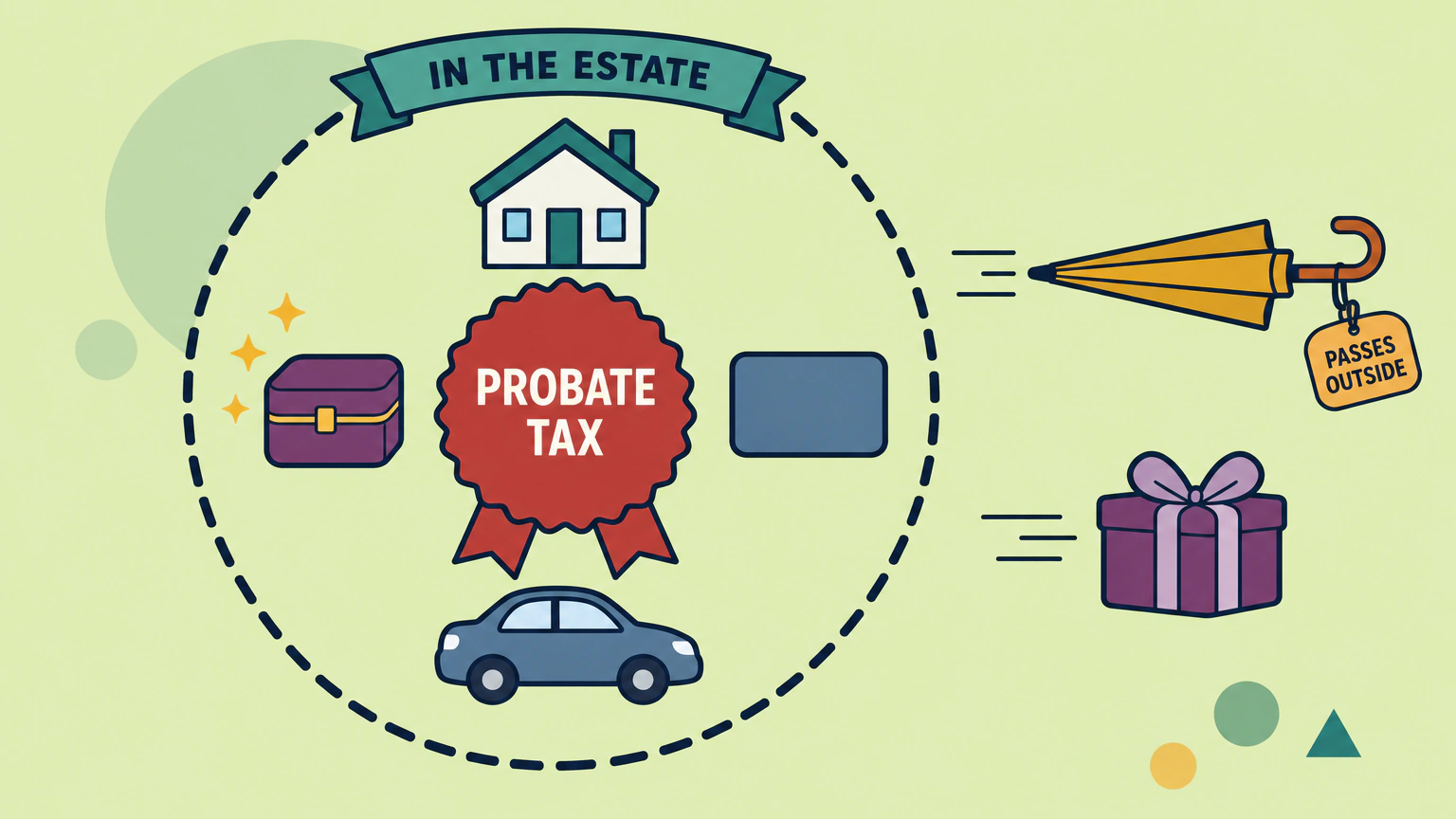
In Ontario, probate fees are the Estate Administration Tax: nothing on an estate worth $50,000 or less, and $15 for every $1,000, or part of $1,000, above that. It's charged on what the deceased owned at death, minus only mortgages and liens on Ontario real estate, and the estate pays it as a deposit when the executor applies to the court.
Three things follow. The tax is owed only if you apply for an estate certificate and the court issues one. In Ontario that's a Certificate of Appointment of Estate Trustee, "estate trustee" being the court's word for executor. A return to the Ministry of Finance is due within 180 days after it, even when no tax is owed. And the lawyer, a bond in some cases, appraisals and the executor's pay all sit on top without lowering the tax.
If your relative lived in another province, its rules apply there. Ontario probate tax can still apply to assets here.
On this page
- How much the tax comes to
- What the tax counts, and what it leaves out
- The family home, a joint account with your child, and the RRIF
- Who pays it, and how to pay before the accounts are unfrozen
- Do you need probate at all?
- After the certificate: the return due within 180 days
- What probate costs on top of the tax
- Lowering the tax, and what each shortcut can cost
- Frequently asked questions
How much the tax comes to
The Act's wording is short. For applications made on or after January 1, 2020, the tax is "$15 for each $1,000 or part thereof by which the value of the estate exceeds $50,000." An estate worth $50,000 or less pays nothing.
"Or part thereof" means the ministry rounds the value up to the next $1,000 first. Say the estate is worth $612,450. That rounds up to $613,000, and $563,000 is left after the first $50,000. The tax is 563 × $15 = $8,445, a little under 1.4% of the whole estate.
The rounding bites at the bottom too. An estate worth $50,400 pays $15, because the $400 over the line counts as a full $1,000. There's no ceiling at the top, however large the estate gets. And an estate under the line still owes the ministry its return once a certificate issues.
Older web pages print bigger totals because applications made before 2020 also paid $5 per $1,000 on the first $50,000. To check your own number, use the ministry's calculator on its Calculating the Estate Administration Tax page.
Why it's a tax and not a fee, and why that matters
Ontario used to call this money a probate fee and charge it under a court-fees regulation. Then an executor, Marie Sarah Eurig, pushed back. Her late husband's $414,000 estate owed $5,710 before she could get probate, and she took the bill to court.
In 1998 the Supreme Court of Canada held that the levy "is a tax, not a fee." The evidence showed no "correlation between the amount charged for grants of letters probate and the cost of providing that service." A tax has to come from the legislature, and this one hadn't.
The legislature passed the Estate Administration Tax Act, 1998 later that year, and it still exempts one estate by name: Donald Valentine Eurig's. At today's rate, that estate would owe $5,460.
You can still see that history in the rules. The tax follows the estate's value, not the court's work. It's payable only "upon the issuance of an estate certificate." And if no certificate issues, the deposit comes back. Income tax is a separate bill, covered in our guide to the income tax side of an estate.
What the tax counts, and what it leaves out
Start with a list of everything the deceased owned. The Act taxes "all the property that belonged to the deceased person at the time of his or her death," less charges registered on real estate.
Counted, per the ministry: real estate in Ontario, plus bank accounts and investments wherever they're held, foreign banks included. RRSPs, RRIFs and TFSAs count when no beneficiary is named. So do cars and boats, in Ontario or not, business interests, household goods, jewellery and life insurance paid to the estate. The ministry's guide adds one that catches families out: property the deceased truly owned "even if the deceased did not hold legal title."
Every value is the date-of-death value. "Use the appraised value at the date of death even if the property sells for less or more shortly after the death," the ministry says. The MPAC assessment, the value on the property tax bill, can help, but the guide warns it "may not represent the fair market value on the date of death."
Left out: assets that pass automatically to a surviving joint owner, plans and policies with a named beneficiary, real estate outside Ontario, and the CPP death benefit.
One exception matters to planners. If the deceased left two wills and the court issues a certificate limited to the assets in one of them, only those assets count.
The only debts that come off
The Act allows one deduction: "the actual value of any encumbrance on real property." In plain words, that's a mortgage, collateral mortgage or lien registered against Ontario real estate.
The ministry's guide gives two examples worth copying. A line of credit registered against the house, with a $200,000 limit and $15,000 owing at death, comes off as $15,000. And if the deceased owned half a property with a $50,000 mortgage on the whole thing, their share carries $25,000 of it.
Everything else stays in. Funeral costs, the lawyer's fee, personal loans, a car loan, credit cards, real estate commissions and a line of credit not registered against Ontario real estate don't reduce the value. Charges on property outside Ontario don't come off either, because that property isn't counted.
Here's how those rules land on one estate.
One estate, counted the way Ontario counts it
| Asset | Value on the date of death | Counted for the tax | Why |
|---|---|---|---|
| House in the deceased's name alone | $780,000 | $660,000 | The $120,000 mortgage registered on it comes off |
| Chequing and savings accounts | $38,500 | $38,500 | Bank accounts count wherever they're held |
| TFSA with no beneficiary named | $64,000 | $64,000 | With nobody named, it falls into the estate |
| Car | $14,000 | $14,000 | The $9,000 car loan doesn't come off |
| RRIF naming a son as beneficiary | $210,000 | $0 | It goes straight to him |
| Life insurance naming a daughter | $100,000 | $0 | It's paid to her, not to the estate |
| Cottage in Quebec | $240,000 | $0 | Real estate outside Ontario is left out |
| Credit card balance and funeral bill | $17,200 owed | Nothing comes off | Only charges registered on Ontario real estate reduce the value |
| Total counted | $776,500 | Rounds up to $777,000. Tax: 727 × $15 = $10,905 |
Example estate, valued the way Ontario's Ministry of Finance tells executors to value one. Without the mortgage coming off, the house would add $120,000 and the tax would be $12,705. Each figure is the asset's value on the date of death, even if it later sells for more or less.
The family home, a joint account with your child, and the RRIF
The house comes first. There's no principal residence exemption in this tax. A house in the deceased's name alone counts at its date-of-death value, less any registered mortgage or lien.
The exemption people have in mind belongs to income tax. The CRA puts it this way: "If the property was solely your principal residence for every year you owned it, you do not have to pay tax on the gain." It does nothing to the probate bill. A home held as joint tenants with a right of survivorship passes straight to the survivor and isn't counted. A share held as tenants in common counts at the deceased's percentage.
The joint account with an adult child is where good intentions go wrong. In Pecore v. Pecore, Paula Pecore's father was told by a financial advisor that joint ownership would avoid "the payment of probate fees and taxes." He put his accounts in joint names with her. In 2007 the Supreme Court used the case to set the rule. When a parent adds an adult child without payment, the law presumes "the adult child is holding the property in trust for the ageing parent." It's up to the child to prove a gift was meant.
In that family the evidence did show a gift, so Paula kept the accounts. When the evidence falls short, the account belongs to the estate, and the ministry counts it. What the parent meant at the time decides it.
Registered plans are simpler. A named beneficiary keeps a RRIF, RRSP or TFSA out. Name the estate, or nobody, and it's in.
Who pays it, and how to pay before the accounts are unfrozen
The estate pays. "The tax is paid by the estate, not by the estate representative," the ministry says, and the Act makes the executor liable "in his, her or its representative capacity only." The bill attaches to your role. Your own savings aren't on the hook.
This is the awkward part. The full amount goes in as a deposit when you file the application, before you have the certificate the banks need to release the accounts. You need the money before you can reach the money, so work out the number first.
Before you apply: six things to pin down
- List everything the deceased owned in their own name, with its value on the date of death.
- Set aside what passes straight to someone else: joint accounts and titles with a right of survivorship, and plans or policies with a named beneficiary.
- If an adult child was added to an account or a title, look for anything the deceased signed or wrote about why.
- Get a statement for each mortgage or secured line of credit on Ontario property, showing the balance on the date of death.
- Round the total up to the next $1,000, take off $50,000, and work out $15 for each $1,000 that's left.
- Ask the deceased's bank whether it will pay that amount from the account by bank draft to the Minister of Finance.
Three routes get families past that.
First, ask the deceased's bank to pay from the account. Advisor.ca's 2023 guide for executors reports that banks "generally will allow payments, such as probate or income tax, to government agencies." That's practice, not a rule, so no bank has to say yes.
Second, if you don't know the value yet, apply on an estimate. You pay on that figure and sign an undertaking, a formal promise to the court, to file the real value and pay any balance within six months.
Third, a judge can let the certificate issue before the deposit, which Ontario calls an order "to pay the tax later when you have access to the assets of the estate." The Act sets three conditions, and you need all of them: the certificate is urgently needed, waiting would cause financial hardship, and enough security for the tax is posted.
At the court office, the deposit goes in by debit (or cash, where available), certified cheque, bank draft or a lawyer's trust cheque, payable to the "Minister of Finance." If you cover it yourself, it's still the estate's bill, so keep the receipt.
Do you need probate at all?
No certificate, no tax. "If an estate certificate is not applied for or is not issued, no tax is owed," the ministry says, and probate "is not always required." It's normally needed when the deceased owned real estate or held assets at a financial institution. So ask each bank, insurer and plan holder what it will accept before you apply.
The house is the usual trigger. If it's being sold, the certificate should be in hand before anyone signs an Agreement of Purchase and Sale, so talk to a real estate lawyer before you list.
Since April 1, 2021, an estate worth $150,000 or less can use the simpler Small Estate Certificate. The court "will usually" process those within five business days, against about 15 for a regular certificate. The tax is the same either way. If the deceased left a handwritten will, either application needs its own affidavit confirming the handwriting and signature.
After the certificate: the return due within 180 days
The certificate isn't the end of the paperwork. The Estate Information Return must reach the Ministry of Finance "no later than 180 days after an estate certificate is issued," and that holds "even if the calculated value of the estate is $0." A deadline on a weekend or holiday moves to the next business day. The return lists the assets used to value the estate, and you can file it online with no login.
Mistakes run on 60-day clocks. Find wrong or missing asset information in the first four years and you have 60 days from discovering it to send a revised return. If you applied on an estimate, the amended return is due within 60 days of fulfilling your undertaking. If an asset turns up later, file a court statement within six months of finding it. The revised return is due within 60 days of that filing. Extra tax goes to the courthouse that issued the certificate, with an affidavit of the new value and the reason, or straight to the ministry.
Keep your records for four years. The ministry has four years from the day the tax became payable to reassess. That limit falls away if required information wasn't supplied on time or a misrepresentation came from carelessness or worse. Then there's no time limit. Failing to file, or making a false statement, can bring at least a $1,000 fine, up to two years in jail, or both. The Act caps the fine at twice the tax when that amount exceeds $1,000. Someone who couldn't have known a statement was false, even with reasonable care, has a defence.
Red flag: Three things you'll read about probate fees that aren't right
- "If the estate underpays, interest builds up." Ontario's Ministry of Finance says in its filing guide that no interest is charged on unpaid estate administration tax. The estate owes the difference. If extra tax is paid after the first return, an amended return is due within 60 days of payment.
- "The fee pays for the court's work." The Supreme Court of Canada found no link between what Ontario charged and what probate cost to provide, and called the charge a tax. That's why it follows the estate's value, not the effort involved.
- "Put your adult child on the account and it skips probate." The law presumes the child holds the money for the parent's estate unless there's evidence the parent meant it as a gift. When that presumption stands, the account is an estate asset and the tax reaches it.
What probate costs on top of the tax
The tax is part of the bill. None of the other costs lowers it, because only charges on Ontario real estate come off the value.
Our own planning fee for a probate lawyer to take a straightforward application with a will through to the certificate is $2,500 to $3,500 in legal fees, before tax, or $2,900 to $3,750 with no will. Court charges, the tax and any dispute are extra.
A bond is a guarantee that covers the estate if the person running it mishandles the money. A regular application usually needs a bond when there's no will, the applicant isn't the named executor, or they live outside Canada and the Commonwealth. Some surviving spouses are exempt, and a judge can waive the bond. It must be "double the amount of the value of the estate unless a judge orders otherwise," backed by a licensed insurer or one or two personal sureties. No will also changes who can apply and who inherits when there's no will.
The executor's own pay is a "fair and reasonable allowance" that a judge can set, unless the will fixes it.
What the estate pays on top of the tax
| Cost | When it comes up | Lowers the value the tax is charged on? |
|---|---|---|
| Lawyer's fees for probate work | Our planning fee for a straightforward application with a will is $2,500 to $3,500 in legal fees before tax ($2,900 to $3,750 with no will) | No |
| Estate administration bond | For regular applications, usually when there's no will, the applicant isn't the named executor, or they live outside Canada and the Commonwealth. Some surviving spouses are exempt, and a judge can waive it. | No |
| Appraisals | When a home, a business or valuables have no clear value on the date of death | No |
| Executor's compensation | When the executor claims it: a "fair and reasonable allowance" a judge can set, unless the will fixes it | No |
| Funeral | Paid from the estate | No |
The lawyer's-fee range is our own planning range for this category, drawn from published Canadian fees rather than a set provincial rate. The tax is worked out on the estate's value before any of these costs.
Lowering the tax, and what each shortcut can cost
If you're planning your own estate, this is where the savings live, and so do the traps. Steps to Justice, Ontario's plain-language legal help site, lists the usual moves: naming beneficiaries on registered plans and insurance, owning property jointly, and giving gifts while you're alive. It warns that with joint ownership or a trust "you may lose control over those assets," and that gifts "can create tax problems." Alter ego and joint partner trusts are another route, but "you usually need legal help to set them up."
Secondary wills are the quieter option. Ontario recognizes a certificate limited to the assets in one will, so anything no bank or registry will want a certificate for can sit in a second will that's never probated.
The Pecore presumption can pull a joint account back into the estate and undo the saving. If you add a child anyway, put your reasons in writing and tell the child. Adding an adult child to title can also raise capital gains questions. In Pecore, the father's accountant warned that transfers to his daughter "could trigger a capital gain." Run it past an accountant first.
The tax is $15 per $1,000, or 1.5%, of the value over $50,000. A shortcut that sparks a family fight or a surprise tax bill can cost more than that. Sometimes paying is the cheap option.
We're not your lawyer, and planning that moves a house or an account out of your estate should go past an estate planning lawyer before you sign anything.
Frequently asked questions
Who pays probate fees in Ontario?
The estate does. The executor, or whoever applies to run the estate, pays it on the estate's behalf, and the law makes them liable only in that role. If you put up your own money so the application can go in, it's still the estate's bill, so keep the receipt. Beneficiaries don't get a separate probate bill on what they inherit.
Do you have to pay probate fees up front?
Usually, yes. The tax goes in as a deposit with the court application and becomes the tax once the certificate is issued. If you can only estimate the estate's value, you pay on the estimate and promise to file the real figure within six months. If the certificate is urgent and paying first would cause hardship, a judge can let it issue first, as long as security is posted.
Is a principal residence exempt from probate fees in Ontario?
No. Ontario's list of what to leave out has no exception for the family home. A house in the deceased's name alone counts at its value on the date of death, minus any mortgage or lien registered on it. The principal residence exemption belongs to income tax on capital gains, a separate federal rule. A home owned jointly with a right of survivorship passes to the survivor and isn't counted.
Do RRSPs, RRIFs and TFSAs count toward probate fees?
Only when they fall into the estate. A plan with a named beneficiary goes straight to that person and stays out of the value. If the estate is named, or nobody is, the plan counts. Life insurance follows the same pattern. Paid to a named person, it's out. Paid to the estate, it's in.
Are probate fees tax deductible in Canada?
No. The Canada Revenue Agency lists probate fees with funeral expenses and estate administration fees as personal expenses you can't deduct on a deceased person's return. They don't lower the value Ontario taxes either. The only things that come off are mortgages, liens and other charges registered on Ontario real estate.
What happens if the estate underpaid or you find another asset later?
Pay the difference and tell the ministry. Extra tax goes to the courthouse that issued the certificate, with an affidavit giving the new value and the reason, or straight to the Ministry of Finance. An amended return is due within 60 days of spotting wrong asset information in the first four years. Paying extra tax starts another 60-day deadline. For a newly found asset, file a court statement within six months of discovery, then amend the return within 60 days of that filing. The ministry's guide says no interest is charged on unpaid tax.
Can you get probate fees refunded?
Yes, in two situations. If no certificate is issued, ask the court office where you applied, and the deposit comes back. If the estate overpaid, the Ministry of Finance refunds the extra, as long as the Estate Information Return went in within four years of the certificate. You also have to ask in writing within 12 years of the certificate, or within two years of a notice of assessment.
Start with the list. Write down every asset, then sort each one in or out the way the worked estate does. Get the mortgage statement, ask the bank about paying the deposit directly, and put the 180-day date in your calendar the day the certificate arrives.