

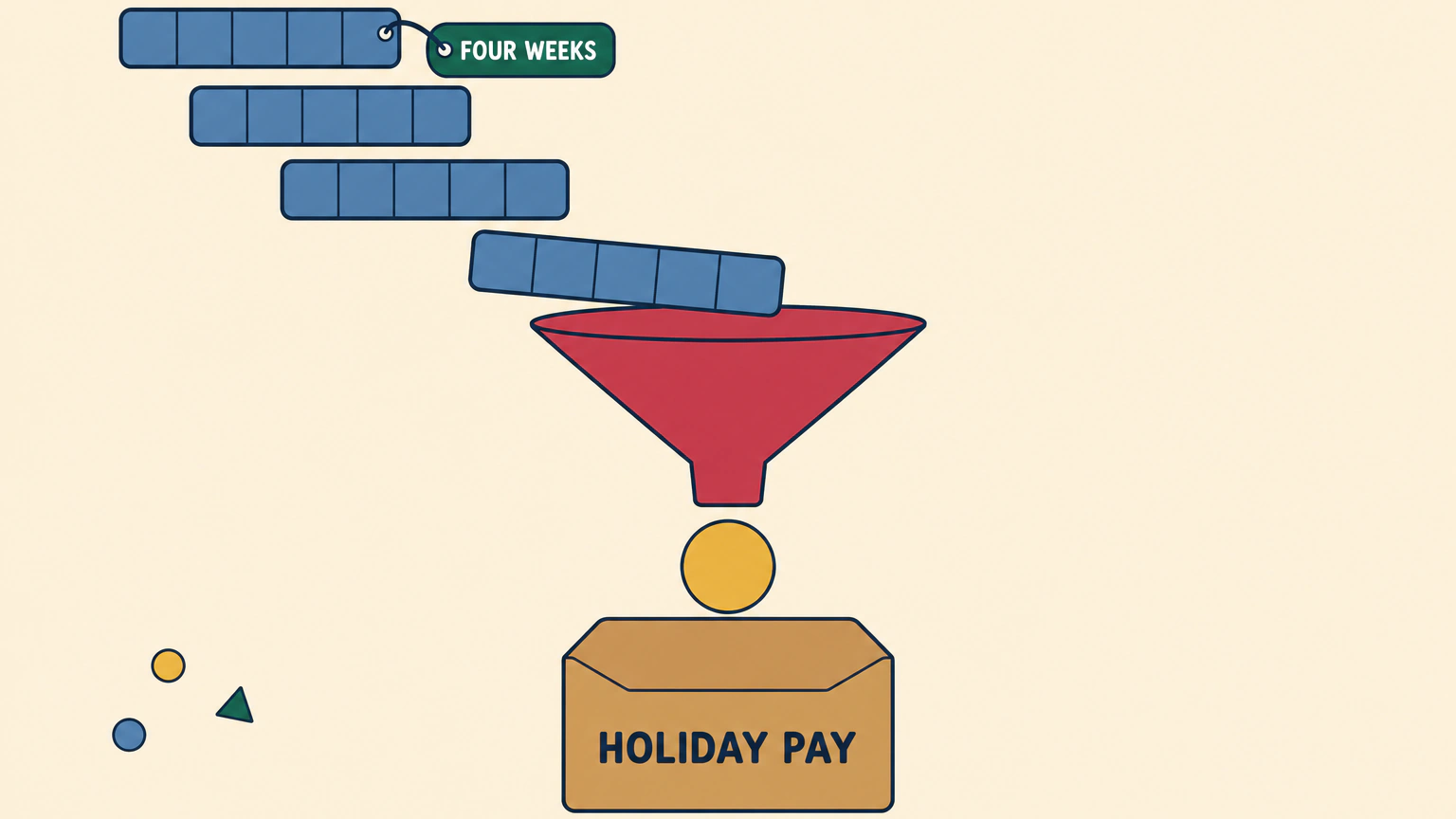
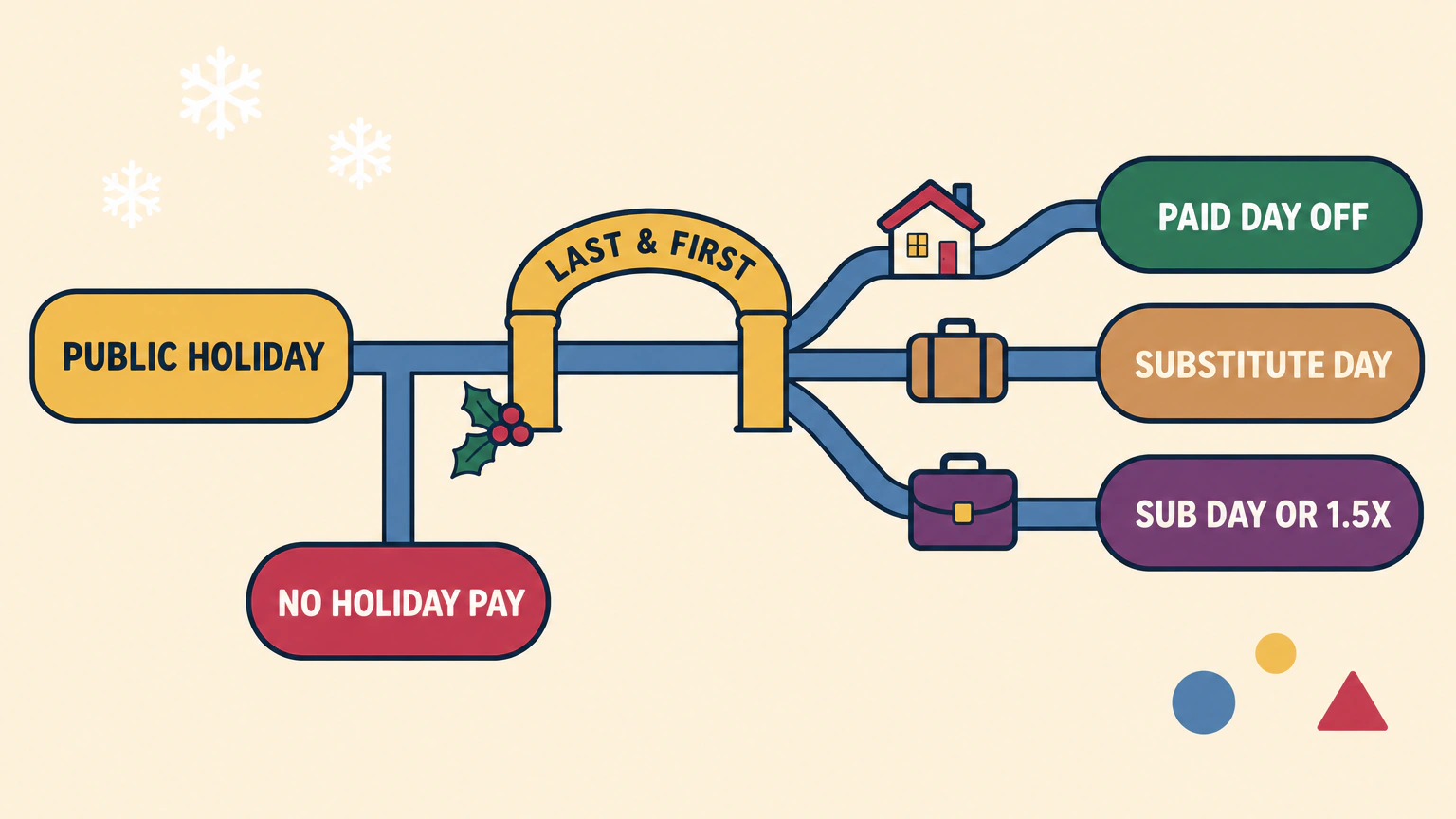
In Ontario, you qualify for stat holiday pay if you work your last scheduled shift before the holiday and your first one after it, or have a good reason for missing one. The pay is your regular wages plus vacation pay from the four work weeks before the holiday's week, divided by 20, which is why it can come in under a normal day's pay.
Three more things up front. Ontario has nine public holidays. If you work one, the default is your regular pay plus another paid day off, and holiday pay plus time and a half needs your written agreement. When a holiday lands on your day off, as Boxing Day (Saturday, Dec. 26) does for most Monday-to-Friday workers, you're owed a substitute day. The three-question tool further down shows which rule is yours.
On this page
- Ontario's nine public holidays, and the days that aren't on the list
- Who qualifies: the shifts before and after the holiday
- Find out what you're owed for your holiday
- How your holiday pay is calculated
- Why holiday pay can come in under a normal day's pay
- When the holiday lands on your day off or your vacation
- If you work on the holiday
- What to do if your holiday pay looks wrong
- Frequently asked questions
Ontario's nine public holidays, and the days that aren't on the list
The Employment Standards Act, 2000 names nine public holidays. They're New Year's Day, Family Day (the third Monday in February), Good Friday, Victoria Day, Canada Day, Labour Day, Thanksgiving Day, Christmas Day and Boxing Day, which the Act simply calls "December 26".
A few days people expect aren't there. Easter Sunday, Easter Monday, the August Civic Holiday and Remembrance Day are the Ministry of Labour's examples. Some employers give them, the Ministry says, but "the employer is not required to do so under the ESA." Nor does the Act list the National Day for Truth and Reconciliation on Sept. 30, Christmas Eve or New Year's Eve.
A contract or workplace policy can add days, because the Act is only the floor. Bank, airline and other federally regulated workers follow a federal list instead, covered near the end.
Who qualifies: the shifts before and after the holiday
There's no minimum service. Full-time or part-time, permanent or on contract, you're in, and the Ministry's guide adds that "it does not matter how recently they were hired."
The one condition is the last-and-first rule in section 26(2) of the Act. You have to work all of your last regularly scheduled day before the holiday and all of your first one after it. "Regularly scheduled" means your schedule, not the business's hours. A Monday-to-Friday worker at a seven-day store doesn't lose a Monday holiday for not working the Sunday, says the Ministry's Policy and Interpretation Manual.
If your employer agrees to swap a shift or let you leave early, the adjusted shift is the one that counts. That agreement doesn't need to be in writing. Days on vacation, on a leave arranged in advance, on layoff or on suspension aren't days you failed to work. Nothing in the Act makes you give notice that you're taking the holiday off. It's yours unless you've agreed in writing to work it, or your job is one that can require it.
Some jobs sit outside these rules entirely, under a regulation called O. Reg. 285/01. Lawyers, doctors, engineers, teachers, firefighters, taxi drivers, landscape gardeners and live-in building superintendents are among them. The Ministry's guide to special rules and exemptions has the full list.
What counts as a good reason for missing a shift
Missing a qualifying shift costs nothing if you had "reasonable cause", and the Manual puts the onus on you to show it. Being sick counts. So does a family member's illness or urgent matter, or a death in the family. The Ministry accepts those even if you've already used up your ESA leave days for the year.
Your employer can ask for evidence that's reasonable in the circumstances. For ESA sick leave, though, section 50(6.1) of the Act bars it from demanding a doctor's note.
The Manual also works through the grey areas. A late bus can count. A car breakdown usually doesn't, if other transport was available. "Slept in" generally won't do, unless a power failure killed your alarm. So keep whatever shows why you were away: a transit alert, or the text you sent your manager that morning.
Find out what you're owed for your holiday
Three things decide what you get: where the holiday lands in your own week, whether you work it, and whether you kept the shifts around it. Pick your answers and the tool shows the one card that fits. Each card names the section of the Act it rests on, so you can quote it back. Everything it shows is a minimum, and your contract can give you more.
What am I owed for this holiday?
Keep the shifts around the holiday, and then what you get depends on whether it's your workday, your day off, or a day you work.
- The shifts around it
- Miss your last scheduled shift before the holiday or your first one after it without a good reason, and there's no holiday pay or substitute day. Work the holiday anyway and you're still owed at least 1.5 times your regular rate for those hours.
- Your workday
- You get a paid day off, with public holiday pay for it.
- Your day off or vacation
- You get a substitute day off, paid as holiday pay. If you both agree in writing, you can take the holiday pay and skip the day off.
- A day you work
- You get your regular rate for the hours plus a substitute day off, or holiday pay plus at least 1.5 times your regular rate for every hour. The substitute day is the default, and the 1.5 times package needs a written agreement. If your employer is allowed to require you to work that day, it picks which.
Answer three questions and we'll show you what Ontario's law gives you.
A paid day off
You get the day off and public holiday pay for it. That's your regular wages plus any vacation pay from the four work weeks before the holiday's week, divided by 20.
Employment Standards Act, 2000, s. 26(1)
Holiday pay is your regular wages plus vacation pay from the four work weeks before the holiday's week, divided by 20. These are Ontario's minimums, and your contract can give you more. Banks, airlines and other federally regulated employers follow the Canada Labour Code instead.
How your holiday pay is calculated
Section 24(1) of the Act sets the formula in one sentence. Holiday pay is "the total amount of regular wages earned and vacation pay payable to the employee in the four work weeks before the work week in which the public holiday occurred, divided by 20".
Why 20? The Manual calls it a "pro-rating" formula "based on a five-day work week". Four weeks of five days is 20, which explains the divisor. The Ministry's guide runs the numbers with $120 a day, five days a week and no vacation in the window. That's $2,400 over the four weeks, and $2,400 divided by 20 is $120. Advice written for another province doesn't carry over, so make sure what you're reading is about Ontario.
Which four weeks count
A work week is the seven-day stretch your employer picked for scheduling. If it never picked one, the Act uses Sunday to Saturday. The holiday's own week is skipped, and the count runs back four full weeks from there. In the guide's example, the work week runs Thursday to Wednesday and Christmas falls on a Tuesday, so the four weeks run from Nov. 22 to Dec. 19. Pay periods don't always line up with work weeks. Check the dates on your stubs instead of grabbing the last two cheques.
What goes into the total, and what stays out
In goes your regular pay for those four weeks: hourly pay, salary and commission alike, because the Act treats all of it as wages. The worked examples follow the Ministry's method, which ties vacation pay to how you're paid it. Its manual notes a tribunal decision that counts earned vacation pay instead. The Ministry's rules are:
- On every cheque: it counts, at 4% or more of your wages for those weeks, or 6% after five years.
- Before your vacation, or with the pay for the period you're away: it counts only if you were on vacation in those four weeks.
- As a lump sum on set dates: it counts only if one of those dates falls in the window.
Out go overtime pay, earlier holiday pay, premium pay, termination and severance pay, and pay for a few kinds of paid leave, such as domestic or sexual violence leave. Tips aren't wages. Neither are discretionary bonuses unrelated to hours, production or efficiency.
The guide's part-time example puts it together. Tegan works three days a week at $120 a day, with 4% vacation pay on every cheque. Her four weeks hold $1,440 in wages and $57.60 in vacation pay. Divide the $1,497.60 by 20 and her holiday pay is $74.88.
Why holiday pay can come in under a normal day's pay
This is where a stub can stop making sense. The divisor stays at 20, even if you work fewer days. The Ministry works these cases itself:
| Situation | Four weeks of regular wages | Holiday pay (÷ 20) | Pay for a normal working day |
|---|---|---|---|
| Part-time, three days a week at $80 a day | $960 (12 days) | $48 | $80 |
| Compressed week, four 11-hour days at $220 a day | $3,520 (16 days) | $176 | $220 |
| New Year's Day after paid Christmas and Boxing Day, $200 a day | $3,600 (18 days) | $180 | $200 |
| Pregnancy leave began partway through the four weeks, $120 a day | $840 (7 days) | $42 | $120 |
These are worked examples from Ontario's Employment Standards Act Policy and Interpretation Manual and the Ministry's guide to the Act. The formula divides four weeks of regular wages and vacation pay by 20. Paid vacation goes into the total too.
Overtime pay is left out. Where overtime starts after 44 hours, a 50-hour week contributes 44 hours of regular wages. In the Manual's example, a worker on $20 an hour doing five 10-hour days gets $184.48, vacation pay included. Their average day's wages come to $212. Unpaid days add nothing either. If someone tells you a sick day can't lower your holiday pay, that's not Ontario's formula. The Manual's own example with two unpaid sick days pays $180 against a $200 day.
A holiday line below a normal day's pay can still be correct.
Red flag: two things you'll read online that aren't Ontario law.
- "Your boss picks time and a half or a day off." Outside hotels, motels, resorts, restaurants, taverns, hospitals and round-the-clock operations, holiday pay plus time and a half needs your written agreement. Without it, the default is your regular pay plus a substitute day.
- "Divide your four weeks by the days you worked." Ontario used an averaging formula based on the previous pay period from January to June 2018. Since July 2018, the divisor has been 20.
When the holiday lands on your day off or your vacation
If the holiday falls on a day you wouldn't normally work, or during your vacation, section 29 of the Act says your employer has to give you another day off instead. It must be a day that would ordinarily be a working day, paid as holiday pay. Before the holiday, your employer also owes you a written statement naming the holiday, the substitute date and the date of the statement.
The day must fall within three months, or within 12 if you both agree in writing, and the Manual says that agreement must be signed before the holiday. The Ministry also reads the rule as letting the day come first. Its Manual gives a Monday-to-Friday worker Friday, June 30 for a Saturday Canada Day. Your employer picks the date, and according to the Manual you don't have to agree to it.
You can instead agree in writing to take the holiday pay and skip the day off. Once you've earned a substitute day, you don't have to requalify by working the shifts around it. If your job ends first, the holiday pay comes with your final pay. If the holiday falls on your usual day off while you're on pregnancy or parental leave, or laid off, you get holiday pay without a substitute day.
The December holidays, worked through
A substitute day is paid "as if the substitute day were a public holiday", so it gets its own four weeks, counted back from its own week. Christmas Day's holiday pay isn't regular wages, so it drops out of the next window. That's the Manual's New Year's example, on this year's calendar.
| Holiday | Date | Four weeks counted | Holiday pay |
|---|---|---|---|
| Christmas Day | Friday, Dec. 25, 2026 | Nov. 22 to Dec. 19: 20 days worked, $4,000 | $200 |
| Boxing Day | Saturday, Dec. 26, 2026, with Monday, Dec. 28 as the substitute day | Nov. 29 to Dec. 26: 19 days worked, $3,800 | $190 |
| New Year's Day | Friday, Jan. 1, 2027 | Nov. 29 to Dec. 26: 19 days worked, $3,800 | $190 |
| Family Day | Monday, Feb. 15, 2027 | Jan. 17 to Feb. 13: 20 days worked, $4,000 | $200 |
Example: a Monday to Friday worker earning $200 a day, a Sunday to Saturday work week, vacation pay paid when vacation is taken, and no other days off. Christmas Day's holiday pay isn't regular wages, so the next two windows hold 19 paid working days. Had the employer made Thursday, Dec. 24 the substitute day instead, that day would pay $200 and New Year's Day $180. The total is $580 either way.
Look for the written statement naming your substitute day before Dec. 26. If it hasn't come, ask for it in writing.
If you work on the holiday
Working a holiday that falls on your normal working day takes your agreement, and in the Act "agree" means agree in writing. Electronic form counts. A verbal yes doesn't. The Manual says that if you work without a proper written agreement, you're still owed holiday pay on top of whatever you earned working.
Once you've agreed, the default package is your regular rate for the hours you work plus a substitute day paid as holiday pay. The same written statement and the same three-month or 12-month limit apply. Only "if the employee and the employer agree" do you get the other package. That's holiday pay for the day plus premium pay of at least one and a half times your regular rate for every hour, with no substitute day.
The Ministry's guide prices the difference. John-Duncan earns $20 an hour and works eight hours on the holiday, and his holiday pay is $160. The premium package pays him $160 plus $240 of premium pay, $400 for the day. The default pays $160 in wages now and a paid day off later.
Premium-paid hours don't count toward overtime. Skip the agreed shift without a good reason and you get nothing for the holiday. Leave partway through without one and you're owed premium pay for the hours you worked, nothing else. The same packages apply when you agree to work a holiday that falls on your day off.
Hotels, restaurants, hospitals and round-the-clock jobs
Section 28 is the exception. In a hospital, a continuous operation, or a hotel, motel, tourist resort, restaurant or tavern, your employer can require you to work a holiday. It has to fall on your normal working day, while you're not on vacation. The Ministry's guide counts nursing homes here too. A continuous operation is one that "normally continues 24 hours a day without cessation in each seven-day period", like an alarm-monitoring company. You then get one of the two packages, and the employer chooses which. Your contract still applies, and so does your right under Ontario's Human Rights Code to a day off for religious observance. If that's refused, a human rights lawyer can tell you where you stand.
Retail workers can say no
Most retail employees "may refuse to work on a public holiday", in the words of section 73(1). The Ministry's guide says that holds even if you don't qualify for holiday pay, and even at a 24-hour convenience store. Already agreed and changed your mind? You can back out with at least 48 hours' notice before the shift. The right doesn't reach businesses whose main trade is prepared meals, accommodation, or education, recreation or amusement, or the shops attached to them.
The 2026 change is about store hours, not your rights. Since April 24, 2026, Ontario no longer requires stores to close on Victoria Day. Municipal by-laws, Toronto's included, can no longer close them on Family Day or Victoria Day. Both are still public holidays under the Act, so your holiday pay and your right to refuse haven't moved. Boxing Day isn't on the store-closing list at all, and you can still refuse to work it. Your employer can't punish you for using any of these rights.
What to do if your holiday pay looks wrong
A short holiday line can be the formula doing its job. It can also be a payroll setting that's easy to fix, like the wrong work week or missing vacation pay. Run the numbers first to see which one you've got.
Check your holiday pay in six steps
- Ask which seven-day work week your employer uses. If it never picked one, the law uses Sunday to Saturday.
- Find the four full work weeks just before the week the holiday falls in, and pull the pay stubs that cover them.
- Add up your regular pay for those weeks, salary and commission included, but leave out overtime, earlier holiday pay, premium pay and tips.
- Add any vacation pay that came on those cheques, or that was paid for vacation you took in those weeks.
- Divide the total by 20 and compare it with the holiday line on your stub.
- If it comes up short, ask your employer in writing and keep a copy of your request and the reply.
If asking doesn't fix it, file a claim with the Ministry of Labour, Immigration, Training and Skills Development. You can do it online or with its PDF form, and an employment standards officer investigates. Don't sit on it. Under section 96(3), a complaint about something more than two years old "shall be deemed not to have been filed". Asking about your rights or filing is protected from reprisal.
One trap catches people. Once you file for unpaid wages, you can't sue in Small Claims Court for the same wages. The exception is withdrawing the claim within two weeks of filing it. If a collective agreement covers the claim, employees represented by the union use the grievance process instead. They can't file a Ministry claim for it.
We're not your lawyer. If the money is tied to a firing or a bigger dispute, talk to an employment lawyer before you file, because filing closes the door on suing for the same wages. For a holiday line a few dollars short, the Ministry is the better fit. Our own planning fee for an employment lawyer's ongoing advice or dispute work runs $250 to $625 an hour.
Frequently asked questions
If Boxing Day falls on a Saturday, is the Monday a holiday?
Not automatically. If you don't normally work Saturdays, your employer has to give you another working day off with holiday pay and tell you the date in writing before the holiday. It can be Monday, Dec. 28, Thursday, Dec. 24 or another working day within three months. If you both agree in writing, you can take the holiday pay and skip the day off. Federally regulated jobs follow a different rule: the working day just before or just after.
Is Remembrance Day a stat holiday in Ontario?
Not under Ontario's Employment Standards Act. It isn't one of the nine public holidays, and the Ministry says employers aren't required to give it, though some do by contract or policy. At a federally regulated employer, such as a bank, an airline or a telecom company, it's different. Remembrance Day is one of your ten general holidays under the Canada Labour Code, with holiday pay.
Do salaried employees get stat holiday pay in Ontario?
Yes, though usually not as an extra line. Unless your contract promises holiday pay on top of salary, the Ministry treats your salary as including it when you get the day off. Your employer still has to check that the salary for that day isn't less than the four-week formula. That check still applies if you work five equal days a week.
Do you get stat holiday pay on maternity or parental leave?
You're entitled to it, as long as you worked your last scheduled day before the leave and your first one after it, or had a good reason not to. The catch is the amount. Employment Insurance benefits aren't wages, so a holiday that falls deep in your leave usually pays nothing. A holiday that lands on a weekend during the leave brings holiday pay but no substitute day.
Do new and part-time employees get stat holiday pay?
Yes. Ontario sets no minimum length of service, and part-time, term and full-time employees all qualify under the same rule. The amount follows your hours. With no vacation pay payable, three $80 days a week gives $48, because the formula divides four weeks of pay by 20. A new hire's total holds only the weeks worked, so the first holiday can pay very little.
Do Ontario's holiday rules apply if you work for a bank or an airline?
No. Banks, airlines, telecoms, broadcasters, railways and trucking firms that cross provincial borders, and most federal Crown corporations follow the Canada Labour Code. It has ten general holidays, including Remembrance Day and Sept. 30, but not Family Day. Holiday pay is usually at least a twentieth of the prior four weeks' wages, excluding overtime. Commission workers with at least 12 weeks' service use at least a sixtieth of the prior 12 weeks' wages instead. Holiday work usually adds time and a half, but continuous operations and managers have different rules.
Do you still get holiday pay you've earned if you quit or get fired?
Yes. If your job ends before a substitute day you've earned, that holiday pay comes with your final wages. It's due by the later of seven days after you leave or your next regular pay day. Quit or get let go right after a holiday and you keep its pay, as long as you were still employed on the holiday itself. Severance is a separate question: here's what you're owed when a job ends.
Before your next holiday, pull the stubs for the four work weeks ahead of its week and run the six steps. If the holiday lands on your day off, look for the written statement before the day comes. Running payroll yourself? The same steps check your numbers, or a payroll service can build the formula in once.